The International Book Fair in Abu Dhabi features unusual historical treasures available for sale. Among them are fragments of Homer's 'Iliad,' written nearly 1800 years ago, as well as a 17th-century Bible gifted as a wedding present.
The centerpiece of the exhibition is a fragment of Homer's 'Iliad' manuscript, dated to the 2nd century, making it approximately 1800 years old. This fragment is executed on papyrus—an ancient material widely used in the ancient world for writing. Yasser Raad, director of the rare books and manuscripts auction house Inlibris, noted that this fragment is part of a preserved tradition of manuscripts of works attributed to the ancient Greek poet Homer, whose 'Iliad' and 'Odyssey' became foundational works of Western literature.
Another ancient Homer manuscript is also displayed at the stand, offered for sale to collectors for hundreds of thousands of euros. According to Raad, such fragments are sought after not only by traditional book collectors but also by museums, libraries, institutions, and private collectors interested in preserving historically significant artifacts.
Nearby is a completely different type of value—a 17th-century Bible adorned with gold and precious stones. This book, valued at 65,000 euros, was given as a wedding gift and later ended up in the library of a German princess, Raad reported. The book cover is covered in gold and inlaid with stones, and the edges of the pages are gilded. The design, depicting two joined hands, symbolizes marriage, and a cross is located in the center. Raad added that the stones served to protect the Bible.
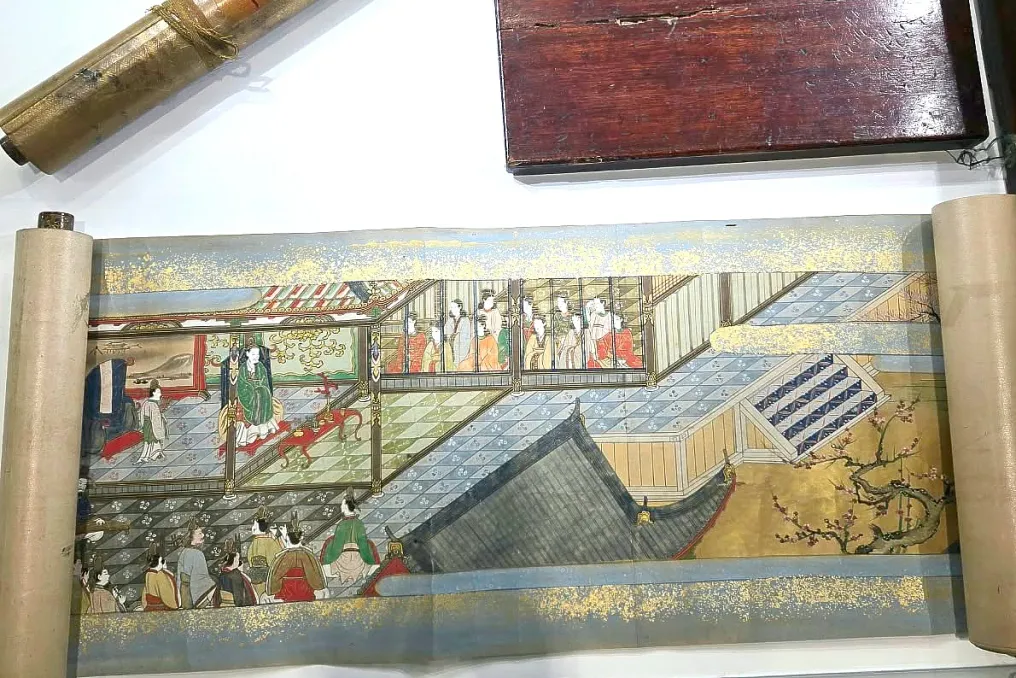
Another outstanding exhibit is a set of five Japanese painted scrolls, dated 1658. When fully unrolled, the scrolls reach a length of about nine meters and contain 26 illustrations narrating a story of romance, revenge, and war. Raad compared viewing these scrolls to a form of entertainment narrative that existed before the advent of modern cinema. The original box in which the scrolls were kept is also included in the collection along with the scrolls themselves, which are decorated with leather and gold, and this set is valued at 450,000 euros.
The collection also includes an early photograph related to the Persian Gulf, taken during the travels of a British naval officer. Raad explained that Charles Courtenay Bell captured this scene during his trip and subsequently compiled his photographs into a personal album, following the practice of naval officers of that era documenting their journeys. One of the photographs bears the inscription 'Sheikh Shahra,' and the picture provides a rare glimpse into the region in the early 20th century; another photo from the same event is held at the British Library and shows the objects from a different angle.
The stand also presents a more personal connection to the UAE: a sculpture of Sheikh Zayed's beloved falcon titled 'No. 1,' created by British wildlife artist and sculptor David Kemmick. Sheikh Zayed invited Kemmick to Abu Dhabi in 2000 and granted him access to the falconry training ground in Suwaiqhan and the wildlife collection on Sir Bani Yas Island, where he studied and drew the ruler's falcons. The resulting full-size bronze sculpture was later cast and hand-painted by Kemmick himself. According to the INLIBRIS list, this is a unique cast piece by the artist. Raad mentioned that there is another sculpture, presumably made for Sheikh Zayed, but its current location is unknown.