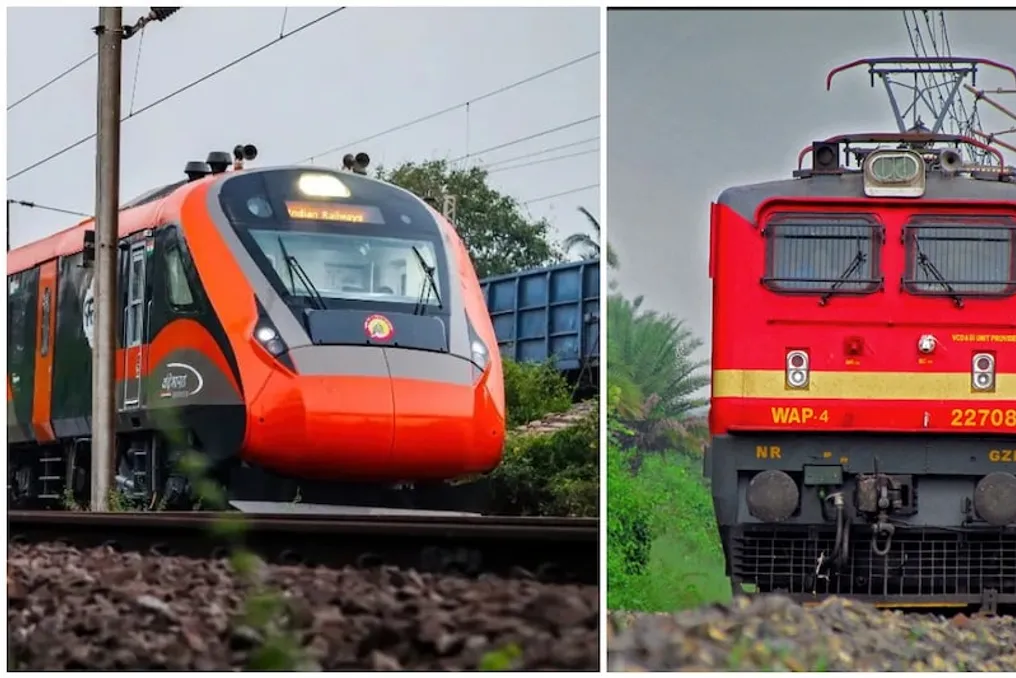
Traveling on the Rajdhani Express was once considered one of the most premium experiences on Indian Railways. Thanks to high speed, air-conditioned coaches, long routes, and onboard amenities, Rajdhani held a special place for a long time. Then came Vande Bharat, which began to change perceptions of comfort and services in trains with its fast intercity runs. Vande Bharat is now also available in sleeper coaches. This article examines the specific differences between Rajdhani and Vande Bharat, and which train is better suited for a particular type of journey.
The Beginning of Premium Rail Travel with Rajdhani
The Rajdhani Express was launched in 1969 between New Delhi and Howrah. This train covered a distance of about 1450 kilometers in approximately 17 hours and 20 minutes. These trains connect the country's capital, New Delhi, with the capitals or major cities of various states, which is why the word 'Rajdhani' is in their name. Due to its high speed and long-distance travel in air-conditioned coaches, Rajdhani quickly became one of the most iconic trains of Indian Railways.
In contrast, travel on Vande Bharat is much newer. Its first commercial service began in February 2019 on the New Delhi-Varanasi route. This train covered a distance of about 759 kilometers in approximately 8 hours. It was initially named 'Train 18', but this name seemed foreign rather than Indian. This is why modern Indian trains were given the name 'Vande Bharat', which reflects both 'Self-Reliant India' and the talent of Indian engineers.
Who is Faster: Rajdhani or Vande Bharat?
When it comes to speed, Vande Bharat surpasses Rajdhani. Vande Bharat trains are designed to run at speeds up to 160 kilometers per hour, and during trials, they reached speeds of up to 183 kilometers per hour. However, the efficiency of any train is not determined solely by its maximum speed. The total travel time can vary due to the route, track conditions, speed restrictions, traffic, stations, and stops. The maximum operational speed of the Rajdhani Express is usually around 130 kilometers per hour.
Which Train to Choose for Which Type of Journey?
There are no set distance limits for either train, but their usage models differ. Vande Bharat is primarily designed for fast intercity travel, connecting one city to another. There are many Vande Bharat routes where passengers can depart in the morning and arrive at their destination the same day. Rajdhani is known for its long-distance journeys. It is more often used for overnight travel because it provides sleeping accommodations for passengers. This makes the choice between them simpler depending on the distance and duration of the trip.
Standard Vande Bharat coaches feature 'Chair Car' and 'Executive Chair Car' seats, providing comfortable reclining seating. In the Executive Chair Car, passengers have more space, and in some rakes, the seats can rotate by 180 and 360 degrees. However, standard Vande Bharat coaches do not have traditional sleeping berths. Rajdhani Express offers First AC, Second AC, and Third AC classes. First AC provides greater privacy, similar to a cabin or compartment. Second AC has two-tier berths, and Third AC has three-tier berths.
The situation is beginning to change with the introduction of Vande Bharat Sleeper. The Vande Bharat Sleeper rake includes 16 air-conditioned sleeper coaches. This means passengers can now travel overnight using the new technology and amenities of Vande Bharat. Although there are still few Vande Bharat Sleeper trains, we expect to see more in the coming years. It is anticipated that Vande Bharat Sleeper trains may eventually replace Rajdhani trains. Nevertheless, the railway has not made any official statements on this matter.
What is the Difference in Catering Between the Two Trains?
Both trains provide meal services during long journeys, although the menu and service may differ depending on the train's route. On Vande Bharat, meals such as tea, breakfast, lunch, evening snacks, and dinner are offered via IRCTC according to the travel time. The menu includes items like poha, upma, paratha, sandwiches, cutlets, dal, vegetables, paneer, chicken, roti, rice, sweets, and beverages. In some Vande Bharat trains, food selection is optional. That is, if a passenger requires breakfast, lunch, or snacks on the train, they must select it when booking the ticket. If not, they do not select the meal option. Consequently, the ticket price is also determined by this choice. Since the Rajdhani journey is long, the meal schedule there is usually more extensive, including morning tea, breakfast, lunch, evening snacks, and dinner. Additional items may be available in First AC.
Technological Superiority of Vande Bharat over Rajdhani
If considering only acceleration capability, Vande Bharat trains clearly outperform the Rajdhani Express. The reason lies in the fundamental design of both trains. Vande Bharat is a self-propelled unit. This means that an additional locomotive is not required to pull the entire rake; the motors are installed directly in the coaches that drive the train.