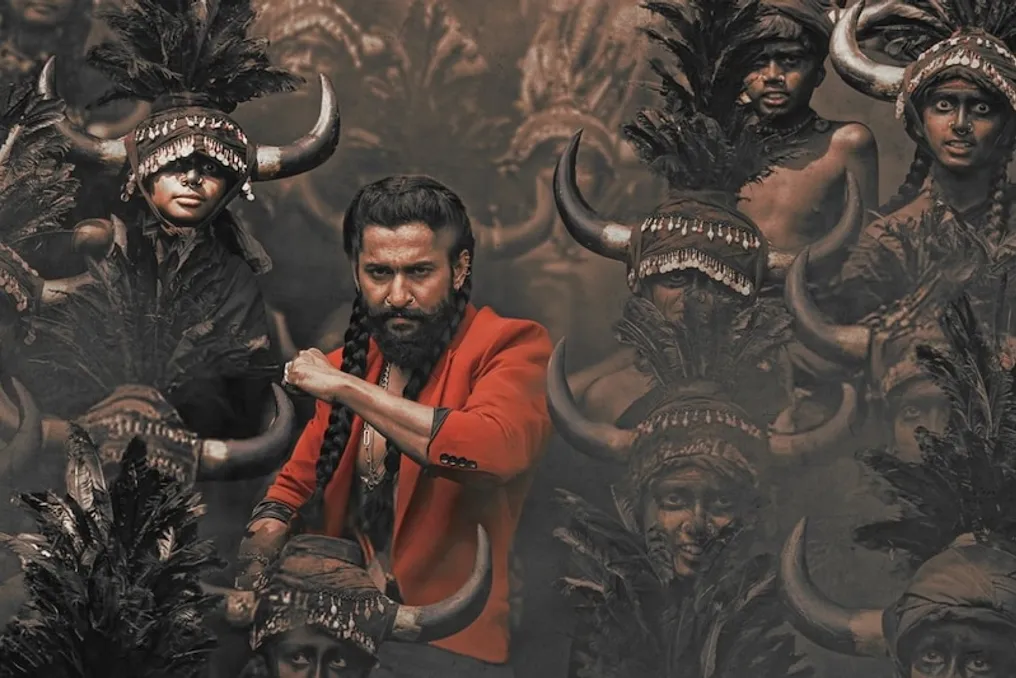
Actor Nani expresses dissatisfaction with the use of the 'Pan-India' label for South Indian films
Read more
Aaj Tak
www.aajtak.in

Actor Nani expresses dissatisfaction with the use of the 'Pan-India' label for South Indian films

The renowned South Indian actor Nani is preparing to release his highly anticipated action-thriller film, 'The Paradise,' which is scheduled to hit theaters on September 24. During a press event promoting the movie, the actor openly commented on the concept of 'pan-Indian' status within the film industry.

Nani stated that he does not wish to see such labeling applied to his films. He believes that when any Indian film made in Hindi achieves success across the country, it is simply called a 'Hindi film.' However, as soon as a similar success is demonstrated by a South Indian film, it is labeled 'pan-Indian.'

During a press conference, when a journalist asked about the necessity of abandoning this label and releasing the film in Tamil and other languages alongside Telugu, Nani clearly stated his position.

He emphasized: 'When a Hindi film performs well, we call it a Hindi film. But when a South Indian film succeeds, we start calling it a pan-Indian film. Therefore, I do not want my films to be called pan-Indian.'

Discussing the double standard regarding this label, Nani raised a point, noting: 'Even if Hindi films like 'Jawan' or 'Pathaan' perform very successfully in Tamil, Telugu, or other language versions, no one calls them pan-Indian; they remain Hindi films. Why is this rule not applied to South Indian films? I do not understand why the word 'pan-India' was created specifically for South Indian films.'

Nani added that although he cannot force anyone to use this term, as an artist, he can only request that his films avoid this designation. He noted: 'My goal will always be for my films to reach audiences in all languages—Tamil, Hindi, Malayalam, and Kannada. This is a normal process, but I do not want this label on my films. People will still say it; there is little I can do about it, but I can only express my opinion and ask.'

Similar stories

Film Hanuman Ansh Surpassed Box Office Collections of Major Blockbusters Thanks to Low Budget
Read more
www.aajtak.in

Film Hanuman Ansh Surpassed Box Office Collections of Major Blockbusters Thanks to Low Budget

The cinematic industry is always an exciting game of box office collections, which allows one to assess a film's success. A film is considered a failure if it earns less than its budget; average if it meets the budget; and if it significantly exceeds it, it is labeled as a hit, superhit, or blockbuster. Regardless of the plot quality, box office receipts remain the most important indicator.

Over the last ten years, many films have been presented in the Indian film industry that set significant records. Speaking of the beginning, the film 'Dangal' with Aamir Khan was the first picture in the history of Indian cinema to collect over 2000 crore rupees worldwide, becoming the first film to reach such a sum.

After this, Indian cinema took a pause. Then, in 2023, the film 'Pathaan' with Shah Rukh Khan was released, collecting 1000 crore rupees worldwide. Shortly after, the film 'Jaan' also earned 1000 crore rupees. The film 'Animal' with Ranbir Kapoor brought in over 900 crore rupees. The year 2025 proved even more significant for Indian cinema: Mohit Suri's romantic film 'Sairat' earned up to 500 crore rupees, while Vicky Kaushal's film 'Chhawa' brought in over 700 crore rupees.

However, at the end of the year, the film 'Dhurandar' stole all the attention, collecting over 1300 crore rupees. Its sequel, 'Dhurandar: Revenge', achieved even greater success, earning 1800 crore rupees and setting a record as the second highest-grossing film in Bollywood.

Despite all these listed films bringing in large sums of money and receiving public recognition, the recently released film 'Hanuman Ansh' easily surpassed them all. Even if the box office collection of this film did not reach 400-500 or 1000-2000 crore, it is considered the most successful film in Bollywood based on the life of Neem Karoli Baba. The main reason for its success is its small budget, which made it the most profitable picture in Indian cinema.

The budget for the film 'Hanuman Ansh' was only 2 crore rupees. Usually, this amount is spent in Bollywood on marketing or actors. The previously mentioned films—'Dhurandar', 'Animal', 'Pathaan', 'Chhawa', 'Dangal', 'Sairat'—have budgets ranging from 50 to 250 crore rupees.

Considering 'Dhurandar', if its budget was 250 crore, it generated a total revenue of 3000 crore rupees, meaning it collected 12 times more than its budget. 'Dangal', being the highest-grossing film, if its budget was 80-90 crore, earned 2000 crore rupees, meaning it brought in more than 25 times the amount. However, the film 'Hanuman Ansh' brought in 280 crore rupees worldwide on a budget of only 2 crore rupees, which is 140 times more than its expenditure. Thus, the film 'Hanuman Ansh' proved that with the right story, sincere faith, and feeling, even a small film can surpass the giants of the industry.

Telugu Star Naani Announces Plans for Film 'The Paradise': No Trailer and Focus on Domestic Market
Read more
www.aajtak.in

Telugu Star Naani Announces Plans for Film 'The Paradise': No Trailer and Focus on Domestic Market

The film 'The Paradise' by Telugu superstar Naani is generating significant interest in the South Indian cinema industry. Although the project features numerous stars from various regions of India, Naani himself does not intend to promote it as a pan-Indian film. Recently, at a press event, the superstar made several important statements regarding 'The Paradise.'

Regarding a trailer, it was announced that one will not be released. There are only two weeks left until the film's premiere. Typically, a trailer is released before a movie comes out, but in this case, the creators have decided to release the film directly in theaters. The reason for this is that filming has not yet been completed, a decision Naani personally confirmed.

Naani explained that the team is focused on refining the final result of the film because some scenes still need to be shot. He noted that releasing a trailer under the current circumstances would force the director, composer, and other key team members to divert attention from the remaining work. If asked what is more important—the trailer or the film itself—he would choose the film. Although he personally would like to create and release a magnificent trailer, the entire team has decided against its release given the current situation.

The Telugu superstar also emphasized that the decision to forgo a trailer was not made due to high anticipation surrounding the film. Naani stated that this decision is not based on preliminary audience enthusiasm. While there is high interest in the picture among the audience, the creators do not feel the film requires a trailer. They do not want to underestimate the viewers and do not rely on the film itself to attract attention without promotional materials.

The creators of 'The Paradise' are also aiming to move away from the concept of a pan-Indian project and focus on their domestic market, specifically the Telugu audience. Discussing the large-scale release and reach of the film, Naani shared the team's views on the multilingual distribution of the project. He clarified that they do not want to label it a pan-Indian film. The film will be released not only in Telugu but also in several other languages. Naani considers Telugu his main priority, and he hopes that viewers of other languages will also see and enjoy 'The Paradise' to its fullest.

The film 'The Paradise', produced by SLV Cinemas, is scheduled for a major theatrical release on September 24, 2026. It will be released in eight languages: Hindi, Telugu, Tamil, English, Spanish, Bengali, Kannada, and Malayalam. Renowned actors such as Raghav Jual and Sonali Kulkarni will also star in the film.

Film 'Bedari' banned in Pakistan due to similarity with Indian film 'Jagriti'
Read more
www.aajtak.in

Film 'Bedari' banned in Pakistan due to similarity with Indian film 'Jagriti'

In 1956, the film 'Bedari' was screened in Pakistani cinemas. It achieved enormous success, filling all halls. This film, directed by Rafiq Rizvi and starring Ragini and Santosh Kumar, became a blockbuster thanks to its songs, especially the song 'Ao Bachcho Seir Karen Tumko' performed by Salim Razi. The song became extremely popular among children across Pakistan.

However, the film was soon banned. Some viewers felt a strange sensation, as if they had seen this film before, and discovered that not only the plot but also the melodies of the songs were familiar to them. It soon turned out that 'Bedari' was an exact copy of the Indian film 'Jagriti', released in 1954, and 'Jagriti' itself was a remake of the Bengali film 'Parivartan'.

The most interesting connection in this story relates to Ratan Kumar. His real name was Syed Nazir Ali Rizvi, and he was considered a popular child actor in the Bombay film industry. Born in 1941, he began performing at the age of just five. Family friends and writer Krishna Chander gave him the role of a child actor in the film 'Rakh'. After this, Ratan Kumar worked in several famous films, such as 'Boot Polish' and 'Baiju Bawra', before getting the role of Shakti in Satyen Bose's film 'Jagriti'.

When 'Jagriti' was released in 1954, Ratan Kumar was about 13 years old. Two years later, in 1956, he moved to Pakistan with his family. Many relatives of his family had already settled in Pakistan after the partition. Limited job opportunities in India also contributed to the family's decision to move to Pakistan.

After arriving in Pakistan, Ratan Kumar's elder brother, Wazir Ali Rizvi, founded a production company called 'Hayat'. The first film of this company was 'Bedari', and it was here that the story took an unexpected turn. The film 'Jagriti', in which Ratan Kumar himself acted, was recreated in Pakistan under a new title and in a new context.

'Bedari' featured Ratan Kumar in two roles. He played Ajay, whose name was changed to Jaffar in the Pakistani film. Furthermore, the character Shakti from 'Jagriti' was renamed Sabar Ali. Notably, despite the change in names, the essence of the characters was preserved: both Ajay and Jaffar mean 'victory' in Hindi and Urdu, respectively.

However, the similarity between the two films was not limited to the plot and characters. The most striking similarity was in the songs. In 'Bedari', the original melodies and harmonies were largely retained, but the lyrics were altered. Instead of Indian nationalist references, Pakistani nationalist motifs were added.

For instance, the famous song from 'Jagriti' sounded like: 'Ao Bachcho Tumhen Dikhaen Janki Hindustan Ki'. In 'Bedari', this song was changed to 'Ao Bachcho Seir Karen Tumko Pakistan Ki'. Similarly, where the original featured 'Vande Mataram', 'Bedari' used 'Pakistan Zindabad'.

Another song from 'Jagriti' contained the lines: 'De Di Hme Azadi Bina Kadg Bina Dhaal, Sabarmati Ke Sant Tune Kar Diya Kamal'. In 'Bedari', these lines were replaced with 'De Di Hme Azadi Ki Duniya Hui Haran, Ai Kaide-Azm Tera Ehsan Ha Ehsan'. Thus, instead of Mahatma Gandhi, Muhammad Ali Jinnah appeared.

This process was not limited to a couple of songs; in many songs of the film, the original melodies were preserved while the lyrics were changed, replacing the Indian context with a Pakistani one. How was the truth about 'Bedari' revealed?

Initially, the similarity between the two films might have gone unnoticed because there was a ban on the public screening of Indian films in Pakistan at the time. Consequently, most of the Pakistani audience could not see 'Jagriti'. Later, a member of the Pakistani censorship board informed Donna about this situation, noting that Lahore filmmakers created 'Bedari' in 1956, which was a carbon copy of 'Jagriti' in terms of plot and songs, utilizing the ban on the import and public screening of Indian films.

Initially, 'Bedari' enjoyed great commercial success in cinemas. However, after some time, viewers began to realize its true nature, understanding that the film they were watching bore a resemblance to a previously existing Indian film in terms of plot and melodies. Following this, protests against its public screening began, and the situation escalated to the point where the Pakistani censorship board immediately banned 'Bedari' and restricted the screening of its songs.

Did this affect Ratan Kumar's career? For a long time, there have been speculations that after moving to Pakistan, Ratan Kumar sought to establish himself in the local film industry, and perhaps that is why he participated in creating a film similar to 'Jagriti' in a new form. Nevertheless, Ratan Kumar, being a very popular child actor, could not achieve the same level of success as a leading adult actor.
Popular