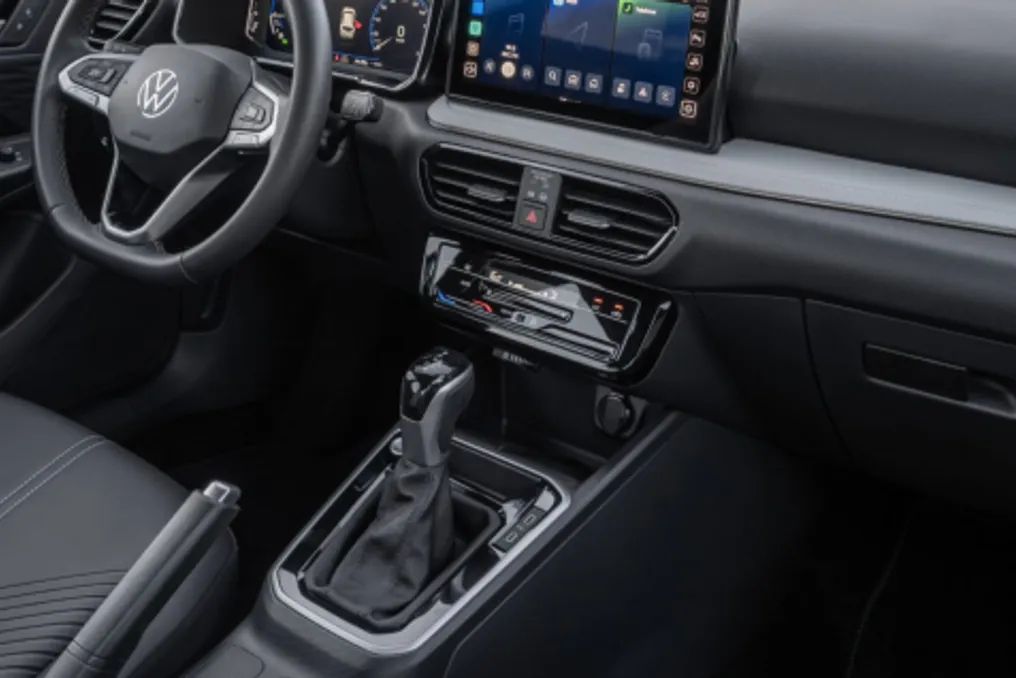
The 2027 VW Tera model was presented during the Rock in Rio event with a significant update, surpassing even the inclusion of the 200 TSI engine in the top-of-the-line versions: the addition of an eight-speed automatic transmission as its pairing.
This new feature, whose prices have not yet been disclosed, promises to bring several advantages to the driving experience, as this additional gear should alter the SUV's behavior in daily use.
Details of the New Setup
The new transmission system is available in the Comfort and High versions. It uses the same three-cylinder 1.0 turbo engine from the EA211 family, manufactured in São Carlos (SP), but in the 200 TSI calibration, which generates 128 hp and 20.4 kgf.m. In comparison, the 170 TSI engine, which remains exclusive to the Tera TSI with a manual gearbox, produces 116 hp and 16.8 kgf.m. Meanwhile, the Tera MPI retains the 84 hp naturally aspirated 1.0 engine.
The gearbox in question is the Aisin AQ300, the same one used by Volkswagen in the Taos and which was introduced in the 2027 T-Cross.
Advantages of Eight Gears
Each gear represents a ratio of gears that multiplies the engine's torque before it reaches the wheels. Short gears provide more power but result in higher fuel consumption, while long gears operate in the opposite manner. The engineers' challenge is to reconcile these two demands: allowing good take-off with a loaded vehicle and maintaining a cruising speed of 110 km/h with the minimum possible RPM, all within the available number of gears.
With only six ratios, this balance becomes difficult. Either the gearbox has large jumps between gears, causing the engine to drop drastically in RPM with each shift, or the interval between the first and last gear is too restricted, which harms both acceleration and highway consumption.
By having eight ratios, it is possible to achieve both goals: a shorter first gear to facilitate starting at traffic lights, a longer eighth gear for cruising, and smaller intervals between the others. In practice, this means the engine spends more time close to the RPM range where its performance is optimized and consumption is lower, in addition to providing less noticeable shifts and less noise at constant speed.
This benefit is even more pronounced in engines like the three-cylinder 1.0 turbo, as they concentrate their torque in a relatively narrow RPM range. A more precise gear selection ensures that the engine stays within this ideal window for longer.
Comparison with Other Models
Volkswagen has not yet released specific data on consumption or performance for the Tera equipped with the new gearbox. The concrete data available refers to the 2027 T-Cross, which shares the same engine and transmission combination.
Considering the Sense version as a benchmark, the manufacturer reported a decrease in urban fuel consumption of up to 7% when using gasoline and 5% when using ethanol, in addition to a reduction in the energy efficiency index, dropping from 1.64 MJ/km to 1.56 MJ/km. There was also an improvement in the 0 to 100 km/h acceleration time, reaching 10 seconds with ethanol and 10.4 seconds with gasoline, compared to 10.4 and 10.9 seconds with the six-gear setup.
However, this data belongs to a different vehicle, possessing its own characteristics regarding weight, aerodynamics, and final drive ratio, serving only as an estimate of what the gearbox can deliver, and not as a guarantee for the Tera.
Technical and Market Limitations
There is a physical limit to this evolution: each additional ratio requires more gears, clutches, and hydraulic systems, which implies increased weight, complexity, and cost. After a certain point, the efficiency gain provided by an extra gear becomes insignificant compared to internal friction and the components needed for its maintenance.
A multi-ratio gearbox requires an extremely well-defined shifting logic; otherwise, it may operate hesitantly on inclines or in traffic, constantly alternating between upshifting and downshifting. For this reason, manufacturers focused on urban consumption tend to invest in CVTs, which eliminate steps and keep the engine at the ideal RPM, although this may displease some consumers in terms of driving feel.
Additionally, there is an indication that Volkswagen itself does not consider the gearbox a universal solution: the Nivus, which uses the same 200 TSI engine, continues to use the six-speed transmission.
The 2027 line will be launched in dealerships in October, but Volkswagen has not yet announced the prices. Currently, the Comfort costs R$ 133,190 and the High, R$ 146,190, both with the 116 hp and six-speed setup. Details of the equipment package for the new line also remain undefined.
For the consumer, the main question remains open: what price will Volkswagen charge for the two additional gears and the extra 12 hp, and how much of the promised savings will remain after the final price is disclosed?