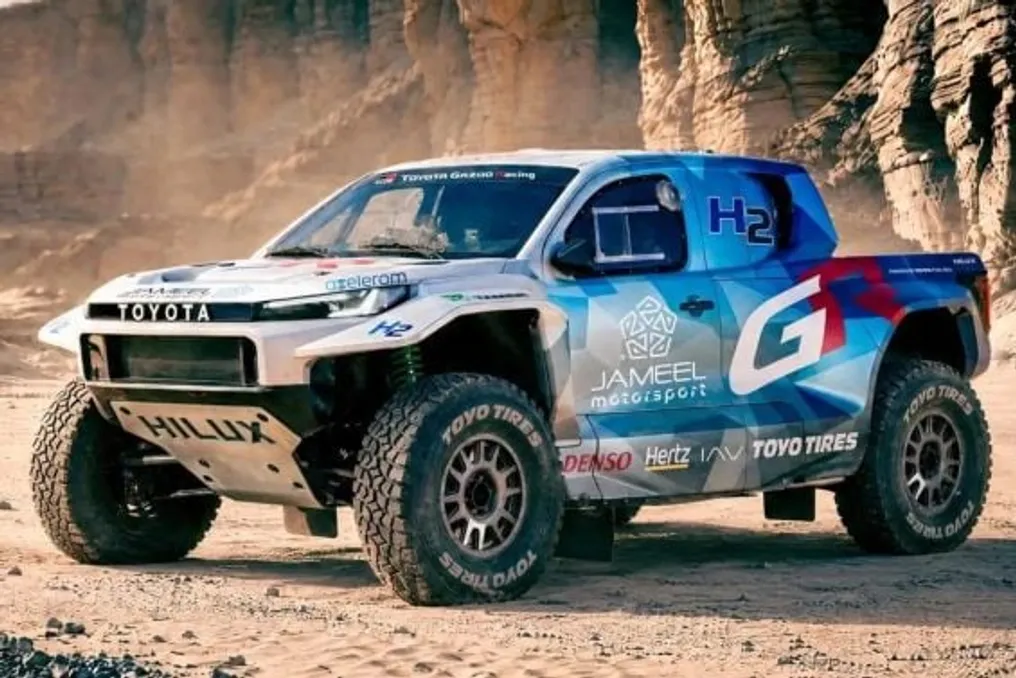
Toyota Gazoo Racing has officially announced the partners for the hydrogen-powered Hilux pickup truck that will compete in the 2027 Dakar Rally, held in Saudi Arabia, and has revealed the final livery of the prototype.
The vehicle has been named DKR GR FC Hilux and will compete in the Future Mission 1000 category. This category is intended for experimental vehicles that run parallel to the main route without directly competing for the title in the main automobile class.
Unlike versions equipped with internal combustion engines, this model uses a hydrogen fuel cell system. According to Toyota itself, this system is '2.5th generation,' integrating elements from the second and third generations of components. Thanks to this technology, the exhaust emits only water vapor during the timed stages on Saudi soil.
The development of the prototype is taking place at the manufacturer's research center located in Belgium, where final assembly is underway before the start of the testing program preceding the rally.
The competition is scheduled to take place between January 1st and 15th, 2027, with the start and finish in King Abdullah Economic City. The Future Mission 1000 comprises 13 stages and totals 1,000 timed kilometers. To meet these requirements, the Japanese manufacturer established four strategic collaborations.
Jameel Motorsport, responsible for the distribution of Toyota and Lexus in the host country, will provide local logistical support. Denso will contribute component technology, while IAV will supply the Dragoon electronic control unit and the corresponding control software. Furthermore, Toyo Tires provided the tires, which are partially manufactured with sustainable materials, as reported by the company.
This project also aims to collect crucial data on the fuel cell's performance when exposed to severe conditions of heat, dust, and intense vibrations. Toyota has already announced a series version of the hydrogen-powered Hilux for 2028, which will have a range exceeding 400 km in the WLTP cycle, a towing capacity of 2,500 kg, and an estimated refueling time of about five minutes.
These figures exceed those of the fully electric Hilux, which has a range of 257 km and a towing capacity between 1,600 kg and 2,000 kg. However, they remain below the values of the pickup sold in Brazil, specifically the 2.8 turbodiesel version, which has 204 hp, 50.9 kgfm, and can tow up to 3,500 kg.
The use of hydrogen is not new to Mission 1000; prototypes such as HySE-X1 and HySE-X2, belonging to a consortium in which Toyota participates, completed the category in 2024 and 2025. However, this brand represents Toyota's debut in motorsport with a fuel cell, a technology whose serial implementation still faces challenges related to infrastructure. According to the European Hydrogen Observatory, Europe has 179 operational hydrogen stations.