When one company sets the rules in artificial intelligence hardware, innovation completely stops, prices rise sharply, and startups desperately need time on servers. This suffocating situation is currently observed in the industry due to a serious shortage of graphics processors.
Huawei is acting as a disruptor to this status quo. The upcoming new Huawei chip is designed to radically change the approach to creating large language models by directly addressing the acute shortage of computing power. The company has stopped merely catching up; it has declared its intentions.
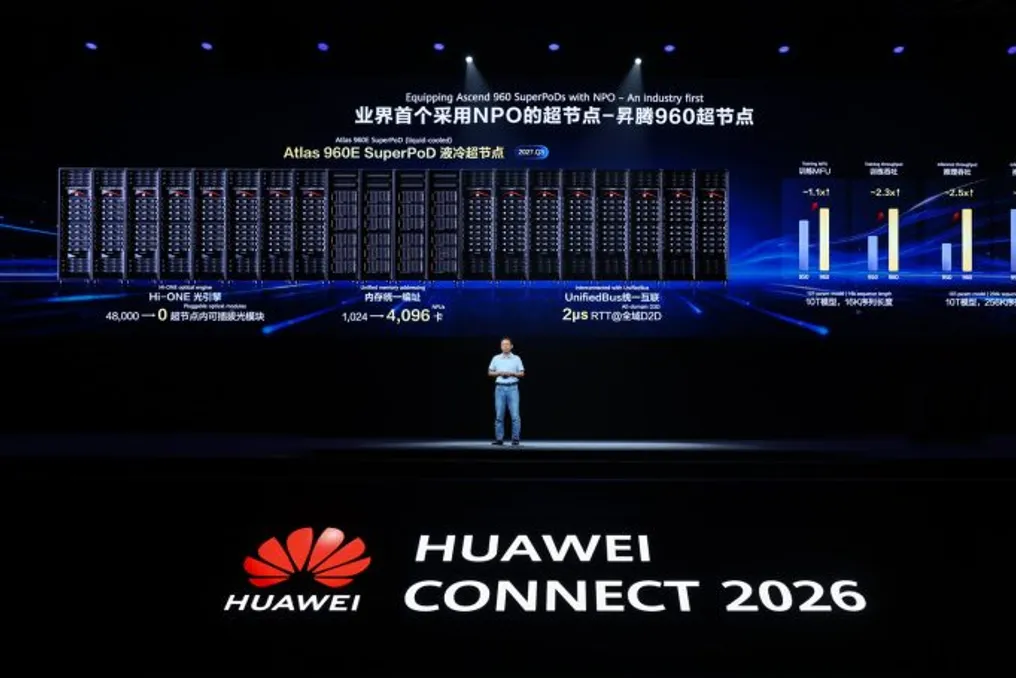
At the Connect 2026 event, Huawei announced plans to release Ascend 960 in the first quarter of 2027. According to available information, Ascend 960 is positioned as an extremely powerful chip for artificial intelligence tasks.
Despite years of skepticism that strict trade restrictions would permanently delay Chinese tech firms, they have proven wrong. Instead of giving up under pressure, Huawei has focused its efforts on survival, investing huge sums in independent research.
Its own localized supply chain has been established. Now, the focus is on a processor designed specifically for processing massive neural networks and resource-intensive generative models.
In the current situation, not only speed but also energy efficiency is important. Data centers consume an unprecedented amount of energy, and any chip capable of reducing the load on the power grid will have an advantage.
NVIDIA has not just created a competitive advantage; it has built an impenetrable fortress with its Superpod architecture, which combines tens of thousands of GPUs into a single, cohesive brain. Nevertheless, Huawei aims to capture a significant share of this market.
This goal is planned to be achieved through very aggressive improvements in interconnects. Simply putting a fast processor on a motherboard is not enough; the real magic always happens at data transfer speeds.
If the 2027 benchmark forecasts prove true, Huawei's network infrastructure could match the impressive throughput of premium NVIDIA enterprise solutions. This opens up the prospect of a world where developers are not exclusively tied to proprietary ecosystems, and there is a real choice of hardware.
Geopolitics complicates all aspects. It goes beyond silicon components and turns into a full-scale proxy war for global technological supremacy.
If Huawei successfully scales production by the first quarter of 2027, the international consequences will be significant. Developing markets will immediately take advantage of this opportunity, gaining access to raw computing power. This will force a reevaluation of control over artificial intelligence, leading to a complete market split.
Code defines our future, and hardware realizes it. For software developers, this shift is both frightening and inspiring. Moving away from established systems requires significant time and entirely new workflows.
However, competition invariably leads to better tools. Perhaps we will see a powerful push towards open source to bridge the gap between these competing semiconductor giants. Software engineers are highly averse to vendor lock-in.
If the 2027 launch provides genuinely functional power, the developer community will solve the software side of the issue itself. The era of the solo game is officially over.