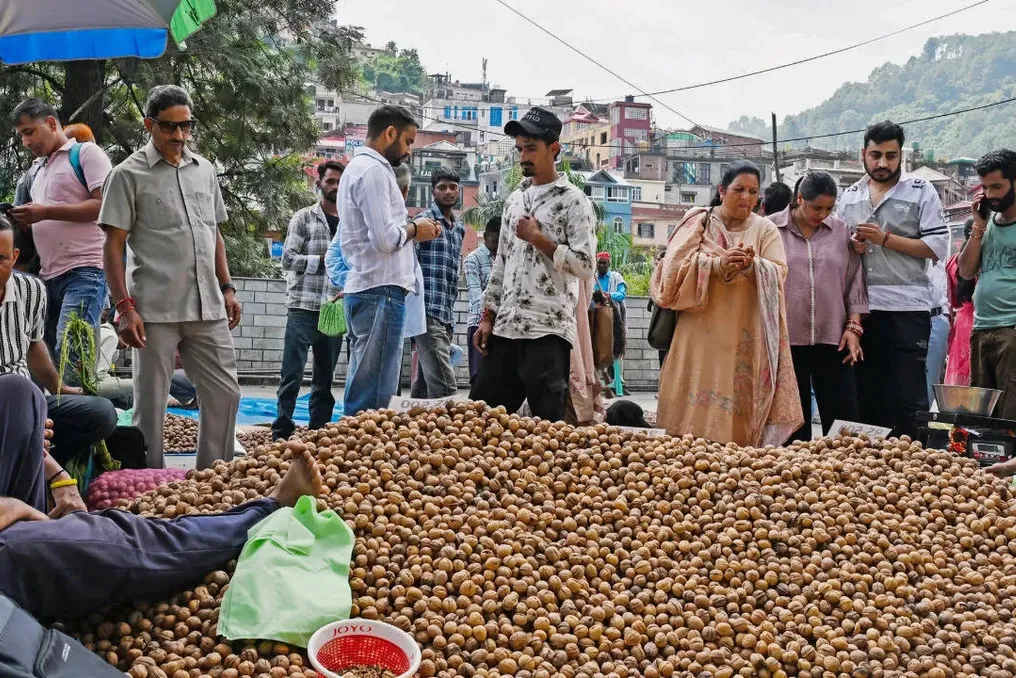
In the village of Gohan, located about 100 kilometers south of Srinagar, Shabir Ahmad, like many other residents, was harvesting walnut crops from tall trees. This work is becoming increasingly difficult. Ahmad noted: 'My back hurts now.'
Jammu and Kashmir produces 3.5 lakh tons of walnuts annually, accounting for about 90% of the country's total production.
Like other rural residents, Ahmad did not use protective gear, and he was proud of it. 'We have been doing this for centuries,' said Ahmad, who also works as a clerk in the local court. However, such bravado does not help during the harvest season. Dr. Mohad Yaqub Bat, a surgeon at Paras Hospital in Srinagar, reported that the valley's medical facilities treat dozens of patients annually after falls from walnut trees, some of whom have serious spinal injuries. Bat stated: 'There is no mechanism to solve this problem.'
Ahmad's younger brother sold one walnut for one rupee, and no two fruits look alike. For generations, walnuts in Kashmir have been grown from seeds. Now, Jammu and Kashmir and the Sher-e-Kashmir University of Agricultural Sciences and Technology (SKUAST) are promoting medium-sized, grafted walnut trees to ensure greater uniformity and help the produce compete in the global market against soft-shelled varieties grown in California and Chile.
This initiative aims to replace scattered plantations with organized orchards of known varieties, allowing farmers to grow more trees on the same area and obtain a harvest that is more stable in size and color. Walnut plantings cover about 80,000 hectares in Jammu and Kashmir, most of which consist of seed-grown trees. Ashfaq A. Pandit, a professor and head of the Fruit Sciences Department at SKUAST, explained: 'When someone plants a walnut seed in the ground, any tree grows. Every tree is its own variety.'
This natural diversity, once considered an advantage, has become a problem in the modern market, where buyers demand uniform products. Traditional walnut trees can bear fruit in about 15 years without the use of pesticides. Unlike traditional seed-grown trees, grafted walnuts belong to known varieties.
Imtiaz Ahmad Lawn, a professor and head of the Walnut Research Center at SKUAST, reported that the university has released new walnut varieties, and grafting cultivation has spread to nearly 90,000 hectares despite the lack of subsidies. Nevertheless, farmers claim that grafted varieties cannot compare to traditional Kashmiri walnuts. Mohammad Sultan, a farmer from Pulwama who has been involved in this for 50 years, stated: 'It cannot compare in taste. The new varieties are fragile, tasteless. They are nothing.'
Researchers had a different opinion. Lawn emphasized that grafted trees start bearing fruit earlier, ensuring a faster return on investment because the orchards and nut quality are uniform. He added: 'They have higher productivity and better export potential. There is a gradual possibility to replace unproductive seed-grown trees.'
This transition has also affected the walnut carving industry. In Jammu and Kashmir, walnut trees cannot be cut down without government permission. This issue was discussed in the assembly in March, when Chief Minister Omar Abdullah spoke out against the bill allowing landowners to cut walnut trees on private property. Omar defended the restrictions, stating that the law serves the broader goal of preserving walnuts and chinar trees.