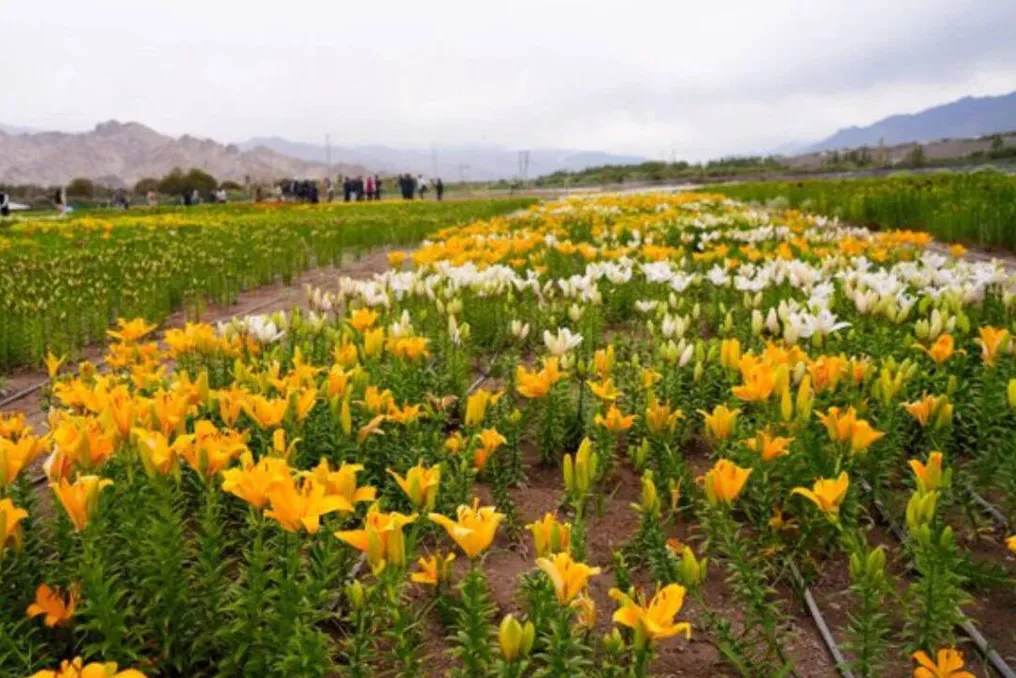
On Thursday, in observance of Prime Minister Narendra Modi's 76th birthday, the Lieutenant Governor of Ladakh, Vinay Kumar Saxena, inaugurated the world's highest and largest double flower fields in India in Leh. These fields are situated at an altitude of 10,600 feet and are part of the administration's efforts to diversify agriculture, develop skills, and create new earning opportunities in the Union Territory.
The gardens cover an area of 40 acres in the Choglamsar and Stakna regions and house over 2.5 million valuable flowers, including 2.4 million lilies and 100 thousand gladioli. The field in Choglamsar was developed in just two months: planting began on July 16, and the first flowers appeared in the first week of September. In Stakna, about 140 thousand lilies were planted in August, with the first blooms expected by the end of October.
Saxena noted that this initiative is the first experiment of its scale and nature at such a high altitude in Leh, adding that its successful implementation could pave the way for similar projects in other parts of Ladakh. Officials reported that the gardens will open to the public on September 18, with an entry fee of 25 rupees for adults and 10 rupees for children.
LG emphasized that floriculture, being a highly profitable agricultural activity, can complement traditional farming, increase farmers' incomes, and create opportunities for entrepreneurship and employment. The flower park in Choglamsar will function as a center for training, demonstration, and model floriculture for youth and farmers, where lilies, gladioli, tulips, and other ornamental flowers for national and international markets will be grown.
Saxena stated that the facility will provide an opportunity to learn about modern cultivation methods, scientific agricultural practices, and improved post-harvest management, enabling farmers to acquire the necessary knowledge and skills for farm and village-level floriculture. He also added that besides serving as a recreational and educational site for residents and tourists, it will create an ecosystem where not only flowers but also knowledge, skills, and enterprises will grow.