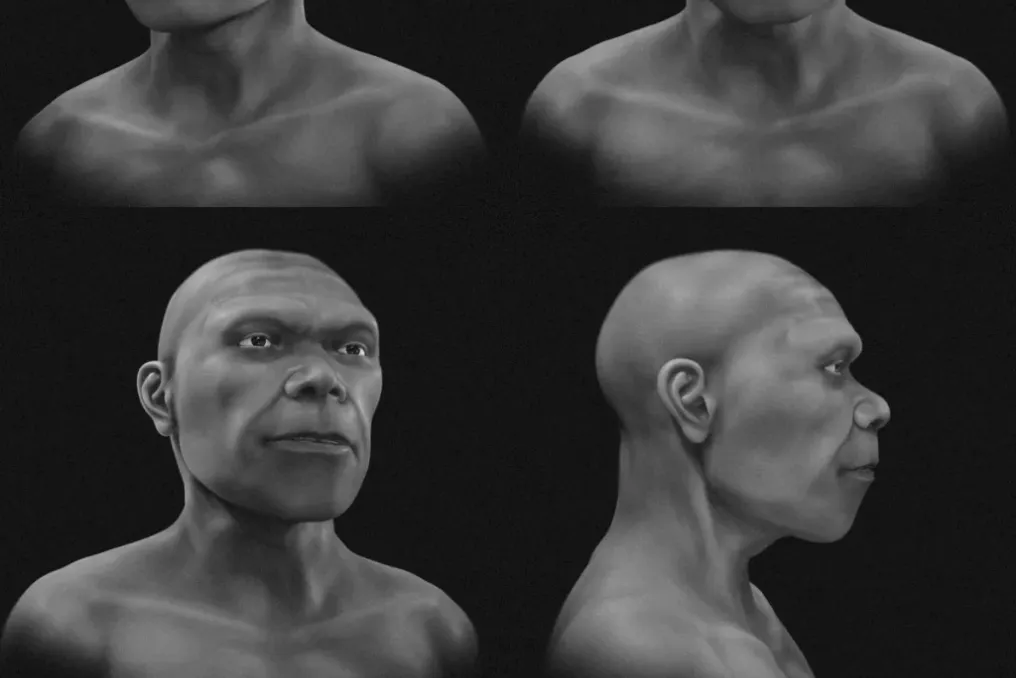
A digital reconstruction based on remains from Jebel Irhoud in Morocco provides an estimate of the appearance of some of the earliest known representatives of the species Homo sapiens. These remains date back approximately 315 thousand years.
To achieve this result, researchers combined parts from different individuals into a virtual skull and used data from modern humans to estimate facial tissues. Therefore, the resulting image does not represent any specific individual.
The Irhoud 1 skull, discovered in 1961 by miners in Morocco, was initially classified as belonging to an African Neanderthal around 40 thousand years old. However, the discovery of other remains and stone tools in Jebel Irhoud led to a revision of this initial interpretation.
In 2017, new analysis concluded that these hominins were Homo sapiens who lived approximately 315 thousand years ago, making them the oldest known modern humans.
The fossils display facial structure and teeth similar to ours, but the skull retains features characteristic of more ancient hominins. This contrast indicates that brain development continued after the basic external form of the human face had already formed.
To recreate the appearance of these people, scientists created a virtual skull by combining various fossils from Jebel Irhoud. The volume of this skull is approximately equivalent to that of an average adult modern male.
After creating the structure, researchers digitally adapted a modern human face to the proportions of the Jebel Irhoud skull. The comparison allowed for an estimation of how soft tissues might have been distributed over the bone structure. Two versions of the face were created: the first is presented in shades of gray and without facial hair for a more objective approximation; the second has hypothetical skin and hair pigmentation with greater artistic freedom.
More details:
The method has significant limitations. Since the skull is assembled from parts of different individuals, the reconstruction does not correspond to any single person who lived in Jebel Irhoud. Furthermore, there is no direct data on the thickness of soft tissues of Middle Pleistocene hominins. To fill this gap, researchers used datasets from modern human populations.
Researchers note: "Since there is no direct data on soft tissues for Middle Pleistocene hominins, using reference datasets obtained from modern human populations is a necessary methodological resource, not an assumption about biological equivalence."
The resulting image gives an idea of what some of the first Homo sapiens might have looked like, but it is not a definitive portrait. The study was published in the journal Heritage. The initial publication on the digital reconstruction appeared on the Olhar Digital portal.