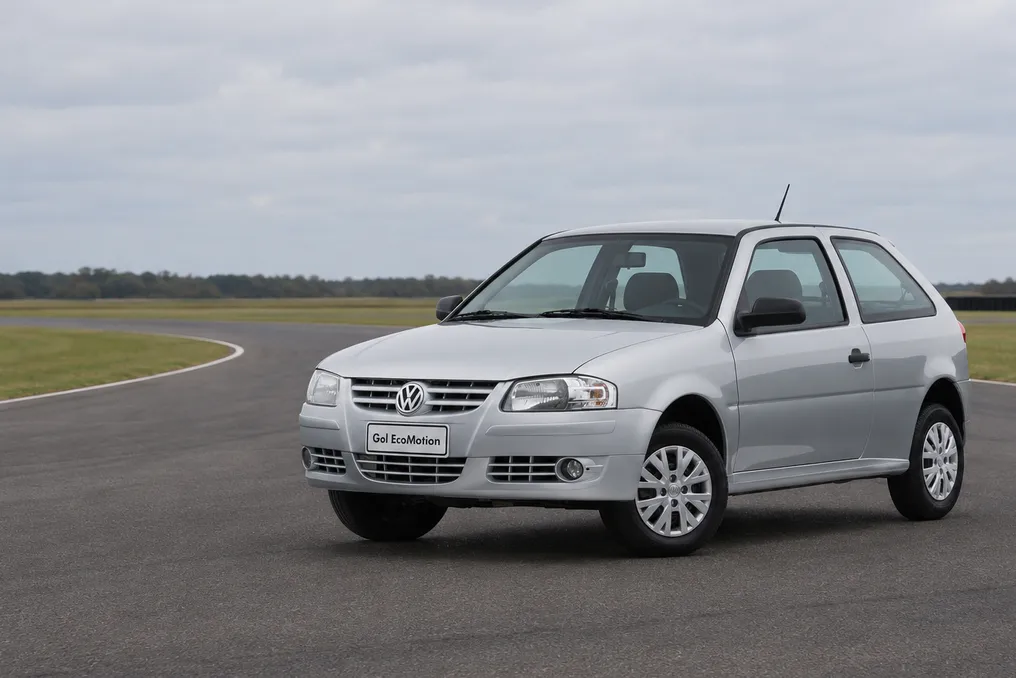
Recently, the author needed to acquire a car for his son, who had just obtained his driver's license. He also has a daughter who will soon reach adulthood, prompting the search for a simple, manual car that would serve both purposes: giving autonomy to the newly licensed driver and preparing the future driver for formal driving school lessons. The author's personal car was not suitable for these tasks due to reasons related to another VW focused on economy.
Although he did not intend to replace official driving lessons, the author considered it crucial to guide the initial steps with caution and patience, just as he did with his nephews when he was the only close relative with a manual transmission car.
He found a versatile vehicle in the form of a modest 2011, two-door VW Gol generation 4. This car met the established criteria: being affordable, simple, resistant to breakdowns, economical, and having a modest engine so as not to overload the two novice drivers. After a detailed review of the chassis (including replacement of shock absorbers, control arms, ball joints, and tires) and other visible components, the improvement task was completed, and the car was delivered for its new functions.
However, the author discovered that the Gol G4 presents defects and qualities in very balanced proportions. If expectations are adjusted to what the car offers and what it was designed to deliver, one perceives a dedicated and hardworking companion, whose positive aspects become more evident with time of use.
Less positive aspects of the engine
The small four-cylinder EA-111 engine seems to have inferior performance compared to current three-cylinder naturally aspirated engines. The difference in torque and power at the extremes of the rotation is noticeable. Although this might just be normal wear and tear, the very short gear ratio suggests an adaptation to increase engine efficiency, similar to the Chevrolet Celta VHC. The engine is sharp; if excessively cooled, a slow response is expected, despite the optimism of the data presented in the manual.
Consequently, city performance is somewhat lackluster: the car requires the next gear right at the start of movement. It is hard not to imagine what this gearbox would be like with a good alcohol-fueled AP2000, but that would already represent another vehicle.
Highway performance and transmission
Strangely, on the highway, the car starts to make more sense. With more space, it is possible to allow the engine to work in higher gears, and the way of shifting from third to fourth, along with the downshifts from fifth to fourth and fourth to third, makes driving dynamic and assertive, even if the speedometer needle is slow to react.
This is not due to the engine, which remains modest, generating about 70 horsepower (when new), but rather to the excellence of the coupled gearbox favorably matched to the longitudinal engine. The shifts are short and quick, possessing that 'weight' acquired over time, amplified by the tiny, low-positioned lever; it is a pleasure, despite everything.
What the engine does not excite, the gearbox compensates for. The non-hydraulic steering—far from being an example of absolute precision—and the firm and practically rebuilt suspension (although the springs were not replaced) transform the little Gol into a pleasant car for freer highways that do not require many overtakes on single lanes.
Its ergonomics differ from modern cars. Since the speed indicated on the speedometer is almost equal to the actual measured speed (considering a larger tire size for comfort), with only a 2 km/h difference at 100 indicated, boredom or sleepiness is unlikely in this vehicle.
Even at 100 or 110 km/h, it never seems slow. The noise keeps the driver alert, as does the pedal movement; the engine at full power in fifth gear—even at this pace—and the pleasant gearbox always maintain attention.
Trying to exceed the indicated 160 km/h (only on descents) is illegal, and feeling the wind trying to enter the 15-year-old cabin through previously unknown gaps is enough to moderate acceleration and comply with the law. Driving this basic Gol is a relative and distinct pleasure; however, it demonstrates that even a machine designed for economy and practicality—and perhaps the most criticized generation of the Gol—can provide good moments behind the wheel.
To be superior, the solution is simple: more engine! It would be necessary to resort to the AP600 or AP800, the latter being short-lived despite generating a good 106 horsepower on alcohol, actually performing and exceeding 180 km/h with the 1.6 liter and approaching 190 km/h with the 1.8.
However, the current goal is to present a Gol G4 that was enhanced by the factory to reinforce its utilitarian and low-cost character. Performance and powerful engines already have numerous articles in FlatOut; today's topic will be slightly different, perhaps less emotional, but current, as it deals with efficiency and economy, central topics in the automotive industry today.
The Gol EcoMotion
The Gol EcoMotion represents a genuine attempt to raise the economy ratings of the Gol G4, which was already an extremely simplified car compared to the previous generation, inspired by the Golf. In 2005, to create a gap between the Gol and the Polo, VW opted for the most economical path: simplifying its best-selling car. The G4 maintained the known bodywork of the Gol bolinha (AB9) but received a deep overhaul and a much more stripped-down cabin. The front and rear gained simpler lines and curves, as if a late 'ninety-something ray' had struck the vehicle.
Externally, this was not enough to seriously damage the Gol's reputation. The problem arose upon entering the car. The beautiful blue lighting panel and the panel inspired by the Golf MK4, with precise finishing and fittings, had disappeared. Everything was simplified. The instrument panel was a challenge to simply check the fuel level or engine RPMs.
The original Fox indicators were already criticized in the Gol. Ignoring this, the factory decided to bet on a higher sales volume car, perhaps to boost sales of the wide-cabin hatchback, eliminating one of the clear advantages of the Gol in internal sophistication. Steering wheel, ventilation controls, gear lever, door moldings, upholstery, seats... Nothing was spared in the process of internal deterioration. Besides being aesthetically poorer, the materials used were of lower quality; the 'island' of electric window switch actuators, correctly positioned on the doors, was unpleasant to look at and operate.
The Gol was losing appeal in a typical process of decline or generational change, a change that would occur three years later (June 2008), when the Gol would completely transform. The public could not predict whether the Gol would be discontinued or if they would be rewarded for their loyalty with a much improved and updated Gol.
It was a deliberately stripped-down and simplified sales champion, three years before the Gol finally received a truly new platform. The old variety of engines from the late nineties, when there were eight options (yes, eight!) in the line, was also a thing of the past. This diversity, ranging from one-liter to 2.0 engines, with 8 or 16 valves and even turbo, was reduced to only three options. VW's structure was being simplified. The Gol stopped playing so many roles in the lineup, as the Polo and Fox began to share that space. Since economy and simplification were the focus of this Gol, VW adopted this spirit with the Gol EcoMotion, years after the launch of the 4th generation, belatedly, in 2011, when this platform coexisted with the new Gol generation, totally different from the previous one.
The practice of keeping an old and simplified body alongside cars with the same name but different generations was not unprecedented. Palio and Corsa (sedan) also used this diversification of options, and since an older car could not be more attractive than the new one, the only possible direction was towards simpler and more stripped-down versions.
The fundamental difference in this little Gol is that there was a real intention to improve its economy, without relying solely on the original basic design or a merely simplified version in terms of trim levels, as always happened with the 'L' or 'CL' models. The directive was technical, not market-driven.
An 'Economy' sticker, like on the Uno or Palio, did not mean the car consumed less because of it; it was just a reference sticker. There was no engineering and technique applied specifically for this purpose, at least not at the Gol's level.
Just as a dedicated team works to make a car run faster, the Gol passed through the hands of professionals who sought the opposite path, although maintaining lightness also contributes to better performance.
Search for efficiency
Unlike bolder initiatives, such as the brand's BlueMotion line, whose most famous example was the Polo BlueMotion (launched a year earlier, now rare), and the Fox BlueMotion, which introduced the modern one-liter three-cylinder EA211 engine before the Up!, the Gol opted for a simpler formula, without neglecting real adjustments for greater economy and lower CO2 emissions.
The main measure of mass reduction was the elimination of hydraulic steering and air conditioning, even as options, which was normal until then. However, this alone would not be enough to achieve the promised 10% reduction in consumption and emissions announced by Volkswagen's marketing. Engineering had to modify other points without excessively burdening the financial sector.
The changes began with the lengthening of the differential, extended by 6.8% while maintaining the gear ratios. This provided a little more time between shifts, and the level of noise and vibration subtly decreased.
Similar to the Polo and Fox BlueMotion, the Gol received 'green tires' with lower ground adhesion; however, to avoid confusion with the public, reports mentioned tires with lower rolling resistance. The choice was 165/70 R13, with 39 PSI recommended on the front axle.
With this pressure, maneuvers became lighter, an important point in a car without power steering. The cost was in comfort and potentially in grip.
To counteract the stiffness caused by the tires and high pressure, the entire suspension was recalibrated—especially the shock absorbers—to preserve a minimum of smoothness and control.
It is difficult to determine the impact of this on intense use behavior, given that most launch tests placed journalists in a kind of organized consumption rally by Volkswagen itself, rather than in a more rigorous dynamic evaluation. However, a vehicle notebook from a major newspaper of the time recorded verbatim that the car presented less stability due to the green tires; nothing serious or different from a common Gol, but indicative that the grip had a lower limit with these tires.
To conclude the engineering part, the engine was electronically adjusted to accommodate the longer differential, and an economy indicator light on the dashboard was included to alert the driver about the need to shift gears.
[ ]