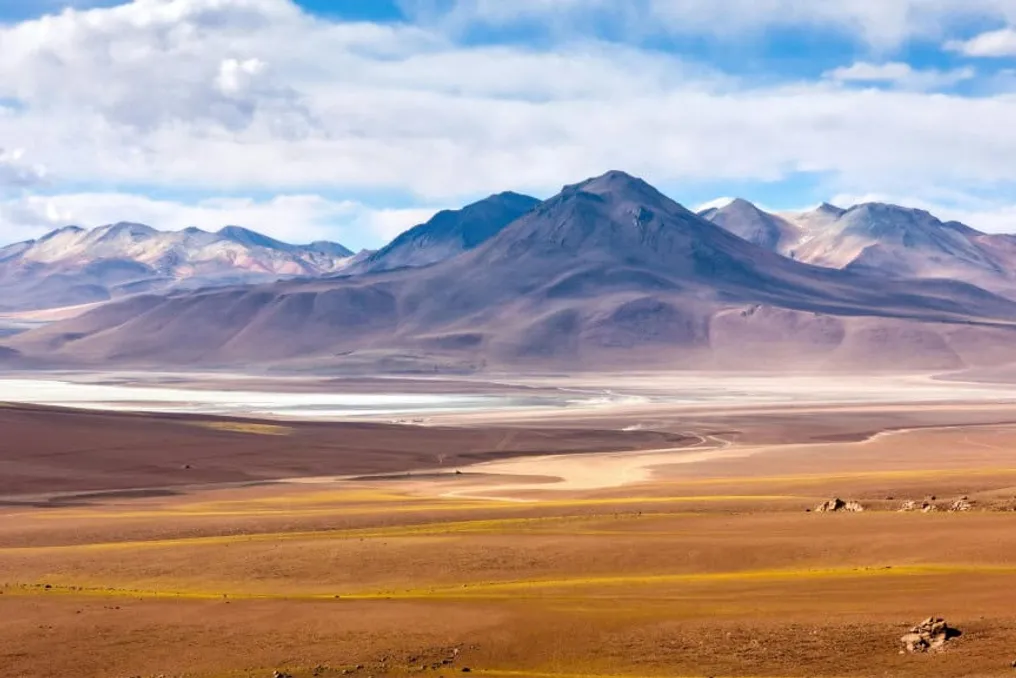
The location of a fossilized tooth demonstrated that capybaras lived in the Atacama Desert area in Chile approximately 8.8 million years ago. This finding casts doubt on the notion that one of the driest areas on the planet has always maintained an arid state.
The molar was recovered from a marine deposit located in Bahía Inglesa, on the Chilean coast. The existence of this semi-aquatic rodent implies that the region had rivers, vegetation, and other freshwater reservoirs under conditions very different from those of today.
The Atacama is recognized as the oldest and continuously dry region on the globe, with arid characteristics that may have prevailed for about 40 million years. The discovery of a tooth from a semi-aquatic animal in this environment represented a surprising event.
Priscilla Martinez, a researcher affiliated with the University of Arizona and a collaborator on the study, expressed her surprise at finding a capybara tooth in a marine deposit in one of the driest areas on Earth. She raised questions about how the animal could have reached that area, asking: 'If capybaras originated east of the Andes in this foothill region, how on earth did these short-legged rodents manage to cross?'
One suggested theory is that capybaras might have crossed the central part of the Andes, spanning Bolivia and Chile, during the Miocene. According to scientists, during this period, the northern part of the mountain range might have been less elevated than it is currently, which would facilitate the movement of these animals.
However, the most accepted hypothesis diverges from this mountain crossing. It is suggested that capybaras dispersed through a series of suitable ecosystems stretching from northwestern Amazonia to the Pacific coast. In this way, a single crossing through such a severe barrier would not be necessary, allowing the animals to progress gradually through favorable environments.
Other evidence points to a very different environmental scenario from the present. Phytoliths, which are plant remnants preserved in the soil, indicate the presence of palm trees in Bahía Inglesa during the Miocene. Combined with the presence of the capybara, this evidence points to a significantly warmer and wetter Atacama about 9 million years ago.
Researchers estimate that rivers and other freshwater bodies could have traversed the area, establishing ideal conditions for both flora and large populations of semi-aquatic animals. The finding contradicts the belief that the Atacama has always been a dry and inhospitable place, given that the presence of the capybara and the evidence of palm trees indicate considerably different past environmental conditions.
Mark Clementz, another co-author of the study, summarized the importance of the discovery, stating: 'Finding this capybara—which I think everyone can agree is by no means a desert animal—in that location will challenge many ideas about the history of the Atacama.'