From the dawn of humanity to the present day, millions of individuals have been born and died on the planet long before the existence of census records. Determining the exact number of humans who have inhabited Earth is a mystery that requires combining archaeological discoveries and demographic projections.
The calculation of this population volume mixes scientific rigor with what is called 'educated imagination,' a term used to describe well-founded assumptions, logical deductions, or solid hypotheses. Due to the scarcity of data about most of the past, demographers rely on these historical models.
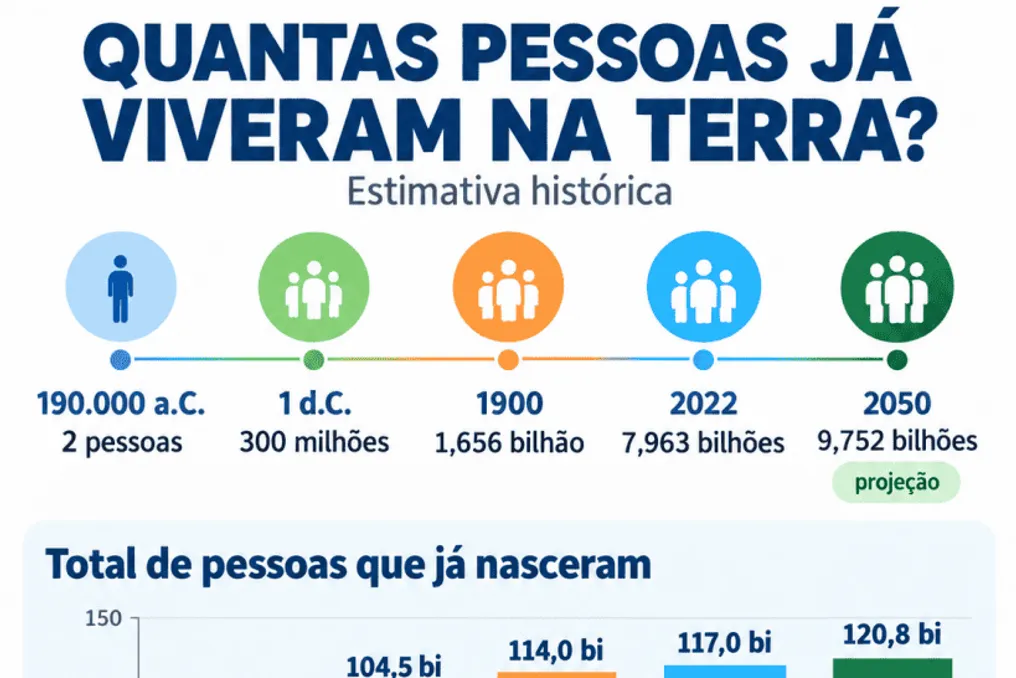
According to the Population Reference Bureau (PRB), a private, non-profit, and non-governmental organization based in Washington, D.C., USA, which is dedicated to collecting, analyzing, and disseminating statistical data on health, environment, and population, it is estimated that about 117 billion human beings have been born on the planet since the beginning of our species.
To reach this figure, the demographic analysis fundamentally considers three elements: the period during which humanity has remained on the planet; the average size of populations in each era; and the birth rate per thousand inhabitants. It is noteworthy that the number of deaths is not directly included in this formula, which partially simplifies this complex puzzle.
The oldest ancestors appeared millions of years ago, but scientific evidence indicates that modern Homo sapiens established themselves around 190,000 BC. For most of this time, our ancestors lived dispersed in small groups in African territories, facing enormous difficulties just to preserve the species.
Advancing in time to 8000 BC, the world population reached approximately 5 million people. In the subsequent millennia, population growth occurred at a very slow pace, culminating in only 300 million inhabitants in 1 AD. Human populations showed constant fluctuations, influenced by military conflicts, climate changes, and seasonal food availability.
In that distant time, life expectancy was extremely low. In Iron Age Europe, the average life at birth did not exceed 12 years. To ensure the continuity of the species in the face of so many adversities, about 80 children were born per thousand inhabitants, a rate that almost doubles the highest birth rates currently recorded in some African nations.
Under such challenging circumstances, human expansion faced almost insurmountable obstacles. At the height of the Roman Empire, in 14 AD, historians present divergences between 45 and 90 million inhabitants within the territory. This large variation in estimates demonstrates the imprecision of ancient historical records, requiring researchers to work with significant margins of error to recreate these scenarios.
In 1650, the global population had reached a modest 500 million individuals. This slow growth was largely caused by devastating epidemics, such as the Black Death. This severe disease did not only affect medieval Europe but also decimated entire populations in Asia and the Middle East over the centuries, drastically reducing the number of inhabitants and complicating the calculations of contemporary scientists.
The picture began to undergo a drastic transformation starting from 1800, the moment the historic milestone of one billion people was reached. Since then, driven by advances in basic sanitation, vaccination, and agricultural production, the mortality rate plummeted. This health revolution allowed more people to reach adulthood, resulting in the significant jump to the current 8 billion inhabitants.
To develop this calculation from primitive times, specialists adopted a simplified premise, starting the count with only two hypothetical people and applying constant growth rates for each period. Projected birth rates dropped from 80 per thousand in antiquity to less than 20 per thousand today.
This semi-scientific approach led to the total estimate of 117 billion births throughout history up to the study year, conducted in 2022. The long interval between 190,000 BC and 1 AD constitutes the most relevant factor in this calculation. If there is any error in this projection, it is likely that the real number is even higher, given that historical population growth occurred in leaps, not continuously.
A fascinating aspect of this colossal count is our temporal position. With a current world population estimated at 8 billion inhabitants, living human beings today represent almost 7% of all those who have ever been born on Earth, a remarkably high proportion for a species that has traversed this planet for over two hundred millennia.
As archaeology discovers new fossils and technology improves analysis methods, our understanding of ancestral demography becomes more precise. Reconstructing the trajectory of the human population is an ongoing effort that aids in understanding our origins and the size of the crowd that paved the way to the present.