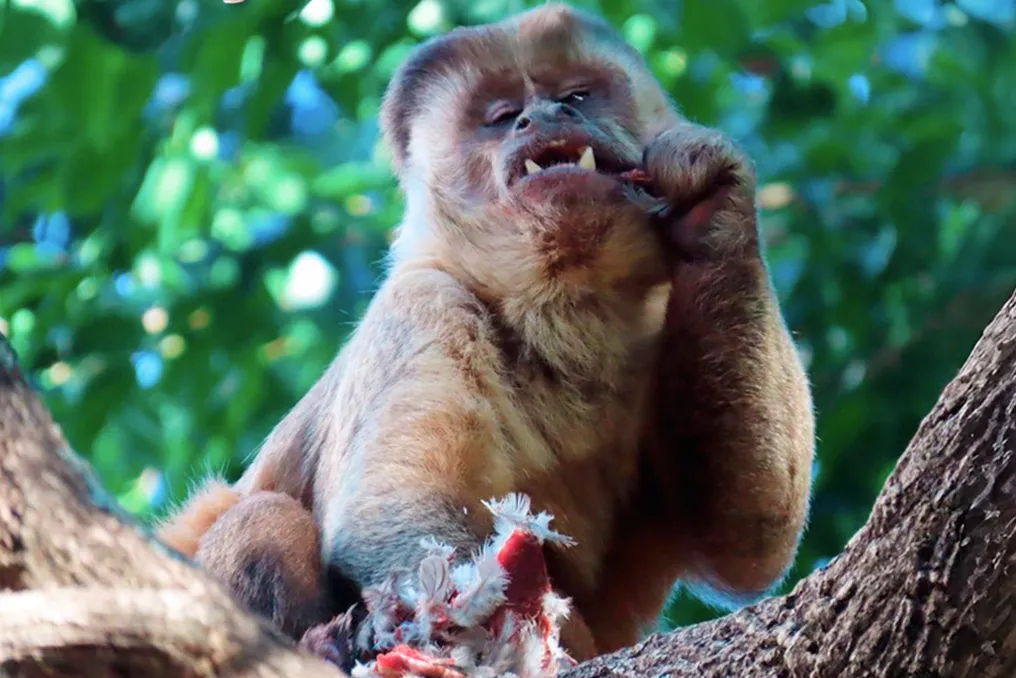
Researchers discovered that small vertebrates are part of the regular diet of capuchin monkeys during observations conducted at Fazenda Boa Vista, located in southern Piauí. The study, published in the scientific journal Plos One, demonstrated that hunting frequency increases when fruit availability decreases, suggesting that this behavior may reflect the habits of our ancestors.
Among all existing primates, humans are notable for frequently hunting animals larger than themselves, a survival tactic historically linked to brain development and the emergence of complex social structures. However, this predatory conduct may have simpler origins, starting with the capture of smaller prey, as observed in chimpanzees and capuchin monkeys.
To understand the factors motivating this behavior in primates, scientists monitored the hunting habits of these monkeys for a period of 45 months. Patrícia Izar, full professor in the Department of Experimental Psychology at the Institute of Psychology (IP) of USP and co-author of the article, reported that the inclusion of meat in the capuchin monkeys' diet was not new; there were already records of capturing rats, snakes, birds, and other primates, but quantifying the frequency and identifying the factors related to hunting was missing.
Over four years, the team tracked the animals, recording who captured each prey item, the type of animal consumed, as well as data on sex and age. Analyzing the frequency of predation events allowed researchers to identify patterns absent in previous studies, which had few recorded occurrences. Patrícia reported that each group of capuchin monkeys was observed from dawn till dusk, totaling 5,093 hours of surveillance, resulting in 446 vertebrate consumption events, either ongoing or about to begin.
Patrícia Izar clarified that capuchin monkeys consume a variety of environmental resources, including fruits, leaves, flowers, invertebrates, and vertebrates. The small vertebrates ingested included various groups, such as lizards, snakes, birds, rodents, bats, and marsupials, like opossums. Eggs and bird chicks were also documented. The professor emphasized that these animals do not have a specialized diet.
The study observed that brains and viscera are often consumed before other parts, which can be explained by the high nutritional value of these tissues. Patrícia explained that the brain is rich in lipids, making it a crucial energy source, and viscera are easy to digest and concentrate nutrients. This may lead the animal to prioritize what offers the highest energy return before dedicating time to other parts.
The consumption of vertebrates also serves a nutritional function, acting as a source of protein and fat. For the monkeys, these small animals function as dietary supplements during times of less access to other resources.
A significant finding of the research was the correlation between the amount of available fruit and the frequency of hunting. The data indicated that the monkeys consumed more small vertebrates when the fruit supply was lower, while insect availability did not show a statistically relevant relationship with the predation rate.
The availability of coconuts helped researchers understand this dietary change. According to Patrícia, at Fazenda Boa Vista, the monkeys consume palm fruits, which are abundant in the dry season. During the rainy season, between December and February, the amount of coconuts drops, and vertebrate intake increases. For the researcher, this variation suggests that meat can serve as a substitute when the fruit supply is reduced.
The analysis revealed that vertebrate predation occurs predominantly individually. Researchers did not observe coordinated hunting actions, although multiple monkeys might approach a prey after it was captured. Patrícia mentioned that when an animal was hunted, the other monkeys would try to take pieces. On certain occasions, there was also transfer of meat or other parts of the carcass between individuals.
This dynamic may have implications for the animals' social life. For example, juveniles follow adults during meals, seeking to obtain some of the food, which creates learning opportunities. Although the study did not directly investigate how monkeys learn to hunt, exposure to food may help young ones recognize what is part of the diet.
Another pattern emerged when comparing the monkeys in isolation: males showed a higher predation rate than females, and adults hunted more than juveniles. Juveniles, in turn, did not show a significant difference compared to adults. Patrícia suggested that possible reasons for the disparity between males and females include body size and energy needs, or the inherent risk of the activity and the caution of the females, adding that more studies are needed to confirm these hypotheses.
For Patrícia, besides clarifying the diet of capuchin monkeys, the research serves as a warning about the effects of habitat destruction on the resources available to these animals. She emphasized that the results underline the importance of conserving the natural environments of these monkeys so they can meet their nutritional needs and live well.
This study is part of the EthoCebus Project, which monitors capuchin monkeys at Fazenda Boa Vista, in southern Piauí. The project began in 2005, with systematic data collection starting in 2006. For this article, data on predation episodes, prey consumed, and individual characteristics were examined.
The results were generated from doctoral research conducted by Michele Pereira Verderane, Noemi Spagnoletti, and Olívia Mendonça Furtado. Patrícia, who currently coordinates the project, commented that this is another result from a long-term project.
The research was conducted in collaboration with Dorothy Fragaszy from the University of Georgia, in the United States, and Elisabetta Visalberghi from the Institute of Cognitive Science and Technology, in Italy. The analysis of the material also involved the participation of anthropologist Susana Carvalho, the first author of the article and director of Gorongosa National Park, in Mozambique. The fieldwork involved the participation of Marino Junior, Marcos Fonseca, Arizomar da Silva, and Cláudio Fonseca, who assisted in monitoring the groups and collecting data. Patrícia highlighted the relevance of these field collaborators, who were also responsible for periods of in situ animal observation.