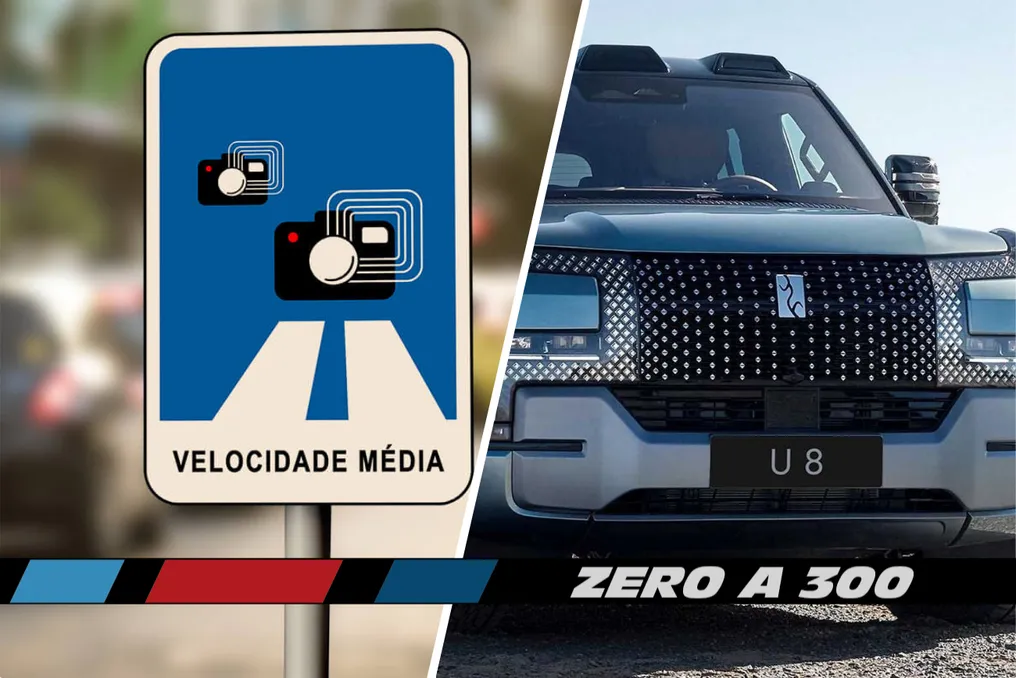
The Brazilian Traffic Code was altered since last Monday (the 14th), allowing drivers with a National Driver's License (CNH) in Category B to drive electric and hybrid vehicles with predominantly electric traction, provided their Gross Vehicle Weight (GVW) does not exceed 4,250 kg. Previously, the limit for Category B was 3,500 kg, and this limit remains unchanged for exclusively combustion-powered vehicles.
The justification for increasing the limit lies in the fact that batteries make electric cars heavier, and the adjustment aims to prevent an electric model equivalent to a standard car from requiring a higher category license solely because of the weight of its propulsion system. However, the text points out that the weight limit in the CNH is not intended to punish combustion engines, but rather to reflect that, above a certain GVW, the legislation considers that the vehicle requires a different type of license for safety reasons.
An example given is the Ram 2500, which requires a Category C license because its GVW exceeds 4,000 kg due to its load capacity and is classified as a truck. In contrast, pickups like the Ford F-150 and Ram 1500 are homologated below 3,500 kg and can be driven with a Category B license, even having a similar size. The change allows a 4,000 kg electric vehicle to be driven by a driver with a Category B license, something that would not be permitted if it were powered only by combustion.
The inspiration for the 4,250 kg limit came from the European Union, although the European rule is more restrictive, requiring that weight above 3,500 kg comes exclusively from the alternative propulsion system. Brazilian legislation, however, did not impose this limitation, leaving the CONTRAN the prerogative to define additional criteria.
This change benefits vehicles such as the BYD Yangwang U8, with a GVW of 3,985 kg, which previously required a Category C license, hindering its commercialization in Brazil. It is questioned whether there is a practical difference, for the driver and other road users, between a 4,000 kg chassis and a monocoque with 4,000 kg batteries, given that the GVW limit exists for safety reasons.
Regarding speed, the new law has not modified the rules of the CTB; on highways without specific signage, passenger cars, vans, and light trucks can reach 110 km/h on dual lanes and 100 km/h on single lanes, while other vehicles have a limit of 90 km/h. Thus, an almost four-ton electric vehicle can theoretically be driven by someone with a Category B license and follow the speed limits for passenger cars.
Expansion of Average Speed Radar Tests
The National Land Transport Agency (ANTT) authorized the implementation of average speed radar system tests on concessioned highways in eight Brazilian states, marking the largest experiment of its kind. The tests will take place in sections located in Espírito Santo, Goiás, Mato Grosso do Sul, Minas Gerais, Paraná, Rio de Janeiro, Rio Grande do Sul, and Santa Catarina, with an initial duration of 180 days, and the system will apply fines based on average speed.
The system works by calculating the average speed by comparing the time a vehicle takes to cover a known distance between two points. The idea is not new in the country; Curitiba started tests in 2014, and São Paulo adopted a similar project in 2017, both initially without applying fines, serving only educational purposes.
To date, monitoring by average speed is not regulated for the application of penalties, being used only for studies and awareness. However, there are projects pending in Congress to modify the CTB and allow speeding infractions to be proven by calculating the average between two points.
During a hearing in the Chamber of Deputies this year, the president of the Brazilian Road Concessionaires Association mentioned that average speed was already being tested purely statistically, requesting legal regulation and advocating for a gradual implementation. Representatives in favor of the measure presented results from pilot projects to support the amendment of the Traffic Code.
Although these radars do not officially issue fines, they generate statistics that will serve as a basis for their future legalization. The average speed system improves the monitoring of excessive speed, forcing the driver to maintain an average compatible with the limit over kilometers, instead of just respecting the limit a few meters before the radar.
However, the system does not distinguish between risk situations; a driver can perform a dangerous maneuver at high speed and then drastically reduce speed, maintaining the allowed average. Road safety cannot ignore that excessive speed contributes to the severity of accidents, and it is crucial to monitor accident indicators in the monitored sections, not just the production of average infraction statistics.
In parallel, a new six-cylinder BMW M3 was spotted camouflaged on the streets of Germany. Although BMW has announced a battery variant for the new generation of the M3, the traditional inline six-cylinder model is already being seen. The sports sedan is still covered, but it revealed a radiator under the bumper and the shape of the headlights, showing similarities to the Neue Klasse look of the electric M3.
It is also observed that the rear of the new M3 will have horizontal taillights that almost touch in the center of the trunk lid. Being a sports version, it features more aggressive bumpers, more voluminous fenders, wider tracks, and larger wheels. A notable detail is the visibly longer hood than that of the electric M3, as the battery and combustion versions use distinct architectures: the electric one uses the NK platform, while the traditional M3 will evolve the existing CLAR architecture.