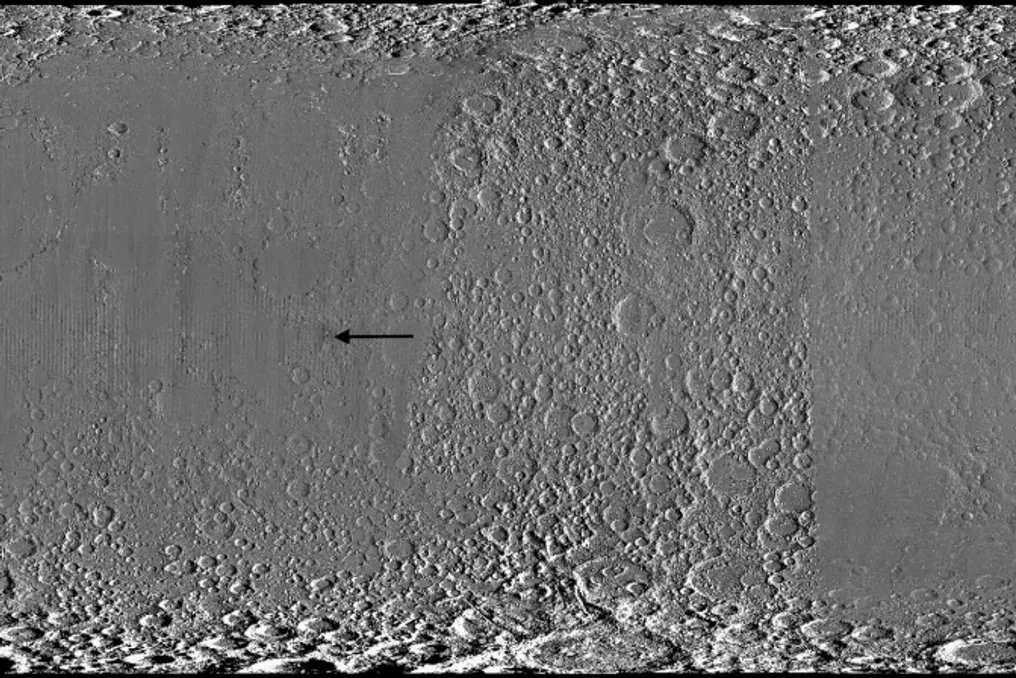
The Lunar Reconnaissance Orbiter (LRO), belonging to NASA, detected a recently formed crater on the Moon. This impact, caused by an asteroid or comet between April and May 2024, resulted in the creation of the largest known impact crater in recent times, with a diameter of 222 meters.
The identification was made after scientist Robert Wagner conducted a detailed comparison of lunar surface images. The collision event dispersed material over a distance greater than 100 kilometers and showed soil modifications, information that may be useful for planning future lunar constructions.
Characteristics of the new formation
This structure, named McGetchin, has a width of 222 meters and reaches a depth of 43 meters. Its dimensions are comparable to the Colosseum, and its depth would be sufficient to house three stacked school buses.
It is estimated that the celestial body responsible for the collision was equivalent in size to a three-to-six-story building. Researchers point out that an impact of this magnitude occurs on the Moon at intervals of approximately a century or even longer periods.
The collision scattered dust and rocks over more than 100 kilometers. Additionally, another study observed an area of about 7 kilometers around the crater that exhibits a nighttime temperature about 9°C lower.
This phenomenon is associated with regolith, the surface layer composed of dust and fragments on the Moon. The impact made this material looser and less dense, decreasing its ability to retain heat.
Scientific implications and additional discoveries
David Paige, from the University of California, Los Angeles, drew an analogy between the process and soil cultivation. He explained that they are now analyzing the impacts as a way to 'cultivate' the regolith, by turning over sediments and exposing materials normally found beneath it to the surface.
The discovery occurred during a routine check when Wagner was comparing maps generated from images from different years and noticed a clear area surrounded by a dark region. He reported immediately stopping his work to investigate the point in question.
Although computational software flagged differences in the images, it generated many false alarms due to variations in shadow and lighting. Subsequent images captured by the high-resolution camera were crucial for confirming the crater, measuring its dimensions, and analyzing the impact effects.
Since 2009, the LRO has cataloged at least a thousand new craters and approximately one hundred thousand other changes on the lunar surface, caused by both impacts and the debris released by them.
The collected data also suggests that the top two centimeters of lunar soil are disturbed every 80,000 years, a faster rate than previously estimated. This movement implies that the marks left by Apollo mission astronauts will not remain intact for this period.
Currently, scientists are working to calculate the risk of materials launched by future impacts hitting a future lunar base. This calculation will assist engineers in designing structures more resistant to the effects of these collisions.