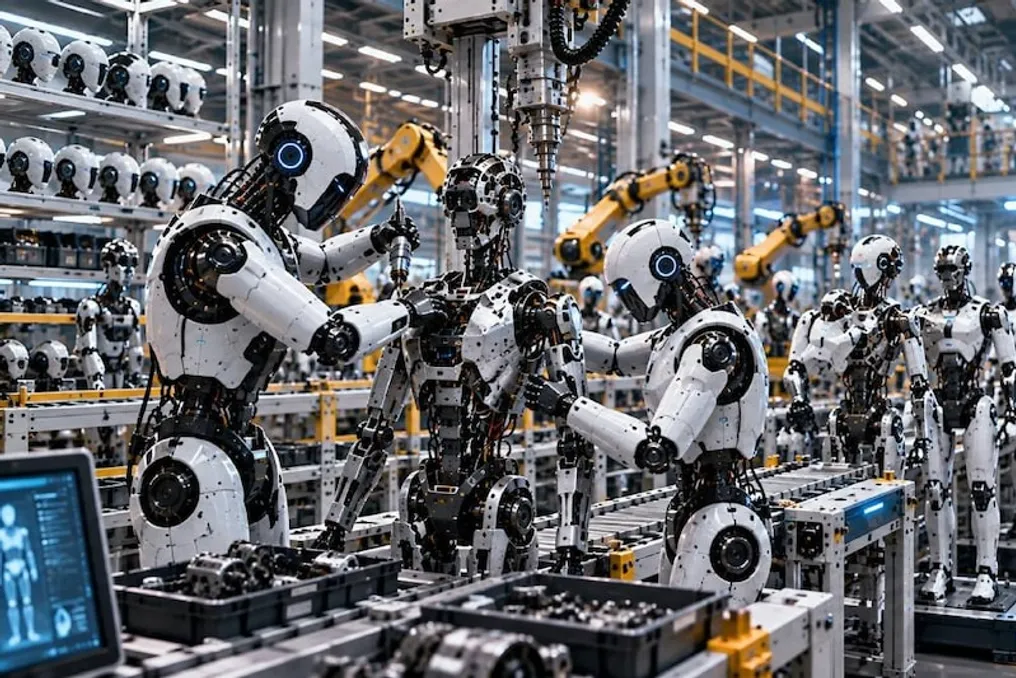
Amid the growing artificial intelligence (AI) and robotics industry, there is a trend where robots begin to produce other robots. The Chinese company UBTECH Robotics has launched a new factory designed for large-scale robot production.
This humanoid factory is located in the Guangxi autonomous region, in the city of Liuzhou. At this facility, robots participate in the parts manufacturing process, which significantly accelerates work, allowing a new robot to be prepared in approximately 10 minutes. According to the company, the new factory can produce 10,000 robots per year, and its area is about 14,000 square meters.
The main volume of production here is dedicated to the industrial humanoid robots, the Walker S and Cruzr series from UBTECH. The creation process of the robots is carried out through the collaboration between UBTECH and Siemens Digital Industries Software. Operations are managed by the company's new system, named Smart Brain, which independently determines which components need to be manufactured. The system also monitors moving parts and conducts quality checks to complete the robot's production.
Each robot that comes out of this process is assigned a unique serial number, which allows for subsequent tracking and verification of its entire manufacturing cycle.
Cruzr Y1 and Cruzr S2 robots are used in the factory operations, responsible for unloading, placing, and feeding materials onto the production line. These robots also assist in creating parts for other robots, contributing to the release of new models.
After assembly, the robots are not immediately sent out. They undergo a series of condition checks. Then, all robots are subjected to four hours of test operation. After this, they are sent for a 360-degree visual inspection to check every part, and only then is the robot considered fully ready.
The opening of the factory occurs during a period of active expansion of the Chinese robotics industry. Robots are no longer confined to research laboratories but are actively being implemented in the real world. According to data from the National Bureau of Statistics of China, the country produced 98,677 industrial robots, indicating the potential for further large-scale use of robots in the future.