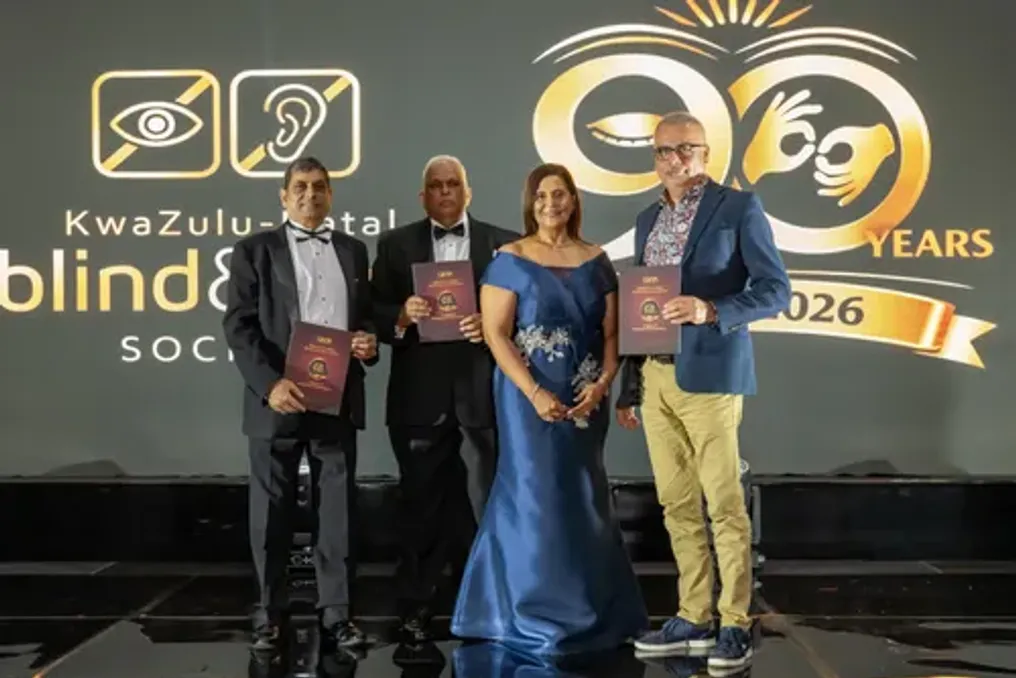
Advisors of the KwaZulu-Natal Blind and Deaf Society—Raven Harku, Vinesh Gokul, Vita Seukuran, and Ajit Waldji—summarized the organization's 90-year legacy, noting its contribution to providing services, empowering, and facilitating social integration.
To mark this significant milestone, the Society hosted a lavish masquerade Gala Dinner at the Imbizo Conference Centre in Sibaya last weekend. The event gathered donors, sponsors, staff, volunteers, and key stakeholders to pay tribute to the society's unwavering commitment to its community.
This momentous occasion allowed for a spotlight on the organization's rich history since its founding in 1936, highlighting nine decades of success, overcoming challenges, and promoting independence for people who are blind, partially sighted, deaf, hard of hearing, and blind-deaf. The evening also included a fundraising auction designated to support the society's ongoing activities and specialized educational programs.
A Look Back
An archival photograph of the Natal Indian Blind Society workshop on Lorne Street, 29, demonstrates the early years of the organization, which provided assistance to blind and visually impaired individuals. During the event, guests were entertained by performances from the KwaZulu-Natal Youth Orchestra, renowned artist Professor Chats Devroop, and magician Mo Magic, who also served as the ceremony host.
The highlight of the evening was the official launch of the commemorative book for the society's 90th anniversary, which documents the organization's heritage, its pioneering founders, and its impact across generations.
Education in Changing Times
Vita Seukuran, the society's president, stated: 'For nine decades, the KwaZulu-Natal Blind and Deaf Society has firmly adhered to its mission of improving the lives of people who are blind, partially sighted, deaf, hard of hearing, and blind-deaf.'
The central element of the society's work is the philosophy of self-sufficiency, not dependency.
Seukuran emphasized: 'My life principle is that we want to teach them independence—to teach a person how to fish, not just give them a fish.' She added that the goal is for people to acquire skills that provide them with pride and autonomy, rather than reliance on aid.
Early achievements of the organization include establishing a school for blind children in the 1940s and specialized education for deaf children in the 1960s, including the V.N. Naika School for the Deaf. Today, the scope of the society's services encompasses social work, advocacy, Braille literacy training, teaching South African Sign Language, and computer training using assistive technologies.
From Typewriters to Technology
Practical workshops on reed weaving and clothing sewing continue to provide practical skills and employment opportunities. One beneficiary, Zaba, who was born deaf, entered the society's sheltered workshop at age 14 without formal education. After mastering sewing and completing a machine maintenance course, he now works as a sewing machine technician, supporting his wife and two children.
The society's innovations have also extended to culinary arts. Its Blind Culinary School, funded by the Dr. Vasana Govinda Foundation, is the first of its kind in South Africa. Seukuran noted that this helps prevent dependence on others, and these skills can help partially sighted individuals start their own businesses.
Embracing Independence
This week, the initiative was expanded with the launch of a new culinary program specifically designed for deaf participants. The society plans to open a therapy room for children with multiple disabilities and a recreational area on October 23rd, the day before its official founding date. Funding is also being sought for an early detection service that will provide audiology and speech therapy for preschoolers.
Concluding the summary of nine decades of work, Seukuran stressed that this milestone is a recognition of collective dedication and community awareness.
Celebrating 90 Years of Service
Seukuran concluded her address by stating that success is the result of teamwork. She acknowledged the contributions of advisors, staff, volunteers, regional committees, fundraising groups, and other individuals who have advanced the organization over the decades. She finished by saying: 'We want people to see their abilities. We want them to stand confidently as full human beings.'