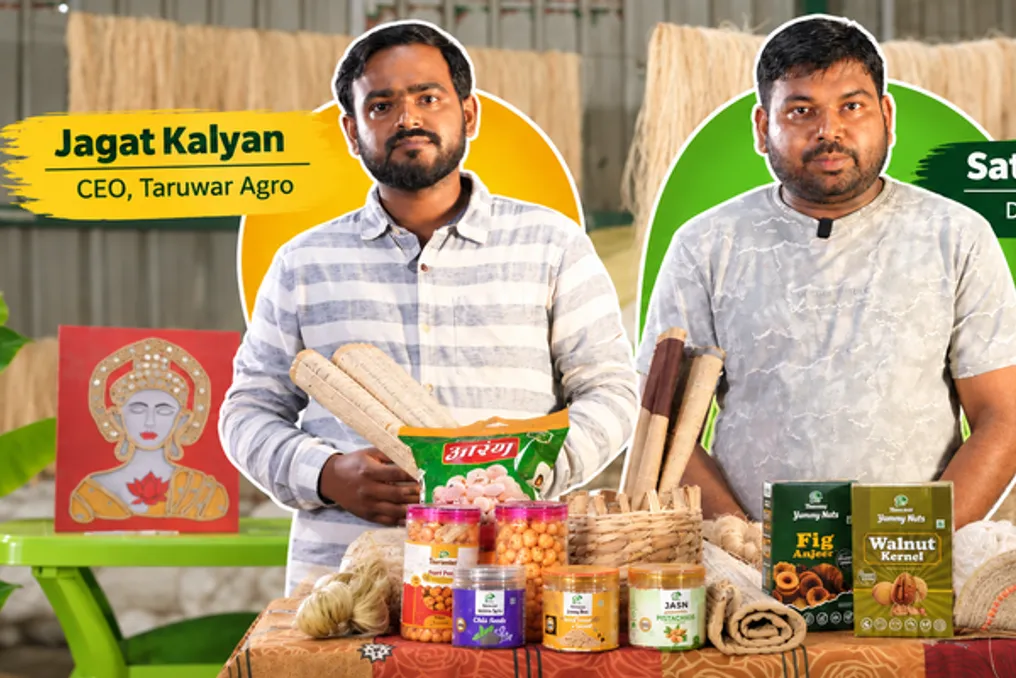
In the agricultural lands of Bihar, banana plants are often considered useless after harvest, as farmers typically cut down the remaining stalks and remove them from the fields due to their limited practical value. However, three friends saw an opportunity in this waste to create a business.
Jagat Kalyan, Satyam Kumar, and Nitish Kumar Verma decided to choose entrepreneurship over traditional career paths and began studying ways to extract fiber from banana stems. Their goal was not just to create a new product but to build a business based on Bihar's local resources.
This vision led to the founding of Taruwar Agro Industries. Today, the company produces a variety of products from banana fiber, including folders, yoga mats, baskets, and prayer rugs. Banana plant residues are used to produce vermicompost and liquid plant feed, minimizing waste. In the fiscal year 2026, the company achieved a revenue of approximately 2.5 crore rupees.
This model has opened up additional income sources for farmers, who can now earn profit from banana plants even after harvesting the fruit. Simultaneously, the company's production and processing operations have created jobs for the local population.
The journey of Taruwar Agro is more than just a startup story; it reflects growing efforts to identify business opportunities in Bihar's local resources and create sustainable livelihoods through innovation. The founders first met while pursuing their Master of Business Administration (MBA). Coming from different parts of Bihar, their friendship gradually evolved into a business partnership.
Jagat Kalyan hails from Hagaria and is an only child. His grandfather was a farmer, and his maternal grandmother worked as a government employee in the agriculture department. Jagat's father worked in the banking sector, and his mother was a homemaker. Due to his father's job, the family later moved to Patna. After finishing school, Jagat obtained an engineering degree in Bengaluru, followed by an MBA. During his management studies, he interned at companies involved in environmental sustainability and Internet of Things (IoT) technologies. After graduation, he was offered jobs in organizations in Tanzania, Dubai, and IDFC First Bank.
Despite these prospects, he chose a different path. Along with his friends, Jagat decided to create something in Bihar. Jagat Kalyan, CEO of Taruwar Agro, stated in an interview with YourStory: 'We all had several job offers. We even had chances to work abroad. But during the COVID-19 pandemic, we started thinking, if we are going to work hard, why not do it for ourselves? Why not create something for our state and our people? We wanted Bihar to produce something that could gain recognition both nationally and globally.'
Following this, the founders began researching Bihar's natural resources and associated business opportunities. Nitish Kumar Verma is from Bihar Sharif. He received his initial education in Bokaro and then studied commerce in Bihar Sharif. After earning a B.Com (Hons) from Nalanda, he continued his studies for an MBA. Before joining this venture, Nitish worked at companies such as S&P and Infosys.
Satyam Kumar is from Hayaghat in the Darbhanga district. He grew up in a family with two sisters and a brother. His mother is a government employee, and his father is a farmer. After finishing school in Darbhanga, Satyam earned a degree in economics and then pursued an MBA. During his studies, he gained experience through internships and work in environmentally focused companies. This experience later proved valuable in his entrepreneurial journey.
The three friends spent several months studying various sectors before focusing on banana cultivation. Bihar is one of India's leading states in banana production, with large-scale cultivation in several districts. However, after the fruit harvest, the banana stalk usually remains in the field and is often discarded by farmers. The founders saw an opportunity where others saw waste.
What farmers considered agricultural residue could become valuable raw material for Taruwar Agro. The team began studying the process of extracting fiber from banana stems. At this stage, they also received guidance from Dr. Sunita Kushwaha, who was then the director and senior scientist at KVK Vaishali, and her team.
Speaking about the early days, Taruwar Agro Director Satyam Kumar noted: 'When we started researching banana plants, we realized they have enormous potential. After the fruit is harvested, the plant becomes a burden for farmers. We started viewing the same plant as raw material.'
He added: 'Our goal was not just to produce fiber. We wanted to create a model that could generate additional income for farmers, create jobs for the local community, and efficiently utilize agricultural waste. With this vision, we launched Taruwar Agro in 2021.'
Taruwar Agro commenced operations in Hajipur, a region known for banana cultivation and located near Patna. The company purchases banana plants after they have borne fruit. In many cases, farmers deliver the stalks directly to the processing unit. This arrangement benefits farmers in several ways: it helps them clear their fields, eliminates the cost of removing plants, and creates an additional source of income. What was once considered waste has now become a marketable resource.
The strength of this model lies in its local approach. Raw materials are sourced locally, and the initial stages of processing also take place in the region. As a result, a small but effective local value chain has emerged, linking farmers, workers, and production operations.
Using specialized equipment, the company extracts fiber from banana stems. The fiber is then separated, cleaned, and dried before being used in various applications. Banana fiber can serve as raw material for handicrafts, textiles, sanitary pads, and many other products.
Taruwar Agro also produces its own range of products, including folders, yoga mats, baskets, and prayer rugs made from banana fiber. The company is also exploring the production of vegan leather based on banana fiber and blended textile materials.
One of the most distinctive aspects of the business is the commitment to minimizing waste. The material left after fiber extraction is used to produce vermicompost. The juice extracted from the banana is processed into liquid plant nutrition. The company is also working on products like banana core juice and jelly.
Furthermore, Taruwar Agro is exploring possibilities for banana chips, banana flour, and banana starch.
Nitish Kumar Verma explained: 'We look at banana plants not just as a source of fiber. Our goal is to utilize as much of the plant as possible.'
He added: 'The fiber can be used to create a wide range of products. The remaining pulp is turned into vermicompost. Other parts of the plant can be used for food and agricultural products. Thus, one banana plant can generate multiple products and multiple sources of income.'
Taruwar Agro is currently exploring growth opportunities beyond banana processing. The company has entered the makhana and healthy snack segment, offering raw and fried makhana in over ten flavors. It is also considering processing walnuts and other dietary products. The idea behind this expansion remains the same: creating value-added products from Bihar's agricultural resources instead of just selling them as raw materials.
For decades, Bihar has been renowned for its agricultural output. Companies like Taruwar Agro are helping redefine this identity by focusing on value addition and product development. Their approach aims for agricultural produce not to stop at wholesale markets but to transform into higher value-added products that can bring greater economic returns to farmers, entrepreneurs, and local communities.
Taruwar Agro was launched with initial investments of about 15 lakh rupees, along with approximately 5 lakh rupees in working capital. The founders raised funds from personal savings and support from their families. To date, the company has not attracted capital from external investors.
However, this path was far from easy. One of the biggest challenges was understanding how banana fiber could be processed and utilized commercially. Information available in books and online sources was limited, so the founders traveled to different places, studied existing practices, and conducted extensive experiments to develop their process.
Sourcing raw material was another hurdle. Although banana plants were readily available on farms, transporting them to the processing unit was not easy. The founders also had to convince farmers that the stalks left after banana harvesting could become an additional source of income, not waste. To solve this problem, the company conducted awareness campaigns and collaborated closely with farming communities.
Satyam Kumar recalls: 'We faced many problems simultaneously. Banana plants were available, but they needed to be collected and transported from the farms to our unit. Farmers needed to be informed about the possibility. We engaged local residents to make the process work.'
The company then faced another issue: a shortage of skilled labor. Since banana fiber processing is still a niche industry, finding trained workers was difficult. Taruwar Agro decided to train local residents themselves. Today, women constitute almost 60% of the company's workforce.
As a result, the business has had an impact extending beyond agriculture. Local processing and manufacturing have created jobs, strengthening the rural economy. In the fiscal year 2026, Taruwar Agro registered a revenue of approximately 2.5 crore rupees.
Creating products was only part of the challenge; reaching customers was another. In the early days, the company sent samples to potential buyers for testing and feedback. Orders gradually started coming in. To reduce transportation costs, the founders worked with several logistics and courier services, and later established distribution relationships with India Post and other partners.
Today, Taruwar Agro operates on both a B2B and a B2C model. The company supplies banana fiber and fiber-based materials to other enterprises, among whom are government institutions. At the same time, products such as yoga mats, baskets, textiles, vermicompost, liquid nutrients, and food items are sold directly to consumers. Taruwar Agro promotes its products through its own e-commerce platform, as well as on major online marketplaces, including Amazon, Flipkart, and Meesho.
According to the founders, creating such a business can take eight to ten months. Reaching the break-even point may take another one to one and a half years. After that, the business can gradually move towards profitability as operations scale and market demand grows.
Over the next three years, Taruwar Agro plans to strengthen its presence in the sustainable fashion and domestic consumption markets. In addition to expanding its existing product range, the company aims to develop vegan leather from banana fiber, banana flour, starch, and textiles with higher banana fiber content. The company is also exploring opportunities in the health and sustainable products segments. Besides expanding across India, Taruwar Agro is also looking at international markets. The company has already sent product samples to France and the Philippines, and future discussions will depend on the feedback and results of these trials. For the three founders of Taruwar Agro, it is more than just a business. It is an attempt to link Bihar's natural resources with entrepreneurship and value creation.