For many years, Sunil Maekar was concerned about the consequences of the Ganesh Chaturthi festival, which remained in ponds and lakes near his home in Vile Parle. He observed hardened silt, peeling paint, and idols that did not dissolve for months.
Because of this, in 2008, his family's mandal decided to completely stop buying ready-made idols. Instead, they began making a giant Ganesha themselves every year, using materials that most people throw away.
The Year Paper Towels Replaced Plaster
The Bal Gopal Mitra mandal is managed by residents of the Siddhivinayak society in Vile Parle East and has existed since 1989. Their approach to Ganesh Chaturthi changed when sculptor Digambar Maekar, along with his sons Sunil and Rajesh, began experimenting with alternatives to plaster around 2008.
Seeing the lakes become murky after every immersion, the family decided that their celebration should leave no trace. All three possessed idol-making skills. They settled on using paper towels stretched over a bamboo frame, resembling recycled newspaper idols that are now made at home across India on a smaller scale. Later, they started adding used flowers collected after the festival to give texture and color.
How 30,000 Paper Towels Turned into a 22-Foot Ganesha
Creating an idol requires months of painstaking manual labor. Bamboo sticks are tied with natural glue to form a tall skeleton. Then, layers of soaked paper towels are manually applied to this frame and left to dry in the sun. The process cannot begin before December, as monsoons ruin the paper.
In 2015, the family created a 22-foot idol from 30,000 paper towels, weighing only 150 kg. According to reports at the time, the paper idol dissolved significantly faster than traditional plaster idols after the bamboo frame was removed.
Then came banana fiber, used flowers, and new experiments.
The following year, Digambar and his sons scaled up. They produced 11 such idols from a total of 355 thousand paper towels. They were delivered to mandals in Goregaon, Andheri, Jogeshwari, Santacruz, Thane, and Kalyan, with prices ranging from 30,000 to 70,000 rupees depending on the size. One of them that year was chosen by the neighboring Mahimcha Raja.
Marine biologists who consulted at the time noted that idols made predominantly from paper pulp were relatively safe due to the cellulose content. Metallic paints, still used on some idols, remained a separate issue.
In other places, similar experiments took different forms. Some organizations now offer clay idols with home delivery, which are then collected for responsible immersion, while others create seed idols that turn into seedlings after the festival ends.
However, the Maekars remained focused on paper, and more recently, on banana fiber and flowers. In 2022, their 21-foot idol was made from banana fiber collected from wedding halls since January, mixed with paper towels to prevent cracking, and mounted on a Garuda bird sculpture.
In 2026, last year's Ganesha became part of the current one.
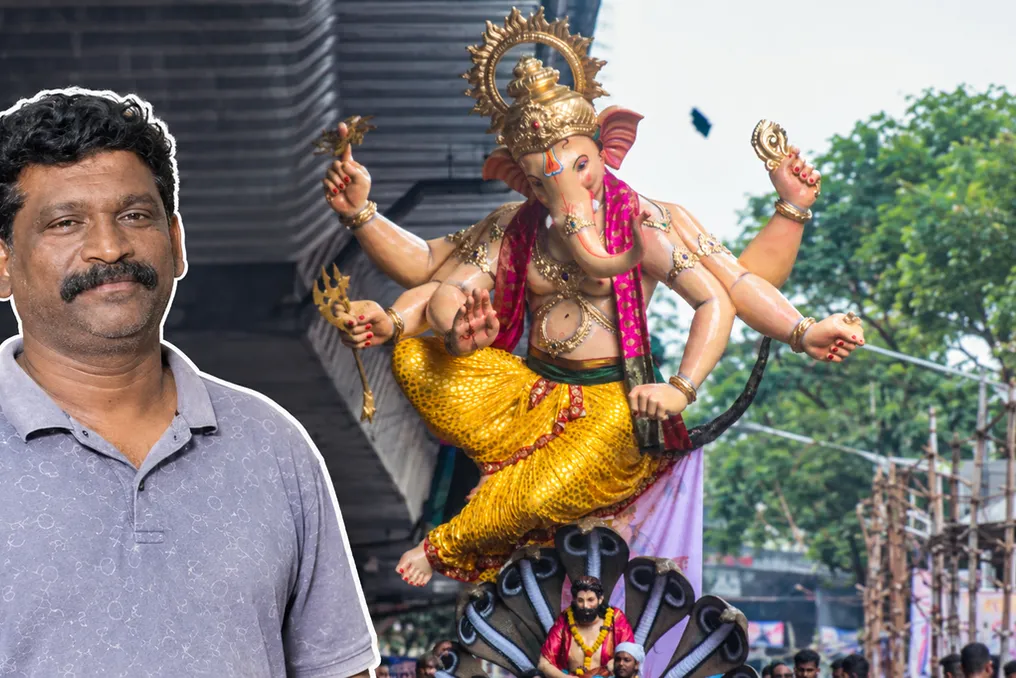
This year, the Bal Gopal Mitra mandal pushed the idea a step further. Their 25-foot Mumbaicha Peshwa was created using paper towels and paper pulp extracted after the immersion of the previous year's idol. The mandal now immerses its paper idol in an artificial reservoir, using exactly the amount of water needed for its decomposition. After the immersion is complete, the paper pulp is collected and stored for use the following year.
Over the past five years, their experiments have included banana fiber, alum, coconut fiber, vegetables, paper towels, and flowers. What started in 2008 as an attempt to find an alternative to plaster has gradually turned into a cycle of reuse. For the Maekars and their mandal, the festival now includes contemplating what happens after Visarjan, and what from one Ganesha can return to the next.