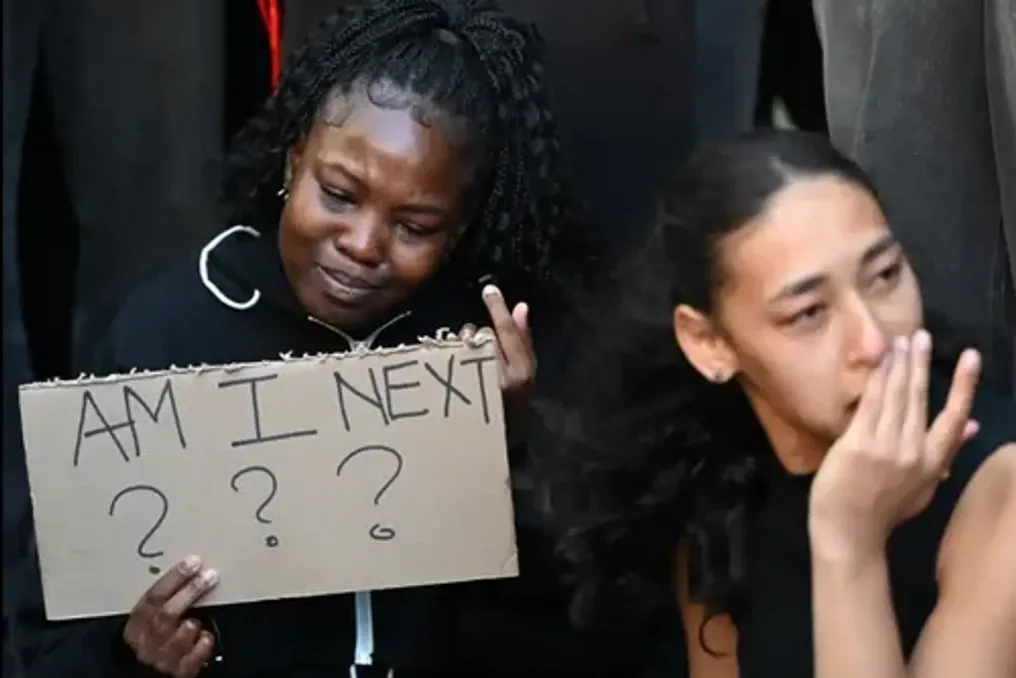
Modern South African society is characterized by the fact that being born a woman entails serious risks. Official data from the South African Police Service (SAPS) shows that in a full financial year covering April 2023 to March 2024, 5,578 cases of women's murders were registered. This corresponds to a horrifying statistic of 15 victims daily. Even looking at quarterly data, 569 women were killed between April and June, and another 1,052 women survived attempted murders.
The overall rate of women's murders in the country is about 24.6 per 100,000 people, which is approximately six times higher than the global average. Regarding intimate partner violence, this figure reaches 5.5 per 100,000 women, five times higher than the global average. These figures are not just statistics; they represent the lives of daughters, mothers, and sisters who have been brutally cut short, often by the very men who claimed to love them.
A System of Accumulated Failures
A deep analysis of this crisis shows that femicide is not a set of isolated crimes but a predictable result of a deeply compromised institutional structure. The South African state has repeatedly demonstrated a striking inability or unwillingness to protect its female citizens. The justice system functions more like a bureaucratic labyrinth designed to exhaust survivors and protect the guilty, rather than a shield.
The state's failures begin at the police station level. Due to a severe shortage of detectives and known, constant delays in DNA forensic laboratories, the police regularly make errors in investigations even before they reach court. Protection orders, which politicians present as a legal lifeline, are effectively powerless. As a result of systemic neglect, the process often requires the victim to independently find and deliver the document to the aggressor, turning legal protection into a pretext for deadly revenge.
When cases advance, the National Prosecuting Authority (NPA) often stumbles, undermined by poor case management and insufficient court funding. The reality is that men kill women in South Africa because they know they will get away with it. Impunity has become a norm woven into the very fabric of the legal infrastructure.
The Myth of Policy Reform
The government's response has historically been a showpiece of policy development. A National Strategic Programme on Gender-Based Violence and Femicide was adopted with significant political fanfare. Presidential addresses condemning the crisis took place. However, these initiatives remain severely underfunded and completely detached from everyday realities on the ground.
Creating laws is inexpensive, but enforcing them requires political courage and resource allocation that the administration is constantly unable to provide. Specialized courts remain scarce, and civil society organizations, which bear the burden of managing understaffed shelters and providing trauma counseling, are forced to plead for state subsidies. Criticism of the system cannot be softened: the South African government is complicit through its inertia.
A Global Call for Recognition
The international community can no longer stand idly by. For decades, global human rights campaigns focused on zones of active conflict, while women in South Africa face mortality rates comparable to real civil wars. This is a structural catastrophe requiring global awareness, diplomatic pressure, and international solidarity.
It is necessary to name this crisis what it is: a national emergency that the local government is utterly incapable of resolving. The world must pay attention to the blood spilled in South Africa. Until the state faces international condemnation and economic pressure related to its human rights compliance, the slaughter will continue unimpeded. South African women are tired of dying while the world watches in silence.