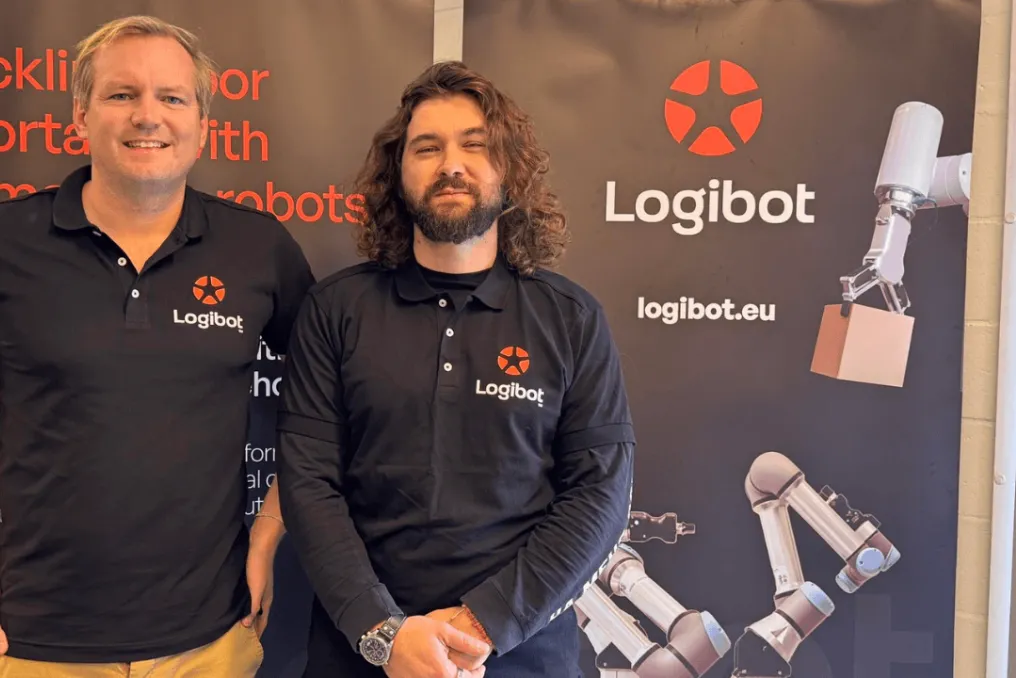
The Belgian software platform Logibot has successfully completed an early funding round, raising 1.4 million euros. These funds will be used to scale its hardware-agnostic level of automation designed for logistics robots.
The investment was led by Beam Berlin, a startup studio from the German family group BEUMER, with participation from RDY Ventures, PMV, and the BAN network of business angels.
European warehouses face significant challenges in filling physically demanding vacancies in remote locations. Furthermore, temporary staff cost 40% more than permanent employees, and high staff turnover increases operational costs due to the need for constant retraining. Approximately 2.5 million people across Europe still perform manual labor in logistics, such as parcel sorting and container movement.
Logibot offers a solution to this problem, allowing companies to implement simpler equipment tailored to specific tasks, eliminating the need for overly complex humanoid machines. The company's software covers the entire automation cycle: it analyzes workflows, tests performance in a digital twin, trains the machinery, integrates devices into existing workflows, and monitors them via remote teleoperation.
A key feature of the platform is its hardware-agnostic nature, which gives companies the freedom to choose and control approximately 95% of the robots available on the market without the risk of being tied to a single supplier.
The company's team consists of seven people. CEO Louis Verspruiven has 12 years of experience in international trade and logistics. Co-founder and CTO Salimjan Gafurov holds two doctorates in robotics and artificial intelligence. Previously, he managed 110 robotics engineers at a major e-commerce player and served as CTO at Verne, the first robot taxi company in Europe.
Early corporate clients include large logistics operators with staff ranging from 8,000 to 21,000 employees, as well as one of Northern Europe's largest postal groups, which is currently using a deployed device in Denmark.
Logibot plans to use the capital raised to launch initial commercial robot deployments and to establish a second division in Zellik, Flemish Brabant. By offering flexible, on-demand automation, the startup aims to provide warehouses with a scalable alternative that eliminates the need for large initial capital expenditures.