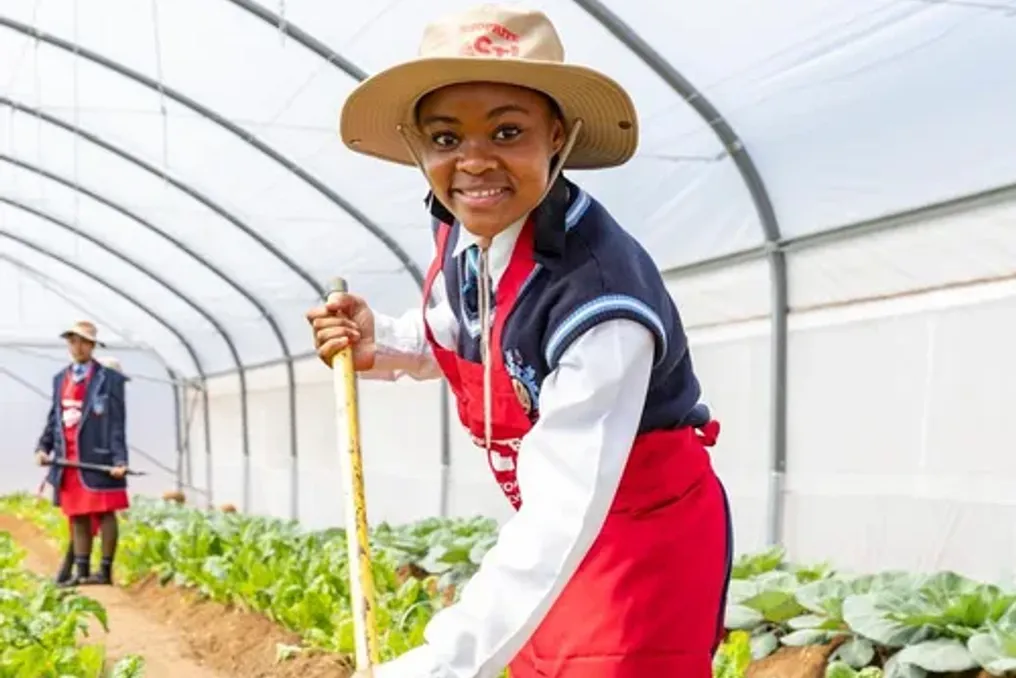
Two new greenhouse tunnels and a water borehole were officially opened at the Soshanguve Special Education School on Tuesday. These facilities will allow forty students to gain practical experience in food production.
The new tunnels will be used for practical lessons in subjects such as soil science, crop rotation, compost production, irrigation, as well as pest and weed control. This project is part of the school's efforts to equip students with practical skills applicable not only in the classroom but also for food production, further education, and potential income generation.
For the school itself, these tunnels represent an expansion of its practice-based learning approach. Previously, Soshanguve students designed and built the Modjaji solar train, which won an engineering category at the Gauteng Special Education Schools Festival. Now, the agricultural project provides another opportunity to transform theoretical knowledge into practical skills.
Principal Mashiane Tladi stated that the school plans to use some of the produce grown in the tunnels to supplement its feeding program and reduce food costs. Any surplus can be sold to the local community, and the resulting income will be reinvested in the school. Tladi emphasized that the goal is for students to view agriculture not just as a subject of study, but as knowledge that can be applied at home, in further education, or even for earning a living.
Agricultural training is also linked to adding an accredited plant production qualification to the CAPS curriculum. The project partner, MarketPlace Academy, will train teachers to run the program, while students will carry out the practical work directly in the tunnels.
The academy's CEO, Chantile Malder, noted that practical experience is a critical component of this qualification. She explained that although students are already studying agriculture at school, the accredited plant production qualification requires hands-on work. The tunnels provide them with a place to complete this work, allowing graduates to leave school with a certificate and recognized qualification that serves as a first step in the industry.
For participants in the pilot phase, this experience has already changed their perception of what is required to grow food. Zanga Mfafuli, a 16-year-old Grade 11 student who was in the first group, said that the project taught him that agriculture involves much more than just planting and watering. He noted that factors such as temperature, soil quality, lighting, pests, and water management play a significant role.
A new group of nine-grade students will now take over from the pilot participants, and the school will manage the tunnels daily. This initiative is supported by the Shoprite Foundation and follows the foundation's first greenhouse tunnel project at Oosrand Commercial and Entrepreneurship School. Over the past two years, approximately 5000 units of produce have been harvested at Oosrand, used for school feeding, and sold to the local community, and over 1700 students have undergone agricultural training.
Shoprite Foundation Director, Mauda Modise, stated that the project in Soshanguve aims to give more young people the opportunity to practice agriculture. She added that at Soshanguve Special Education School, they strive to give more youth the chance to experience agriculture firsthand. Modise specifically noted that students will receive not only theoretical agricultural education but also practical skills that will enable them to grow food for their own sustenance. The project is part of the foundation's broader skills development work in schools, which also includes an Artificial Intelligence, coding, and robotics Program covering over 8800 students across seven laboratories in five provinces.