Top Indian AI Teams Compete at Elastic and AWS's Forge the Future Hackathon Finale
Read more
YourStory [india, en]
yourstory.com

Top Indian AI Teams Compete at Elastic and AWS's Forge the Future Hackathon Finale

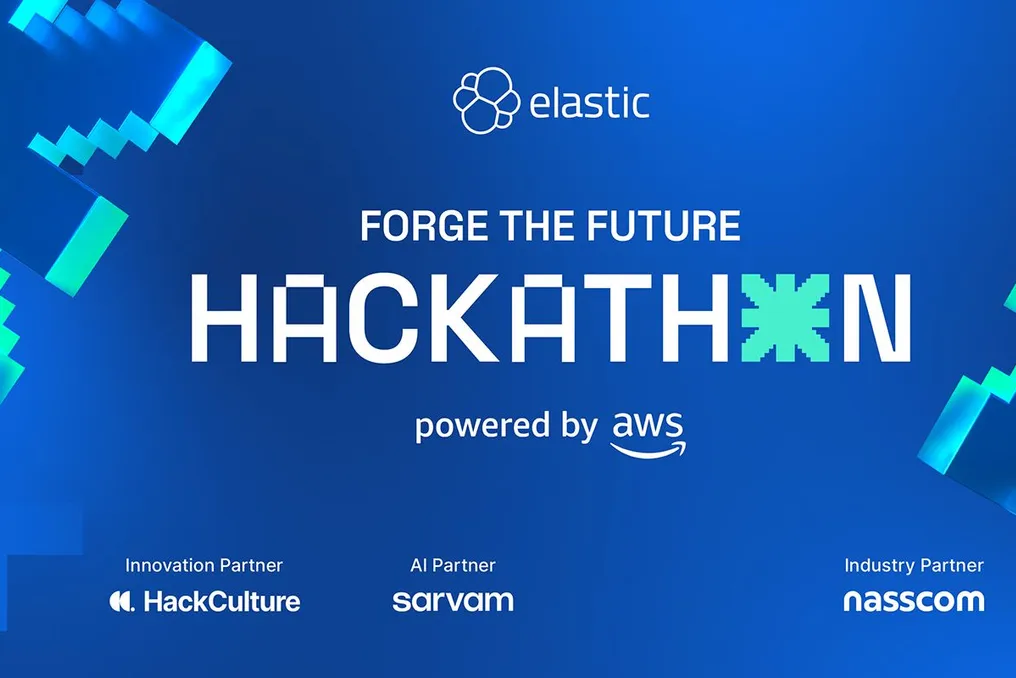
At the Forge the Future hackathon finale, organized by Elastic and supported by AWS, top AI developers from India are competing to build autonomous and explainable agents. The contest aims to develop solutions capable of solving real enterprise challenges in search, observability, and security, moving beyond simple demonstrations.

The competition is held with the participation of Nasscom, Sarvam AI, and HackCulture. Agents are tested based on measurable performance, reliability, and real impact, with the ultimate goal of creating a product worthy of presentation at the Elastic{ON} event in Mumbai and ready for industrial use. After registration, team formation, and idea submission, selected teams proceed to the Grand Finale.

Competition Structure

Forge the Future is divided into four thematic tracks, evaluated based on factual data rather than presentations. In the first track, dedicated to intelligent search and AI platforms, teams had to create an AI experience capable of independently determining where and how to analyze information. This included developing hybrid search systems comparable to pure vector databases, as well as RAG agents for document analysis in the BFSI sectors and multi-stage Agent Builder workflows for sorting support requests.

The second track, focused on observability and autonomous operations, required transforming signals into actionable insights and incidents into actions. Tasks involved comparing the performance of ES|QL queries against LogQL and PromQL, as well as creating agents that can detect anomalies, correlate traces, and suggest troubleshooting methods.

The third track concerned AI-powered security and Security Operations Centers (SOCs). Teams were asked to reimagine security operations for the AI era, addressing issues related to AI-driven SOC workflows, fraud detection in BFSI, CERT-In compliance agents, and large-scale threat hunting using ES|QL.

The fourth track, dedicated to industry solutions and vertical capabilities, asked participants to create solutions for risk management in BFSI, e-commerce and retail analytics, as well as for healthcare and insurance. All these solutions had to be based on real data and ensure explainability and auditability.

Each team worked on the Elasticsearch Platform, which ran on the AWS cloud infrastructure—the same stack upon which their solutions would be built and evaluated. The registration and team formation process ran from July 18 to August 21, with idea submissions accepted during the same period. Selected teams, announced on August 26, will now head to the in-person Grand Finale in Bengaluru, scheduled for September 18–19.

During these two days, teams will develop, refine, and present their solutions to Elastic and AWS experts, turning weeks of preparation into a live demonstration before technology leaders. The total prize pool amounts to 600,000 rupees. The winning team will receive 300,000 rupees plus 75,000 Sarvam credits, the second team will receive 200,000 rupees and 50,000 Sarvam credits, and the third team will be awarded 150,000 rupees and 25,000 Sarvam credits.

In addition to monetary prizes, the top three teams will gain broader exposure: the opportunity to demonstrate their developments to technology executives, industry experts, and the wider Elastic community.

Partners and Future Events

Elastic acts as the organizer and technology partner, providing its expertise in search, observability, security, and generative AI. AWS serves as the cloud partner, ensuring secure and scalable infrastructure for all solutions. Nasscom AI, representing the Indian AI ecosystem, is the industry partner facilitating reliable AI adoption, while Sarvam AI, an Indian company creating multilingual foundation models, acts as the AI partner. HackCulture, a global innovation platform, is responsible for running the program from start to finish.

The Forge the Future hackathon does not end with the Grand Finale in Bengaluru. Approximately two weeks later, on September 30, Elastic will host the Elastic{ON} event in Mumbai at the JW Marriott Mumbai Sahar as part of the global Elastic{ON} 2026/2027 tour. This one-day event themed 'Forge the Future' will gather developers, SREs, IT leaders, and security specialists to explore how enterprise data can power agentic AI in search, observability, and security.

The top three teams from the Forge the Future hackathon in Bengaluru will bring their winning solutions to Mumbai, presenting them to the wider Elastic community, technology leaders, and industry experts at Elastic{ON}. For these developers, the Grand Finale is not just the conclusion of a contest but a direct path to the stage where their production-ready AI agent work will be seen by those shaping the future of enterprise AI in India.
Similar stories

Indian team of 70 participants will compete in WorldSkills championships, covering fields from jewelry to robotics
Read more
timesofindia.indiatimes.com

Indian team of 70 participants will compete in WorldSkills championships, covering fields from jewelry to robotics

India will send a team of 70 people to the 'Olympic Games of Skills' in Shanghai, representing an unusually diverse composition. Among the participants are a jewelry apprentice with an eighth-grade education, an eleventh-grade florist, a farmer's son trained in refrigeration equipment, as well as young specialists in robotics, cybersecurity, and Industry 4.0.

At the WorldSkills 2026 championship, which will take place from September 22 to 27, India will participate in 63 skill categories. The delegation includes students, pupils, and young professionals trained in both traditional crafts and new technologies. Furthermore, the composition remains predominantly male, as only 14 out of 70 participants are women.

Karnataka has the largest representation with sixteen contestants, followed by Odisha with thirteen and Tamil Nadu with twelve. Maharashtra will field five participants, while Bihar, Haryana, Telangana, and Gujarat will each present three.

Among those traveling to Shanghai is Md Dilkhush from Bihar, whose father is a farmer. He received training in refrigeration and air conditioning equipment, becoming a national champion in IndiaSkills, and will compete in installation, maintenance, troubleshooting, and energy-efficient cooling systems.

Joy Das from Tamil Nadu, the son of a fisherman, completed the eighth grade and mastered jewelry making, winning gold medals at the state and national levels. Laumnakima from Mizoram, an eleventh-grade student, will compete in floristry, and Prakash Sutar from Gujarat continued his father's path as a carpenter in carpentry.

The delegation also demonstrates how professional trajectories are increasingly intersecting with family and educational backgrounds. Anuja Ware from Karnataka, whose parents are doctors, will participate in visual merchandising. She previously created an exhibition space for Bharat Tex, visited by Prime Minister Narendra Modi, and won gold at regional and national skills competitions.

Mehrunissa Begum from Telangana has progressed from an apprenticeship in logistics and expedition to winning gold medals at the state, regional, and national levels. A daughter of a bakery owner and homemaker, she spoke about overcoming anxiety and feelings of depression during competitions.

Smriti Nambiar from Karnataka, a baker contestant who studied at IHM Pusa, was recognized as a student all-rounder and rising culinary talent of the institute for two consecutive years. Krishnanjali Sahu from Odisha will represent the country in confectionery arts, and Jansirani Raut competes in restaurant service.

The team also includes a strong component of 'green skills'. Vishnu Prajapat from Rajasthan, whose father is an electrician, will participate in renewable energy after gaining practical experience in solar installations and familiarizing himself with wind turbines. Rushikesh Pitambaram will represent India in water supply.

On the technological front, the Indian delegation will participate in competitions on autonomous mobile robotics, cloud computing, cybersecurity, software testing, unmanned aerial vehicles, optoelectronics, and integration of robotic systems. Mobile application developer Arjun Vidjabaskar started coding at the age of 12, while the Industry 4.0 participant Sukhan Maskeranhas is the son of two employees of the ISRO Control Centre in Hassan.

Harsh Pawar from Maharashtra, whose father works as a quality supervisor at a cylinder manufacturing plant, will compete in 3D digital game art. Pawar has already won silver at the Global Skills Competition in Australia. Two-person teams will represent India in areas such as autonomous mobile robotics, mechatronics, landscape design, concrete construction, and integration of robotic systems.

The forty-eighth edition of the event will begin on September 22, with competitions held from September 23 to 26 and the closing ceremony on September 27. Participants will perform tasks corresponding to industry standards under the close observation of international experts. The event will also serve as a platform for conferences and industry exhibitions dedicated to technical education, workforce development, and sustainable technologies.

India aims to improve its results from WorldSkills Lyon 2024, where the country won four bronze medals and 12 distinction medals.

Sarvam Co-founder States India Will Lead AI Adoption and Scaling Over the Next Decade
Read more
business-standard.com

Sarvam Co-founder States India Will Lead AI Adoption and Scaling Over the Next Decade

Sarvam co-founder Prateek Kumar stated that India will become a leader in artificial intelligence (AI) over the next ten years. He emphasized that the financial sector will play a key role in stimulating demand and adoption of this technology.

Speaking at the Global Fintech Fest 2026, Kumar noted that although four years have passed since the launch of ChatGPT, this is the first year for India to create its own AI models. He predicts that India will take leading positions in terms of scale and speed of AI adoption in the coming decade.

Furthermore, Kumar added that the country will not only implement AI in large volumes but will do so at prices accessible to a billion users. He pointed out that India currently possesses its own AI models, has access to GPUs, and has a growing talent pool.

He also reported a significant increase in the number of AI use cases in India. Citing examples of Sarvam's work in building an advanced AI model from scratch, Kumar mentioned that the company processed 350 million minutes of voice AI over the last 12 months. Today, Sarvam serves 400 million requests daily via API and has digitized tens of millions of documents.

Prateek Kumar also highlighted the necessity of building data centers and token factories in India that are not subject to US Patriot Act laws. In his view, this will give companies better control over the AI stack and data.

Sarvam has established itself as a significant developer of cutting-edge AI models from India. Recently, Sarvam attracted investments ranging from $300 to $350 million and achieved unicorn status. Additionally, IT company HCLTech invested approximately $234 million in Sarvam.

Microsoft research shows Indian employees are leading the definition of the future of work with AI
Read more
yourstory.com

Microsoft research shows Indian employees are leading the definition of the future of work with AI

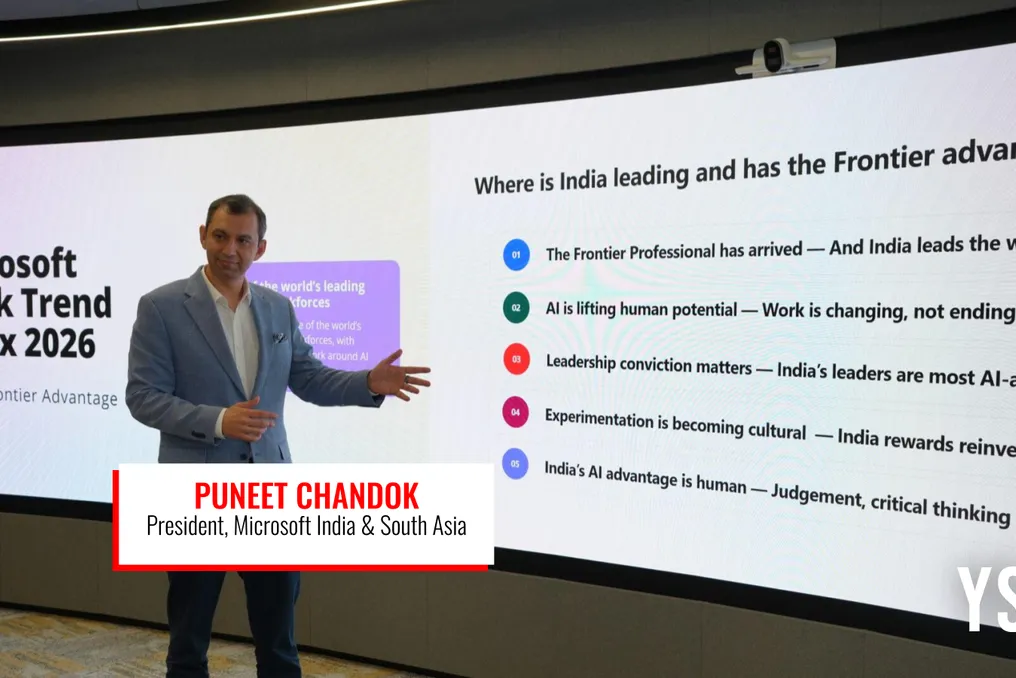
According to the Microsoft 2026 Work Trend Index, which focuses on the state of artificial intelligence in the workplace, India has become a global leader in workforce transformation.

New research from Microsoft, presented in Bengaluru on Thursday, demonstrates that specialists in Indian offices are moving beyond performing basic AI tasks to managing complex automated workflows. This transformation is changing daily employee activities, shifting them from routine work to high-level supervision.

Nearly a third of Indian specialists surveyed qualify as 'frontier professionals.' These professionals actively develop and control multi-stage systems using AI agents, balancing automation with strong human judgment.

The study covered 20,000 AI users across 10 markets and shows that India possesses one of the world's largest frontier workforces. Instead of letting technology replace them, these professionals are directing it to unlock new opportunities.

In India, 32% of AI users are frontier professionals, double the global average of 16% and the highest among the markets studied. Furthermore, almost 8 out of 10 Indian users claim that AI tools enable them to perform work that was impossible 12 months ago, compared to nearly 6 out of 10 globally; this figure reaches 85% among frontier professionals.

Puneet Chandok, President of Microsoft in India and South Asia, noted: 'One in three Indian AI users works with agents on multi-stage, real-world tasks. Globally, this is one in six. This is not lagging behind; this is leadership.'

This represents a huge leap from 2025, when business leaders merely expressed intentions to create human and agent teams on a large scale. Now, this aspiration has materialized, giving rise to new types of high-value work.

Despite the rapid adoption of highly automated systems, the results show that Indian workers refuse to delegate final responsibility. The study emphasizes that as automation becomes more complex, human judgment becomes more valuable, not less.

Indian AI users lead the world in prioritizing quality control of automated outputs. Nearly two-thirds consider evaluating AI-generated work a critical skill, compared to half globally. Moreover, 59% of Indian specialists place high importance on critical thinking, significantly higher than the global average of 46%.

Crucially, almost 9 out of 10 respondents in India state that they retain full responsibility for thinking, viewing system-generated material only as a starting point.

More than 4 out of 10 Indian workers feel that their company leadership has a clear and unified plan for using AI, nearly double the global average.

Managers are actively involved in AI adoption: both frontline managers (91%) and non-frontline managers (81%) use this technology. Frontline managers redesign team workflows to incorporate AI agents and automation. Meanwhile, non-frontline managers mainly adhere to traditional management methods and adopt/support AI, but with less intensity than frontline managers.

All of this is supported by a corporate culture that encourages rethinking. One in four Indian organizations rewards employees for rethinking workflows without immediate commercial returns, compared to only one in eight globally.

Scaling in large, complex operations is the ultimate test of AI implementation. In India, major IT companies are demonstrating how to transition from small-scale pilot projects to full enterprise transformation. In less than six months, Infosys, TCS, Wipro, and LTIMindtree jointly licensed over 4 lakh seats of Microsoft 365 Copilot, a generative assistant integrated into daily work applications.

Infosys is expanding its Copilot adoption to over 1 lakh employees, achieving a monthly active usage rate of 91% in delivery, engineering, and corporate departments. This figure reflects the proportion of licensed users who regularly interact with the tool, proving that it has become an indispensable work tool.

Speaking at an event in Bengaluru, Balakrishna D. R., Vice President of Execution and Head of Global AI Services and Industry Verticals at Infosys, noted: 'Building a frontier enterprise requires more than just technology. Organizations that achieve sustainable value from AI are those that combine leadership alignment, workforce readiness, management, and intelligence embedded in all business processes.'

AI deployments are bringing measurable productivity gains in Indian enterprises. At TCS, nearly 9 out of 10 licensed employees use this technology daily. TCS reports a productivity increase of 20–25% in research and content creation, as well as a reduction in process cycle time by 25–35%, which is the total time spent completing a business process.

Monthly active usage at Wipro exceeds 95%, saving an average of 250,000 full equivalent days per quarter, where each day represents one employee's workday. The company has also democratized agent creation, allowing employees to build over 29,000 custom user agents, alongside 60 enterprise-level solutions. Wipro and Persistent Systems have launched large-scale training programs to ensure all their personnel are fully prepared for AI adoption.

Popular