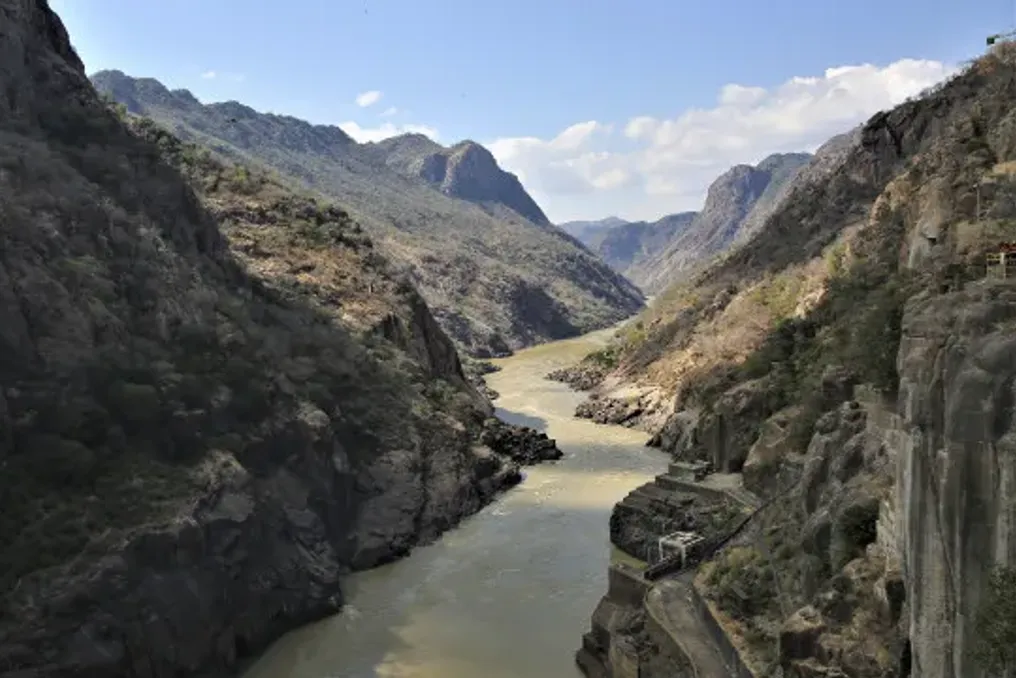
HCB announced that the mid-bed discharge of the Mozambican dam will reopen on the 20th of this month, operating at 80%. This action is described as a punctual, controlled, and technically approved maneuver that does not alter the hydroelectric plant's prudent water management policy, even considering projections for the next rainy season.
This procedure was implemented following the total shutdown of the Songo substation and aligns with current environmental requirements, as part of the annual maintenance program for the energy production complex. The main objective is to ensure compensation for the ecological flow of the Zambezi River.
The reopening of the discharge will guarantee the maintenance of continuous flow along the Zambezi River, which aids in preserving the ecological flow and essential conditions for ecosystem balance and the activities of riverside communities.
HCB clarifies that this operation follows protocols for careful management of the water resources of the Cahora Bassa reservoir, taking into account current operational conditions, as well as future hydrological and climatic forecasts, including scenarios related to the El Niño phenomenon.
In a broader context, Lusa reported that electricity generation in Mozambique increased by 8.8% in the first half, reaching 8.06 million megawatt-hours (MWh). This growth was driven by the recovery of hydropower generation, after periods of unfavorable hydrological conditions in 2025.
According to government data for the first half, total electricity production in the country reached 8,061,261 MWh, corresponding to 49.9% of the annual target set at 16.17 million MWh. Comparatively, in the same period of 2025, production was 7.41 million MWh.
This recovery was predominantly sustained by the water sector, which registered a growth of 12.2%, totaling 6,554,547 MWh, benefiting from better inflow conditions and greater operational availability of generation structures. The report indicates that the improvement in inflows allowed for a partial recovery of production levels seen in previous years.
Hydroelectric plants were responsible for 81.3% of all electricity generated in the country during the semester, highlighting the national system's strong dependence on water resources.
HCB, located in the province of Tete, in the center of the country, maintained a crucial role in this sector, generating 6.37 million MWh between January and June, which represents approximately 80% of all electricity produced in Mozambique.
The company manages, under a concession regime, the hydroelectric exploitation of Cahora Bassa, considered one of the largest energy facilities in Africa. The project includes the South Power Station, already operational with an installed capacity of 2,075 megawatts (MW), and a planned North Power Station, with potential to add up to 1,200 MW, in addition to the Songo converter substation and its transport infrastructure. There are also plans for a solar power plant in the hydroelectric exploitation area.
HCB holds a majority stake of 85% in the Zambezi Electric Company (CEZA), with 7.5% belonging to REN (Portuguese), 4% to Mozambican investors, and 3.5% corresponding to own shares.
The Cahora Bassa reservoir is the fourth largest in Africa, featuring a maximum length of 270 kilometers, a width of 30 kilometers between banks, covering an area of 2,700 square kilometers, and having an average depth of 26 meters.