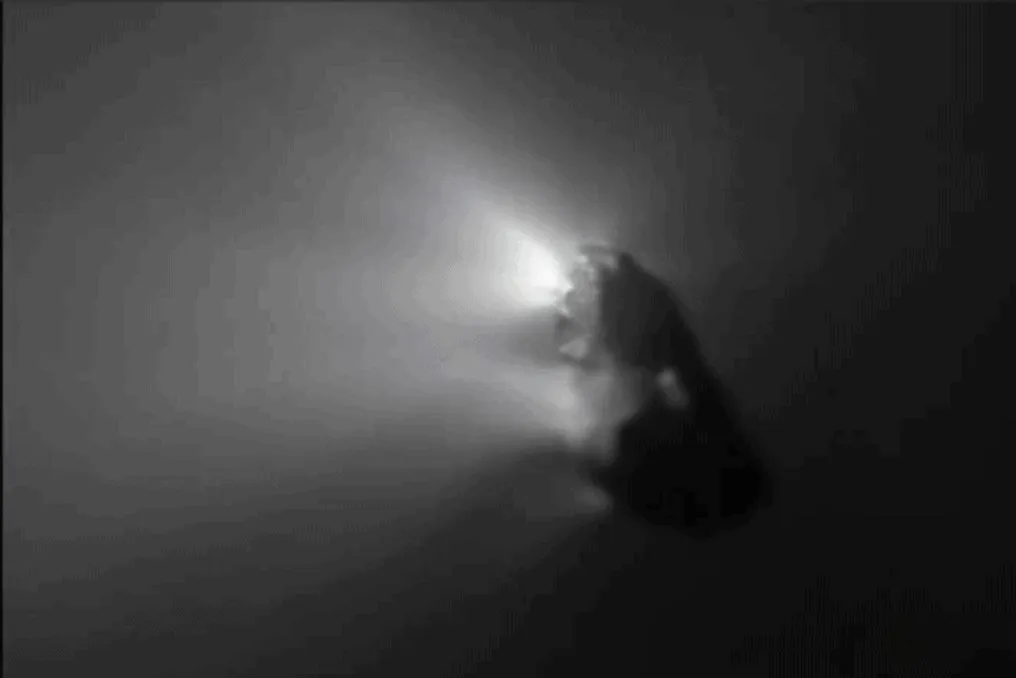
There is a proposal for a mission whose goal is to reach Halley's Comet and accompany it during its next solar passage. Halley's Comet does not approach Earth frequently; its next visit to the solar system is scheduled for 2061. The proposed mission aims to achieve what the probes that visited it in 1986 could not—namely, observing the comet over an extended period.
The main difficulty lies not just in reaching Halley (which is difficult in itself), but in the ability to track its movement. The comet's orbit is retrograde, meaning it moves in the direction opposite to the movement of most planets in the solar system, and has an inclination of about 162 degrees, which significantly complicates placing a spacecraft on the same trajectory and speed as the object.
Researchers from Khalifa University and their colleagues have presented a possible solution. Instead of relying on a single gravitational maneuver, the proposal combines flybys of Jupiter and Saturn using a low-thrust propulsion system. The calculated launch windows are August 2036 and September 2037.
Halley's orbital characteristics explain the difficulty of observing the comet. When the comet was studied in detail in 1986, various spacecraft made flybys, including the European Space Agency's 'Giotto' and Soviet 'Vega' probes. Since the trajectories of these probes did not allow them to follow the comet, observations were limited to a few hours.
The new proposal is based precisely on this limitation. The goal is not just to cross Halley's path, but to reach it along a trajectory that allows staying close while the object approaches the Sun. This is important because the comet's activity changes as it receives more heat. A mission remaining nearby at this stage could record these changes.
Studies of comet exploration missions also demonstrate how different observations can be used to study characteristics such as composition, shape, and interaction with space travel factors. To reach Halley, the spacecraft will not fly directly to it. The idea is to use the gravity of Jupiter and Saturn to assist in changing the trajectory during the flight.
The spacecraft will weigh about 2 thousand kilograms, including instruments and fuel, and will use a type of engine called a Hall effect thruster. It does not provide a large impulse immediately but gradually accelerates the spacecraft over a long period. The first important planet on the way will be Jupiter. By flying past it, the craft uses the planet's gravitational force to gain speed and be directed toward Saturn.
A further significant change will occur at Saturn. The gravity of this planet will help tilt the spacecraft's trajectory, making its path more similar to Halley's. This is necessary because the comet follows a very inclined orbit relative to the orbits of the planets. Thus, Jupiter will help the craft gain speed, and Saturn will change its trajectory direction. Thanks to these two maneuvers and continuous engine acceleration, the proposal suggests that the spacecraft could reach Halley in 2060, about a year before the comet reaches its closest point to the Sun.
Reaching Halley before its maximum solar approach would allow observation of an important phase of the comet's journey. The craft would arrive when the comet is still beyond Mars' orbit and could observe it as the Sun's heat increases the activity of its nucleus. However, at present, all of this remains only a mission concept described in the paper, not an approved space project. If advanced, the mission may have two possible windows: August 2036 or September 2037.