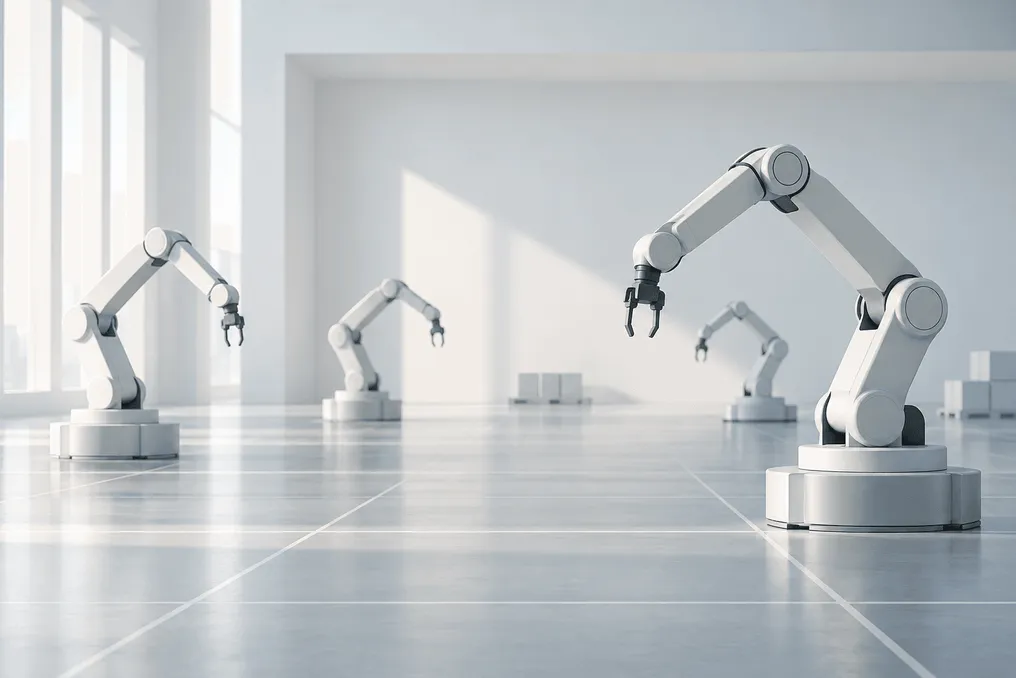
The Chinese industrial robot market is ceasing to be exclusively a competitive showcase featuring Fanuc, ABB, Yaskawa, and Kuka. According to data collected by MIR DATABANK and reflected in Estun's materials, the share of domestic brands in total sales volume is projected to reach approximately 55% by 2025, significantly higher than the less than 30% recorded in 2020. Meanwhile, the traditional 'big four' maintain a substantial global installed base and remain strong in the premium automotive and semiconductor segments.
Estun's report on 2025 shipments recorded about 33,400 units of industrial robots, accounting for roughly 10% of the market, and the company announced achieving the first leading sales volume among all brands in China. Inovance secured the position of the leading domestic competitor with an overall share of about 9.2%, while capturing approximately 25% of the SCARA segment, leveraging its advantage in universal servo drive production.
Both companies are actively developing vertical integrations: Estun is expanding its presence from motion controllers and servo drives to the robots and workstations themselves; Inovance is focusing on integrating servo drives and control systems into SCARA robots, six-axis manipulators, and machine vision systems. This shift is supported by component localization, as data from GGII shows a sharp rise in the share of domestic reducers and servo drives through 2024.
Nevertheless, there are noticeable capability gaps. Domestic manufacturers are already demonstrating a dominant local share in collaborative robots, welding robots, palletizing robots, and light six-axis models, achieving static repeatability of around ±0.02–0.03 mm on some mid-range manipulators. However, in full-cycle automotive production shops and when working with advanced semiconductor tools, proven process packages from Fanuc, ABB, and Kuka are still utilized.
Software suites for offline programming, such as ROBOGUIDE, RobotStudio, and KUKA.Sim, contain decades of application libraries; switching brands necessitates migrating accumulated software, process experience, and engineer habits, not just replacing the manipulator itself. Thus, structural analysis indicates that product and software depth is more critical than financial performance. Domestic suppliers are successfully conquering new areas in lithium-ion battery, photovoltaic cell, 3C, and economically sensitive cell manufacturing, whereas high-tech software for the automotive and semiconductor industries remains a slower area of development. Estun's initial orders for spot welding in body shops signal a potential breakthrough in this field, and overcoming this barrier will depend on process packages and simulation systems as much as on the number of axes or price.