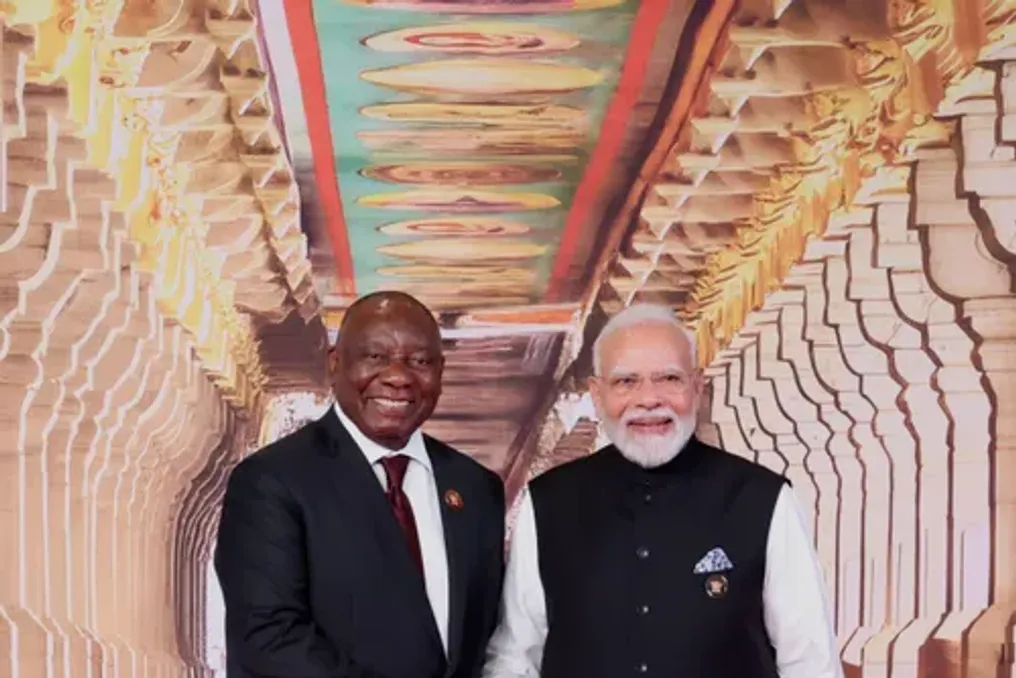
During a business roundtable between representatives of South Africa and India, held in New Delhi on the sidelines of the 18th BRICS Leaders' Summit, President Cyril Ramaphosa stated that political dialogue must transform into commercially viable projects and long-term private sector partnerships.
Ramaphosa strongly urged India and South Africa to begin a 'new era' in economic relations, asserting that both countries have a rare opportunity to deepen investments, trade, industrial development, and sustainable growth while BRICS is reviewing the rules of the global economy.
At the meeting in the Indian capital, BRICS leaders gathered against a backdrop of tense international circumstances, including the protracted conflict between the US and Iran, as well as the ongoing war in Ukraine. After India's term ends, China will take over the chairmanship of BRICS.
Ramaphosa viewed this period as a structural change, not routine diplomacy, emphasizing that BRICS is moving beyond merely reacting to existing global economic rules and is beginning to create them. He noted that emerging markets now play a key role in global growth, and therefore South Africa and India should view their complementary strengths as a shared asset rather than separate, unconnected narratives.
This thesis was supported by Ramaphosa's personal experience. During his visit to New Delhi, as a guest of the Indian Ministry of External Affairs, he observed ordinary purchases being paid for in rupees without the need for a third currency. Ramaphosa later informed Prime Minister Narendra Modi that when purchasing books in Delhi and paying in rupees, the transaction successfully completed in rand, and 'there were no problems.'
Discussions within BRICS covered trade in local currencies, experiments with cross-border payments, and consultations between central banks, ensuring that commercial activities between partners are not dependent on the permissions of third countries. This is where the rewriting of rules becomes concrete: it manifests in the ability to conduct settlements without the permission of a third country.
Ramaphosa highlighted six areas for cooperation. The first is the transition to energy and green industrialization. Both countries aim to move away from carbon-based systems, focusing on renewable energy, green hydrogen, critical minerals, battery value chains, and sustainable production. He mentioned that Indian groups such as Vedanta are already operating in South Africa.
The second area is mining, critical minerals, and processing. It is argued that South Africa's mineral reserves and India's manufacturing capabilities are perfectly suited to complement each other in new energy chains. Pretoria's policy is to increase mineral processing at the point of extraction, rather than exporting raw ore.
The third pillar is infrastructure and connectivity. To boost African trade, investment is needed in transport, logistics, ports, digital networks, smart cities, and industrial corridors. South Africa has identified 195 strategic integrated projects worth over $100 billion, including roads, railway corridors, renewable power plants, and hospitals. Ramaphosa called on Indian companies to consider partnering in these projects.
The fourth area is agriculture, which remains the basis of employment and food security in both countries. Potential for cooperation in agro-processing, agritechnologies, and sustainable practices was discussed.
The fifth point was the digital economy and innovation, covering fintech, digital trade, artificial intelligence, and cybersecurity. An example cited was Atain, an Indian firm that opened a new branch in Cape Town.
The sixth aspect concerned people and institutions. Ramaphosa stressed that the success of a partnership is measured by achieved influence, not signed agreements. He also noted that South Africa is undertaking internal reforms, opening up energy, telecommunications, and logistics for greater competition.
Currently, trade relations are significant: India is one of South Africa's largest trading partners, and over 150 Indian companies have invested more than $10 billion in South Africa.
The realization of a 'new era' will depend on subsequent actions: whether projects go to tender, whether processing remains within South Africa, and how commonplace transactions in rupees and rand become.