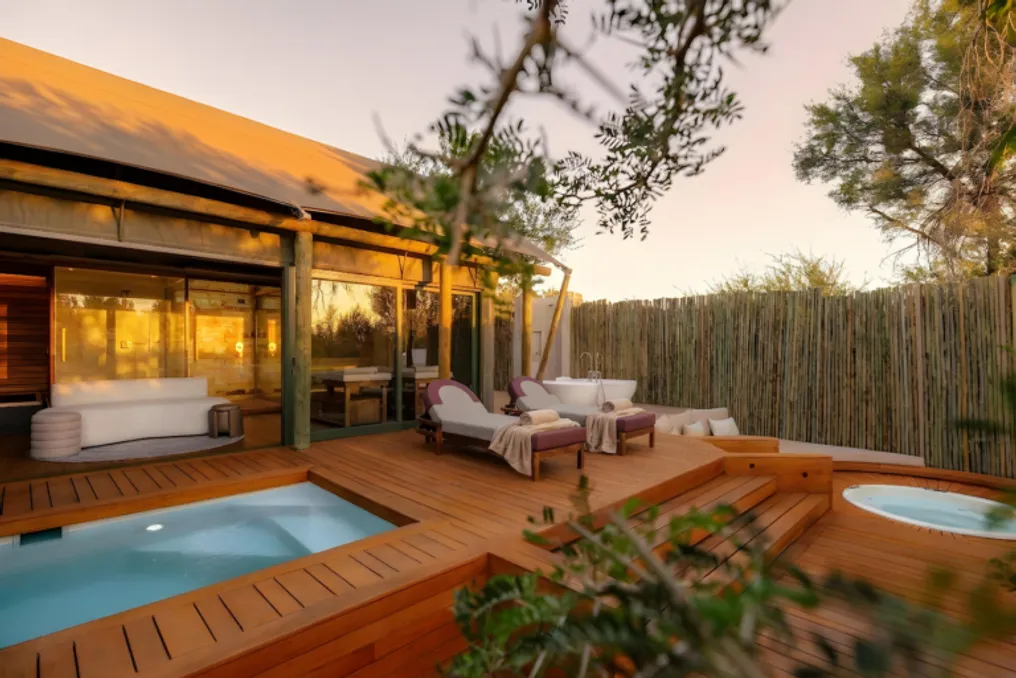
Kuganha offers luxurious wellness safari retreat in Karoo, where the tent functions as a spa center
Read more
Getaway
getaway.co.za

Kuganha offers luxurious wellness safari retreat in Karoo, where the tent functions as a spa center

Kuganha presents a new elite wellness safari complex located in the Western Cape. It allows guests to enjoy the Big Five, the vast landscapes of the Karoo, and an exceptional spa experience without leaving their private tented luxury apartments.

The complex is situated on a 10,000-hectare conservation area inhabited by Big Five animals and is less than an hour and a half's drive from Cape Town. Kuganha differs from traditional safari lodges because the wellness facilities are integrated directly into the tent, rather than being located in a separate building.

Each of the ten private tented luxury apartments spans at least 320 square meters, making them among the largest single private tented safari suites in Africa. The concept is unique because each suite is equipped with a sauna, steam room, cold plunge pool, salt halotherapy chamber, and a flotation pool.

Furthermore, every room features two massage tables, a relaxation area, an outdoor shower, double soaking tubs, a private plunge pool, and a jacuzzi, all opening onto a spacious private terrace. Thanks to this setup, guests do not need to plan their entire day around visiting the spa; they can freely move between heat, cold, steam, water, massage, and relaxation modes right in their personal space.

Upon arrival, guests undergo an introductory wellness ritual in the suite, which begins with immersion in cold water, followed by sessions in the sauna, salt halotherapy, and steam shower. Flotation therapy can be done later, whenever desired.

The main idea is not to follow a strict wellness schedule but to have the freedom to determine what brings pleasure. Kuganha's spa rituals include a wide range of services: from deep tissue and relaxation massages to Rungu and salt stone massages, as well as facials and scalp treatments, scrubs, wraps, manicures, and pedicures.

For a deeper immersion, signature programs such as 'Skin Hydrating Journey', 'Body Recovery Journey', and 'Restoration Journey' are offered. The latter combines specialized Rungu massage movements with sensory deprivation during swimming, creating an experience aimed at physical release and deep tranquility.

It is important to note that the wellness services are part of Kuganha's all-inclusive package. Guests have unlimited access to the private amenities in the suite during their stay, and treatments and rituals can be arranged according to their own schedule, subject to availability.

However, wellness is only one component of the offering. Kuganha is located on land that has undergone an extensive nature conservation and restoration program, including the rehabilitation of local vegetation and the reintroduction of wildlife. The owners discovered a connection between landscape restoration and humanity's need for self-restoration.

This philosophy extends to the kitchen: Kuganha's gastronomic offering is based on fresh, organic, sustainable, and local produce. Meals can be taken in privacy in the suite or in the restaurant overlooking the watering hole and infinity pool.

In addition to the tent, guests can enjoy the wild safari, the endless Karoo sky, and the silence provided by the surrounding thousands of hectares of restored wilderness. Kuganha was recently named by Robb Report as one of the 50 greatest luxury hotels in the world in 2026, cementing its niche as a luxury wellness safari.

Perhaps this is what makes the concept so appealing: here, you don't have to chase relaxation. You just have to arrive, close the door, and let the outside world recede.
Similar stories

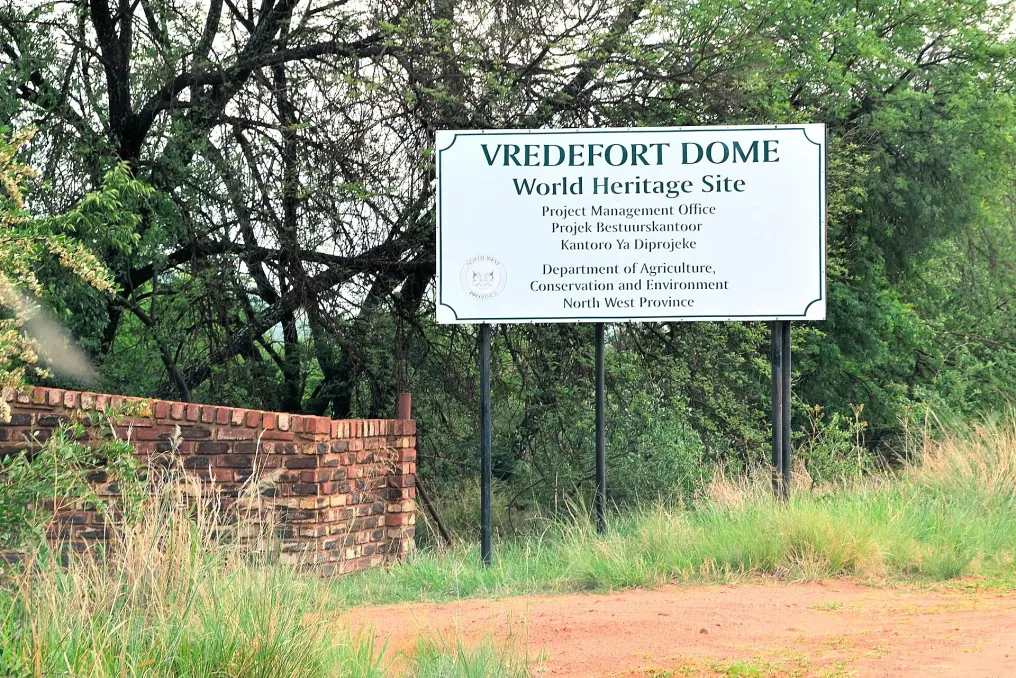
What to do in the Vredefort Dome area besides studying the impact crater
Read more
getaway.co.za

What to do in the Vredefort Dome area besides studying the impact crater

Approximately 2.023 billion years ago, an object from space collided with the Earth's surface with such force that it created the oldest and largest known impact structure on the planet. Today, the giant crater, which would have been suitable for photography, no longer exists; time, erosion, and geology have naturally altered this landscape.

Instead, visitors find a landscape composed of grasslands, river valleys, and farms traversed by the Vaal River. Although the crater itself is the main attraction, Vredefort is a combination of many factors that make it one of South Africa's most unusual corners.

Although the impact may have occurred long before we became part of this history, the modern landscape has undergone significant erosion. This erosion has allowed scientists to study what happened beneath the massive impact structure, exposing deep crustal rocks.

UNESCO notes that rocks representing over 3.2 billion years of geological history are exposed here. Furthermore, there are so-called 'fracture cones' formed by shockwaves from the colossal collision, which led to the appearance of cone-shaped structures in the rock. These structures, along with fractured rocks, folds, and other geological features, are evidence of the Dome's scientific significance.

For those planning a trip, it is recommended to include a geology tour during the weekend. The Dome Conservatory offers tours of the geological and cultural heritage, and local specialists organize hikes and trips around the impact structure itself.

The Vredefort Dome has various hiking routes that take visitors through geological formations, rocky landscapes, and river areas. Among the routes listed by the Dome Conservatory are the moderate Dome Trail, a river cruise along the Vaal River, and the Rooihaas trail near Venterskrone.

For those looking for more than just a leisurely walk, local guides can arrange half-day, full-day, or even overnight excursions. Here, you are not just walking through a crater, but through a landscape shaped by an impact that predates dinosaurs, mammals, and, remarkably, ourselves.

The Vaal River flows through the Dome, offering a new way to experience Vredefort. Depending on the chosen experience and conditions, options for canoeing, swimming, and rafting are available. The Dome Drift route includes sections with light rapids and longer calm pools, while other stretches of the river are quieter.

On land, you see stones below and ridges above, while on the river, the landscape unfolds gently around you. Hills become part of a wider vista, and suddenly the scientific grandeur of the place confronts something much simpler—water flowing across the South African landscape. For thrill-seekers, rafting adds adrenaline, while calm boating or swimming allows the river to do what it does best.

People inhabited this region thousands of years ago, and the Dome holds evidence of human history. The Dome Conservatory identifies Stone Age stone tools, San rock art, and remnants of 19th-century gold mining settlements among the region's cultural heritage.

Publications of the National Museum document engraved stones in the Dome attributed to various periods of San rock art tradition. Venterskrone is a small historical settlement that emerged around the gold discoveries in the late 19th century after a gold-bearing conglomerate was found in the area in 1887. The subsequent mining on the Vaal River attracted prospectors, entrepreneurs, and led to the establishment of settlements in this landscape.

The Dome is not only ancient, but layered: first came the collision, then geological processes, followed by humans, movement, mineral extraction, and finally, the extraordinary landscape that became home to people.

If the Dome appeals to your inner researcher, Paris might appeal to the collector. Located on the banks of the Vaal River, Paris has developed a strong identity linked to art, antiques, and lifestyle. Its streets are lined with galleries, antique shops, cafes, restaurants, and small businesses, making it an ideal place where a quick coffee can easily turn into a long day of wandering.

Paris complements a weekend in Vredefort well, as it brings a human scale to the experience. After long reflections on geological events, the simple pleasure is worrying about whether the old chair you liked will fit in the car.

The area supports a combination of grassland, forest, and rocky habitats, providing an environment for abundant flora and fauna. Over 450 bird species have been recorded in the region, which the Dome Conservatory considers an important focus for birdwatching.

You don't have to be a fanatic ornithologist to appreciate this. However, it is worth bringing binoculars if you want to look closely at plants growing in seemingly impossible places between rocks. When visiting a geological super-site, there is always the temptation to spend all your time looking back. But the living landscape is no less interesting.

The meteorite might have arrived two billion years ago, but the birds, the river, or the grass under your feet—no. Naturally, the best way to conclude a weekend in the Vredefort Dome is by stargazing in the evening. Ultimately, the lessons of geology, exploration, adventure, and all of history take a backseat, and you remain standing under a magnificent, vast sky.

Suddenly, you realize the scale of the knowledge gained. You recall how something so distant from Earth created such monumental changes and gave rise to the world you stand in today. Long before people appeared here to name hills or build roads between them, something flew from space and struck the planet with an energy release that UNESCO describes as the largest known energy release event in Earth's history.

Today, you can sit relatively calmly under the stars and look up. The easiest way is to approach the Vredefort Dome as a crater. This is technically useful and forms the basis of the story. But the real pleasure lies in following threads outward: from the hills to the river, from the history of mining to San rock art, from the cries of birds to the old shops in Paris, from the landscape underfoot to the stars overhead.

You can come here wanting to understand how a meteorite changed the Earth, and leave reflecting on everything that happened afterward. You can come as a geology enthusiast and discover that you also love rivers. You can come seeking adventure and find yourself lingering, admiring a rock, a drawing, a bird, or a sunset. That is the wonder of Vredefort—a place for science lovers, nature enthusiasts, poets, and explorers. So yes, come for the Dome, but definitely leave room for everything else.

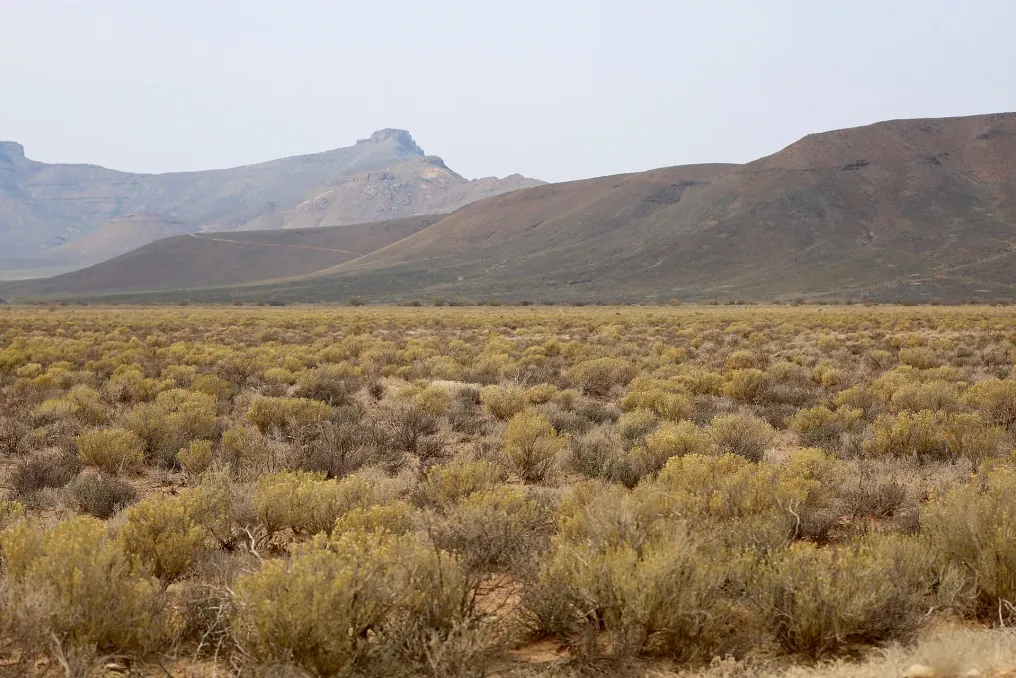
Journey through Tankwa Karoo: 48 Hours Away from City Hustle
Read more
getaway.co.za

Journey through Tankwa Karoo: 48 Hours Away from City Hustle

Tankwa Karoo is a place people go to soothe life's stresses and reconnect with their inner child. There are no noisy restaurants here, and deep within the landscape, there is no mobile phone reception, which eliminates constant notifications requiring attention. Instead, visitors are greeted by gravel roads, endless mountains, vast skies, and an almost palpable silence. For a 48-hour escape from Cape Town, few places could offer such a convincing opportunity to simply disappear.

The most convenient route from Cape Town goes through Ceres, then along R46, followed by a turn onto R355 towards Calivy. From there, the road becomes just another magnificent part of this experience.

The Tankwa Karoo National Park is located approximately 180 km from Ceres to the Rudeverf reception station; SANParks estimates the drive from Ceres at about two hours and twenty minutes, but it should be noted that the condition of the gravel roads can significantly alter this time.

Road R355 passes through a landscape that gradually becomes more sparse. The mountains recede, the vegetation thins out, and the space between objects seems to increase. Although the temptation to speed on this empty road is great, the loose gravel, sharp stones, and sudden changes in surface prompt slow movement. SANParks advises using a vehicle with good clearance and quality tires, warning that heavy rain can damage roads and cause floods.

Another simple rule is to fill up the tank before the trip. There is no fuel, shops, restaurants, ATMs, or mobile reception in the park itself. The nearest refueling points are located in Ceres, Sutherland, Middelpos, and Calivy, all of which are more than 50 km away.

It is this lack of amenities that makes Tankwa so appealing. If you are traveling on R355, it is worth taking time to visit Tankwa Padstal—a legendary stop for road travelers where the journey briefly takes on a social character. After that, you can return to the road and continue your journey.

Tankwa allows you to start measuring distances differently. Instead of asking 'How much longer?', you find yourself stopping because the light has changed just enough to slow down, a mountain appears in the distance, or the road ahead looks too beautiful not to photograph.

For a weekend trip, it makes sense to stay inside Tankwa Karoo National Park if you do not want to spend limited time on constant travel back and forth. SANParks offers various accommodation options, including rustic cottages and designated campsites. Elandsberg Cottages are situated on hills overlooking the Karoo plains and the Roggeveld escarpment, while Paulshoek Cottage is located about 5 km from the Rudeverf reception station. Designated campsites are also available for visitors who prefer a more ascetic experience.

The essence here is not luxury and grandeur, but space and the comfort of being unfilled. After unpacking, try to do very little. Drive around, sit outside, and prepare dinner. Watch the light move across the plains, and perhaps spend an amazing amount of time doing absolutely nothing, without feeling like you are wasting time. And this, increasingly, feels like a new definition of luxury.

Wake up early while the Karoo is still cool, and set off before the daytime heat sets in and makes your adventures slightly uncomfortable.

The park offers self-guided wildlife viewing, bird watching, mountain biking, scenic viewpoints, off-road tracks, and stargazing. Wildlife is not the main event, as in larger South African safari parks, but this does not mean Tankwa is empty. SANParks currently lists five mammal species in the park: Cape zebra, eland, gemsbok, red hartebeest, and springbok. Additionally, 183 bird species have been recorded, making the park particularly valuable for bird lovers interested in Karoo species. Therefore, allow yourself to take it easy.

One of the most memorable viewpoints in the park is the Gannaga Pass. This pass climbs the Roggeveld escarpment over about 6 km, gaining approximately 700 m through a series of turns. Its stone walls were built as part of a public works program in the 1930s, and those who died during construction are buried at the foot of the pass.

This is a reminder that the feeling of solitude in Tankwa is not new. People have navigated this complex landscape for generations. Stop at the summit and look back. The Tankwa basin stretches below in muted shades of brown, gray, and green, framed by mountains and the endless sky. Almost nothing disturbs your view. This is precisely the place where you realize that the absence of things can be as spectacular as their presence.

Upon returning to camp, resist the urge to fill the second half of the day. Tankwa reaches its best state when you give it time.

The park is located in the Succulent Karoo biome and contains a remarkable diversity of vegetation. SANParks lists 780 plant species in the park, with the region's floristic diversity usually being most impressive from August to October. But even outside the flowering season, there is beauty in the seemingly desolate landscape.

As day turns to evening, the mountains turn into silhouettes, and the plains take on warmer tones. City lights do not compete with the sunset. Then the real show begins. Stargazing is one of the main reasons to visit Tankwa, and it requires almost no effort from you. SANParks describes the park as a place of seclusion and vast horizons, with quiet, star-filled nights.

There is something wonderfully satisfying about being surrounded only by darkness and a sky full of stars that we rarely find time to see. Without mobile reception, the usual noise of life seems very distant.

The last morning is reserved for a final slow drive and a full breakfast before packing up. Time in the park is limited. From April 1st to September 30th, travel is prohibited from 6:00 PM to 6:30 AM, and the summer restriction from October 1st to March 31st is from 7:00 PM to 5:30 AM.

If you have time and road conditions permit, you can turn the return journey into part of the adventure rather than just repeating the route.

A week in Tankwa Karoo is not for everyone. If you require constant connectivity, restaurant choices, and a packed schedule of activities, you may find the emptiness frustrating. The park has limited infrastructure and is still described by SANParks as being in a stage of development and land consolidation.

But if you truly want to disappear for 48 hours, it is hard to imagine a better place. Tankwa asks little of you. Just enough fuel, enough water, good tires, and a willingness to slow down. Everything else can wait until you return.

Popular