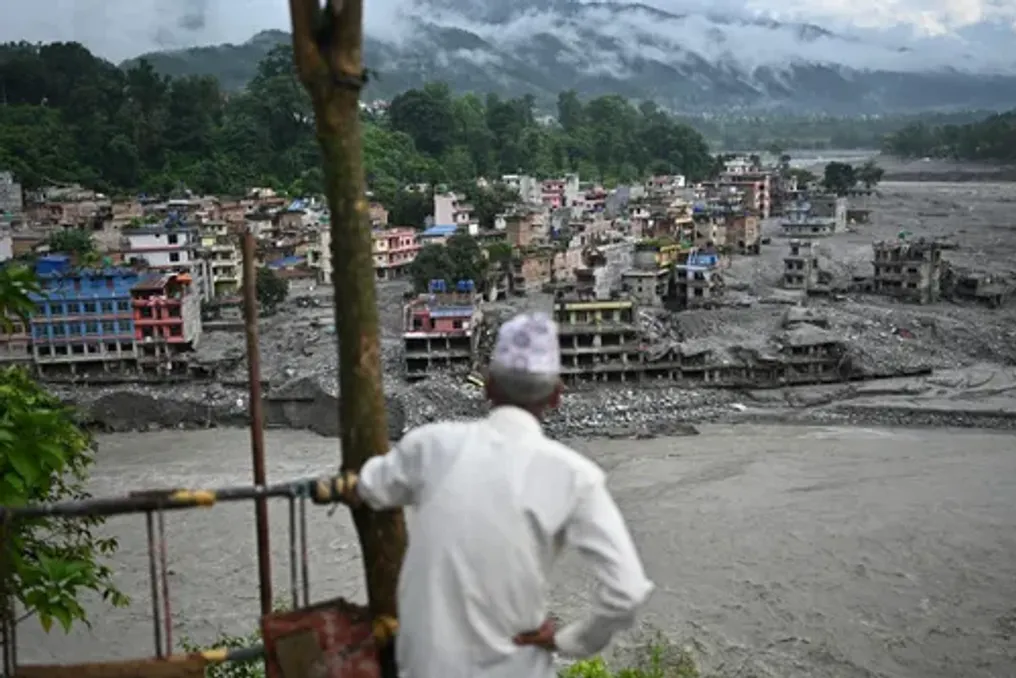
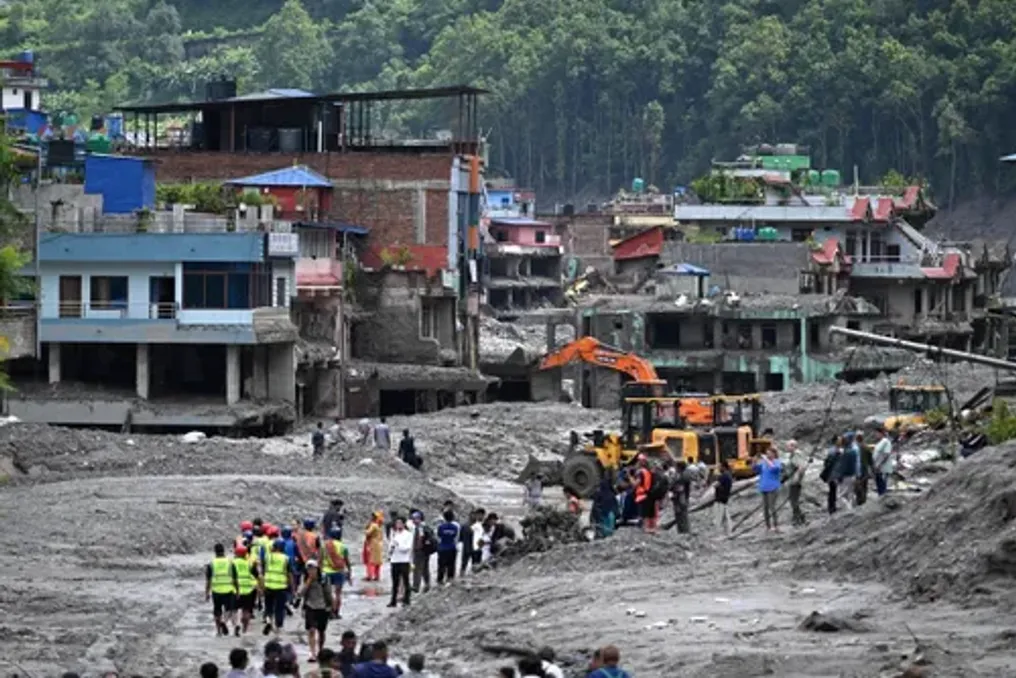
A massive tragedy in the Himalayas of Nepal on August 26th led to the destruction of settlements and communities around Rasuwa, near the border with Tibet. These catastrophic flash floods were captured by surveillance cameras and witnessed by people worldwide. Flows of ice, water, mud, and debris rushed through the Bhote Koshi, Trishuli, and Narayani river systems with terrifying force.
According to available reports and analyses, a huge mass of rocks and glaciers, about 600 meters wide, collapsed over a kilometer into the Lhende River valley, triggering the formation of a natural dam. When this barrier broke, a chain reaction ensued, claiming hundreds of lives, leaving thousands missing, and more than 90,000 people in need of urgent assistance.
This unstoppable torrent destroyed the livelihoods and infrastructure of local communities, irreversibly changing the lives of an entire generation of residents in the region. Serious questions arise regarding the causes of this disaster, the possibility of preventing it, and how many lives could have been saved.
Climate Change
The most frequently cited culprit is climate change, and this is justified. In 2024, the global average temperature exceeded 1.5°C above pre-industrial levels for the first time in an entire calendar year. Although this does not constitute a formal breach of the Paris Agreement threshold, which relates to longer-term warming, it serves as an alarming signal.
Professor Christo Kozze, an expert in disaster risk reduction and complex adaptive systems from the School of Geospatial Sciences at Northwestern University (NWU), noted that definitive conclusions cannot yet be drawn. He stated that while many link this to climate change, it is too early to place all responsibility solely on it. Such events are likely caused by multiple factors that need to be studied to prevent future disasters.
Kozze also emphasized that besides climatic influence, disasters can often be linked to governance issues. Since the disaster occurred on the border between China and Nepal, this could create ambiguity about who is responsible for monitoring and managing the developing risk. He added that the conditions leading to the disaster developed over time, even if the event itself was sudden. With two countries involved, each might assume the other was in control, leading to no one taking full responsibility.
Therefore, according to the expert, climate change alone cannot be considered; the obvious lack of effective early warning and monitoring systems must also be taken into account, as these themselves can be management failures.
Information Vacuum
A deeper problem, it is argued, relates to information control. Dibyesh Anand, Professor of International Relations and Deputy Curator at Westminster University, pointed out in his article in The Conversation that despite warm relations between Nepal and Beijing and strict adherence to the 'One China' principle, China's tight control over Tibet complicates cooperation along the shared border.
Tibet represents a militarized border with limited access, restrained independent observation, and strict information control, making it an 'information vacuum.' This extends to glacial and hydrological data that could help Nepal predict floods originating from the Tibetan Plateau. Anand notes that Nepal lacks a mechanism to receive real-time data on Chinese glacial lakes and rivers, while Nepalese officials accuse Beijing of concealing critical information.
Most telling, he says, is that when a disaster in the Nepal-Tibet border region requires rapid crossing of borders by rescuers or transmission of warnings downstream from an upstream lake, it encounters a system designed for control, not speed. Although growing evidence suggests that the recent glacier collapse occurred on the Nepalese side of the border, near the Langtang Lirung peak, no warning reached the people in its path.
Authoritarian Control
Authoritarian control, exercised without due consideration of consequences, is becoming a characteristic feature of the changing geopolitical landscape. Isolationism and strategic mistrust increasingly hinder the international cooperation necessary to counter natural disasters that recognize neither borders nor political ideologies. Residents situated at the junction of competing states are forced to bear the burden of these consequences.
There is something both farcical and condemnatory in this situation, reminiscent of the most ridiculed scenes from Stanley Kubrick's film 'Dr. Strangelove.' However, there is nothing funny about the outcome.
This brings us back to climate change. In a study published in Natural Hazards Research, lead author Md Mujahidul Islam and colleagues identify the same fundamental problem. Their 2025 review shows that an early warning system is only as reliable as its weakest link: detection is meaningless if an actionable warning never reaches the people in danger.
Researchers point out that remote and marginalized communities are the most vulnerable, where weak internet, radio, and cellular coverage exists. The solution lies not only in technology but also in people-centric and community-based systems that utilize local knowledge, trusted volunteers, local languages, and multiple communication channels. A warning that does not reach the last village is not a warning at all, as happened in Nepal.
Where Do We Go From Here?
Climate change may not have acted alone, but it is steadily increasing the probability of more dangerous extreme events. Glacier warming, permafrost thaw, and increasingly unstable mountain slopes create risks that extend far beyond their points of origin.
In 2021, in India, in an incident similar to the one in Nepal, a mass of rocks and glacial ice collapsed in Uttarakhand, causing a landslide that claimed over 200 lives. In 2023, in Sikkim, India, the South Lhonak lake burst. Many lives were lost while the early warning system, which was supposed to be established in 2022, remained incomplete. These are not isolated incidents.
The reality is that disasters do not stop at border crossings. Calamities do not wait for bureaucratic approval. Yes, climate change can amplify danger, but human intervention, or lack thereof, determines whether lives are lost or livelihoods are saved. While we may not be able to prevent every glacier collapse, we have the tools to protect the most vulnerable from the full force of nature's wrath. In Nepal, nature unleashed a flood, but human systems failed to keep pace.