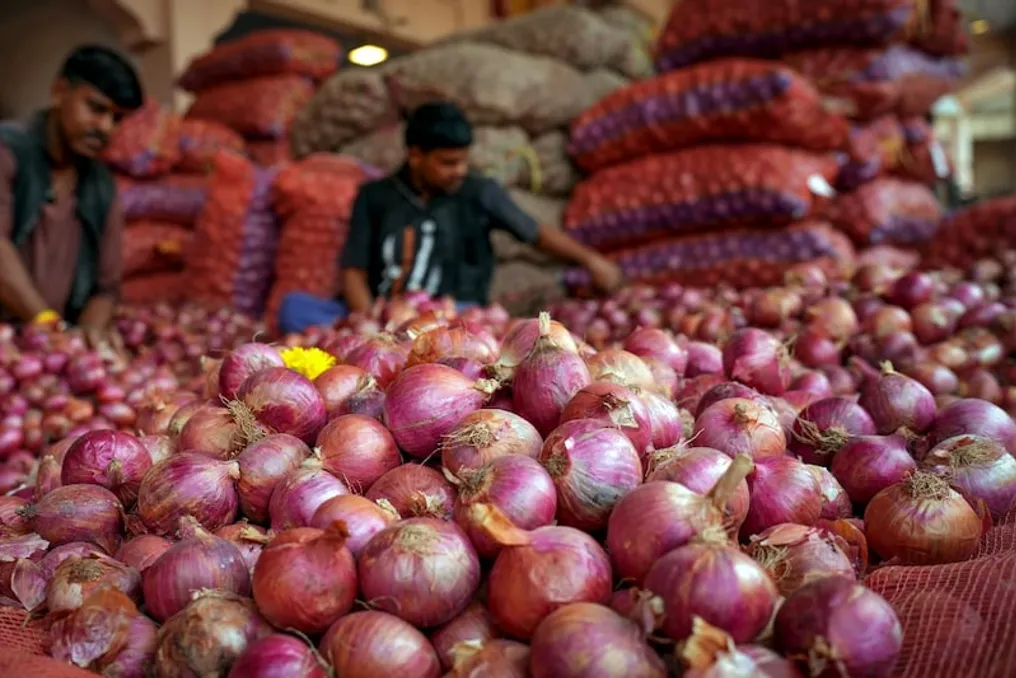
Onions, which usually enhance the taste of everyday dishes, are currently increasing household budgets. When visiting markets in some areas, people have to pay between 60 and 70 rupees per kilogram, while the government claims to be selling onions from buffer stocks for only 35 rupees per kilogram. Thus, there is almost a twofold difference between state prices and open market prices.
The average retail price of onions across the country on September 16 was 53.84 rupees per kilogram, which is approximately 94 percent higher than 27.71 rupees per kilogram a year ago. The government began releasing onions from buffer stocks held under the Price Stabilization Fund starting August 24. This onion is sold through the National Cooperative Consumers' Federation (NCCF), National Agricultural Cooperative Marketing Federation of India Limited (NAFED), central warehouses, and mobile vans at a price of 35 rupees per kilogram.
However, a problem has arisen: government onions are not reaching all markets and consumers. The delivery of buffer stocks from production regions to major consumption centers remains a difficult task. This is why, while state sales are conducted at a price of 35 rupees per kilogram, people have to pay significantly more in the open market.
The impact of the rise in onion prices is clearly visible in statistical data. The average retail price of onions in the country on September 16 was 53.84 rupees per kilogram, whereas on the same day last year it was 27.71 rupees per kilogram. This means that over a year, the price of onions has risen by approximately 94 percent. The situation in the wholesale market is not much different: the average wholesale price of onions on September 16 was 45.65 rupees per kilogram, indicating persistent price pressure from the market to the retail level.
To curb rising prices, the government increased the supply of onions from buffer stocks. This campaign now covers 19 cities. 'Kanda Express', railway wagons, and over 30 trucks are used to transport onions from production areas to major cities. The government states that the impact of selling buffer onions in some markets has begun to show. Nevertheless, real relief for ordinary consumers will only be achieved when onions at state prices become easily available in the maximum number of markets.
Seasonal factors are also behind the sharp rise in onion prices. Early season onion stocks are gradually depleting, and the next crop requires time to appear in the market. This period between the early and autumn harvest is traditionally considered expensive for onions. According to government guidelines, during this 'low season' from September to December, the supply of onions from buffer stocks is increased to prevent a sudden spike in prices.
Concerns have also intensified due to the delay in planting autumn onions. In July, the government reported that planting in Nashik, Maharashtra, was delayed by about 15 days, and in the Chitradurga-Challakere area, Karnataka, planting was estimated at about 60 percent of the norm. This could directly affect the arrival of the new harvest. If autumn onions arrive late to the markets, old early-season stocks may remain under pressure.
Weather and market trends are also contributing to the concern. The government had previously stated that monsoon delays and related circumstances affected the onion situation. Furthermore, the government noted that speculative buying by some traders influenced market sentiment. Thus, besides actual supply, the market atmosphere also affects prices.
The government asserts that there is no shortage of onions in the country. Onion production is projected to be 307.37 million tons in 2025-26, compared to 307.67 million tons last year. According to government estimates in July, sufficient stocks were also available in major producing states such as Maharashtra, Madhya Pradesh, and Gujarat. Therefore, the problem is not in the overall volume of production, but in when, where, and how much onion reaches the market.
The government has set a target to procure 2 million tons of early-season onions in 2026-27. About 1.21 million tons have already been purchased. The procurement price for the buffer has also been increased from 1875 to 2125 rupees per quintal. This means the government is now purchasing early-season onions at a price of about 21.25 rupees per kilogram. The goal of this buffer is so that when the inflow of the new harvest to the market decreases and prices begin to rise, state reserves can be released to increase supplies.