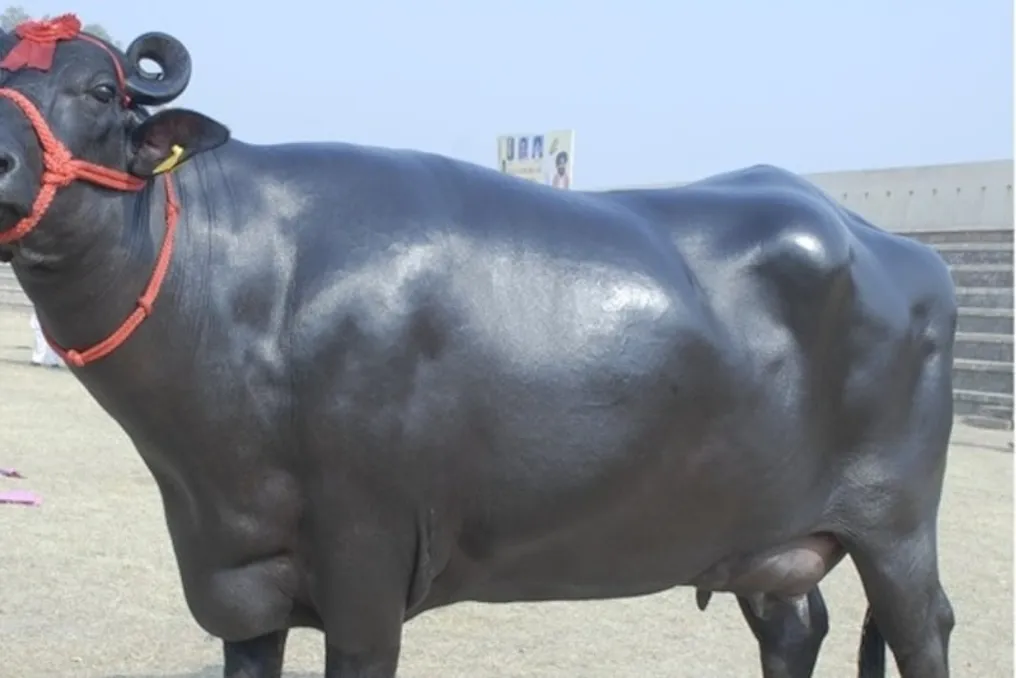
Buffaloes can be found everywhere, but some have unique horns. These horns are small, curl inwards near the head, and the animal's body is shiny black. If someone calls such a buffalo a Murra, its identification is related not only to color but also to the overall breed and appearance. Thanks to its high lactating ability and high fat content in milk, the Murra is popular among livestock breeders. However, the question remains: why is it called a Murra, how to recognize it, how much milk does it yield, and what is its price?
The Murra's body is usually glossy black, strong, and well-developed. The animal's head is medium-sized, and the skin is smooth. But the most distinctive feature is its small, tightly curled horns. According to data from the Central Institute of Buffalo Research (ICAR-CIRB), Murra horns are small, they bend backward and upward, and then curl inwards in a semi-circle shape. It is these curved horns that distinguish it from many other buffalo breeds.
Nevertheless, one cannot consider a buffalo a Murra based only on its black color and curved horns. For accurate breed identification, factors such as physical structure, pedigree, milk productivity level, and health status are also taken into account.
It is believed that the name 'Murra' is associated with the most outstanding physical characteristic of this breed. According to ICAR-CIRB, buffaloes that produce a lot of milk and have curved horns were selected in northwestern India and were named 'Murra'. The word 'Murra' translates to 'curved' or 'twisted'. The horns of this breed are small, dense, and curl inwards after bending backward and upward. With age, the spiral curvature becomes more obvious. This special horn shape is part of the genetic and breed identity of the Murra.
Scientific studies have also investigated the relationship between various physical traits of the Murra and its milk productivity. However, no clear difference was found during the research between the horn shape and the volume of milk production. That is, curved horns are a trait of the Murra, but not a direct cause of high yield.
The Murra is among the main milk-producing breeds. However, each Murra produces milk in a different amount daily. The volume of milk depends on age, diet, health status, care, and breed quality. According to ICAR-CIRB, over 305 days, the milk production of a Murra ranged from 1003 to 2057 kilograms. Under favorable conditions and with a good animal, this figure can exceed 5000 kilograms. The milk fat content is about 6.9–8.3 percent. This is why the Murra is valued not only for the volume of milk but also for its high fat content.
There is no single answer to the question of the cost of a Murra that yields about 9 kg of milk per day. The price of a Murra is determined not only by the volume of milk. Its age, breed, number of calvings, pregnancy status, milk fat content, health, and milk production records also affect the price. Because of this, the price of each Murra yielding 9 kg of milk will be different. A well-bred buffalo with excellent performance can cost significantly more than ordinary livestock.
The price of a quality Murra depends on its age, health, and ability to produce milk. Special attention is paid to how many liters of milk the buffalo yields daily. Generally, the price of one Murra can start from approximately 60 to 80 thousand rupees. While Murras that yield more milk and are of a superior breed can cost from 1 to 1.5 lakh rupees. Some special buffaloes with record yields can cost 2 lakh rupees or even more.
When buying a buffalo, one should not determine the price solely based on its appearance or breed. It is much more important to independently check its ability to produce milk. Experts advise milking several times before purchase to establish a fair price. In some regions, government livestock subsidy programs provide financial assistance to herders who meet the criteria, which can facilitate the purchase of a buffalo.
The main region for the Murra is Haryana. According to ICAR-CIRB, its original habitat is in the districts of Rohtak, Hisar, and Jind in the state of Haryana. Additionally, it is found in the districts of Nabha and Patiala in Punjab, as well as in West Uttar Pradesh and Delhi-NCR. Today, the Murra is not limited to these territories; it has spread to many parts of the country and is used to improve local buffalo breeds. If someone wants to purchase a Murra, they can get information from livestock breeders in these key areas of Haryana or from reliable dairy farms.
