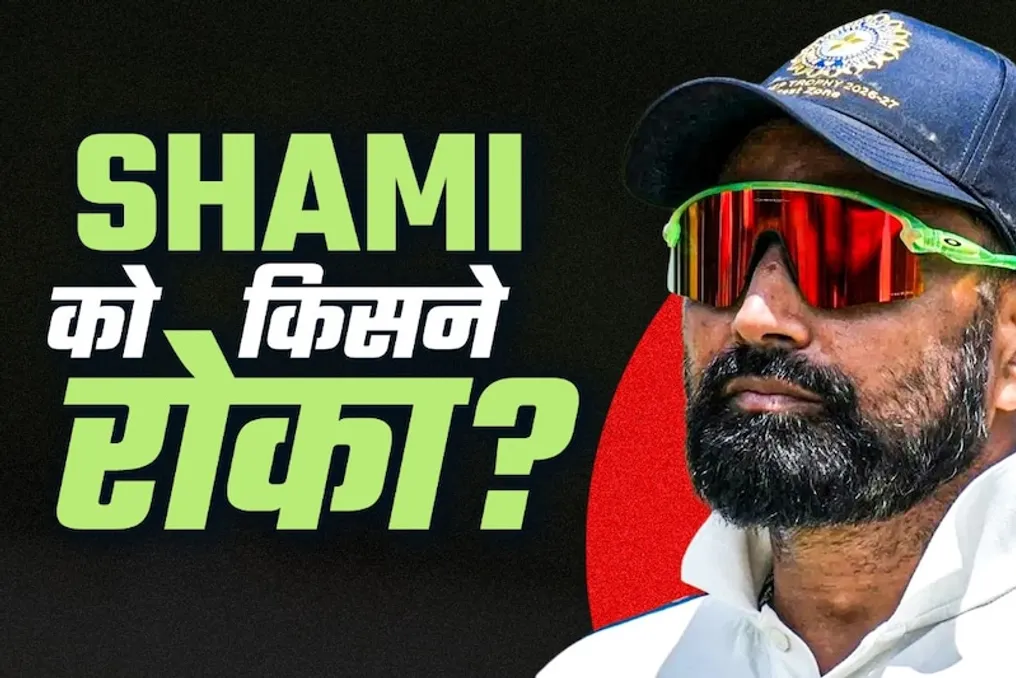
In Indian cricket, the appearance of any player in the squad is news, but sometimes their absence becomes an even more significant story. This is what is happening with Mohammed Shami. When the team squad for the ODI series against the West Indies was announced, 37-year-old Ravindra Jadeja returned, Akib Nabi received his first ODI invitation, and Naman Diri was given a chance. Nevertheless, 36-year-old Mohammed Shami remained outside the squad again.
This raises the main question: why has the decision regarding Shami not changed? The answer lies in the fact that the decision regarding Jadeja was changed. The player who was not in the ODI squad a few months ago has now returned to the team. In light of this, the natural question arises: why is the door still closed for Shami?
It is necessary that emotions do not play a role in selection. It is absolutely true that an experienced player cannot be given a spot solely based on past achievements. However, consistency is also important for understanding selection decisions. Jadeja's return has created an interesting context in this situation.
If there were a plan to use Shami in ODIs, he would be in this team. According to sources, Shami definitely had a 'chance outside the main squad,' but ultimately, the selectors did not choose him. The question here is not so much whether Shami should be in the team, but rather what the selectors' mindset towards him is.
Instead of Shami, experienced options like Mohammed Siraj and Prasidh Krishna were included in the squad. Furthermore, Gurnoor Barar and Akib Nabi took places. For Nabi, this is his first challenge in ODIs. This means that the selectors are not just meeting current needs but are also considering new options.
This is important in the context of preparing for the 2027 ODI World Cup. Before the next World Cup, the team needs to clearly define its choices among fast bowlers. Therefore, testing new players is a natural part of the selection process.
However, Shami's constant absence in this process sparks debate. Is Shami no longer part of the selectors' future plans? At present, it is premature to draw any final conclusions, as the selectors have not made an official statement that Shami is permanently excluded from the ODI plan.
Nevertheless, constant absence from the squad itself is a signal that cannot be ignored in cricket.
Considering Shami's case only through the lens of age would be incomplete. He is one of India's most experienced fast bowlers. His career includes over 200 wickets in ODIs, impact in major venues like the World Cup, and experience in a long international career. But this is where the question arises between the selectors and Shami.
Are the selectors prioritizing the future, or do they still want to keep the possibility of Shami's return open? If the plan is entirely focused on the future, then giving chances to new players like Nabi is understandable. But if Shami is still part of the ODI plan, then the reason for his constant exclusion must be more obvious.
This is where the Jadeja story comes into play. Jadeja's return is the most interesting part of the whole affair because it shows that selectors can change their decision about a player. With changes in circumstances, performance, or team needs, the door can reopen.
Then why doesn't the same door open in Shami's case? This question is related more to the direction of selection than to Shami's achievements. If Shami is no longer considered part of the team's future, then providing constant opportunities to new bowlers may be part of this strategy. But if that is not the case, the reason for Shami's exclusion will remain an open question.
Shami is not complaining, so the questions don't end... Shami's attitude towards the situation was also discussed. Shami is not among the players who publicly complain often. He has a career, achievements, and experience in big matches.
However, the player's silence cannot be considered an answer to the selection question. Regardless of whether Shami speaks or not, the question remains open.
On one hand, the decision regarding Jadeja was changed. On the other hand, a new player like Nabi received a direct spot in the ODI team. And in the middle is Shami, for whom the door has not yet opened. This is the biggest story of this selection.
Could this be just one series? Caution is needed here. Shami's absence in the series against the West Indies does not necessarily mean the end of his ODI career. One three-match series does not define the entire picture of the 2027 World Cup.
But if this model continues in the future, new fast bowlers will get chances, and Shami will be constantly excluded, then the grounds for assuming that the selectors are moving towards the next generation will become very strong.
At present, the picture is this: Jadeja has returned, Nabi has made his ODI debut, but Shami remains outside the squad. And so, the question goes beyond one series: why has the decision for Shami not changed? Has the place of this experienced bowler in the selectors' plans for 2027 become as it was before?