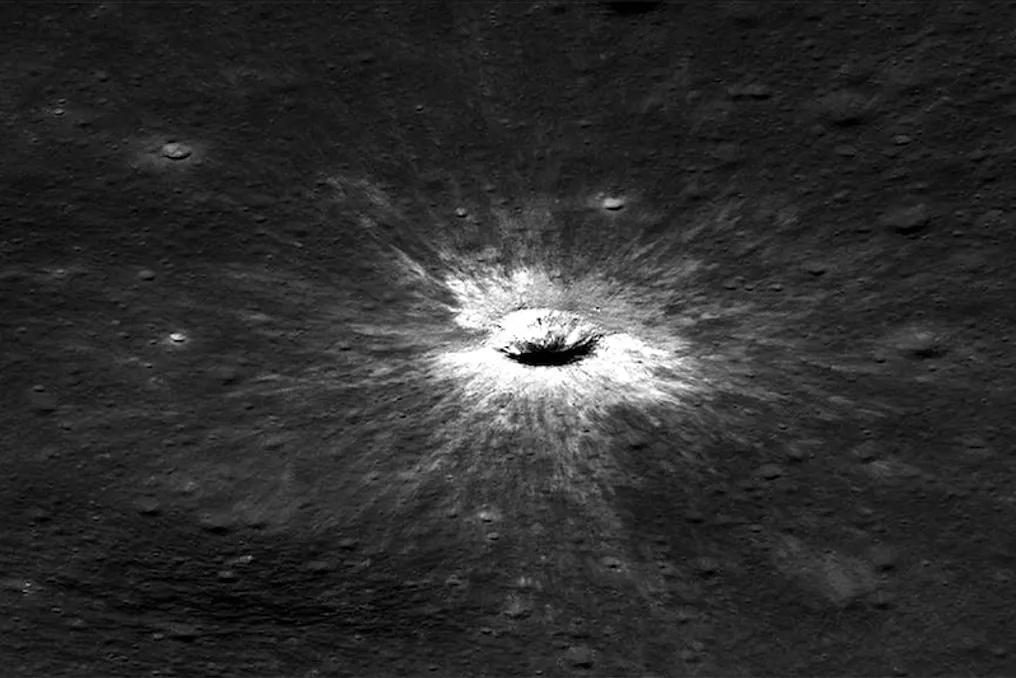
NASA's Lunar Reconnaissance Orbiter (LRO) has discovered a new, very large crater on the Moon's surface, which was formed as a result of a strong impact between April 11 and May 22, 2024. Scientists have named this feature the Macgathchin Crater. It measures 222 meters in width and has an average depth of 43 meters.
This crater is the largest fresh impact crater discovered in the Solar System recently. Such large formations on the Moon occur only about once every 132 years, making this discovery extremely significant for the scientific community. The crater's identification was made by the LRO camera team by comparing old and new images; initially, a bright patch appeared in the wide-angle camera image in 2025, followed by detailed photographs taken with the narrow-angle camera.
Analysis of pre- and post-impact images showed that a large meteorite or comet fragment struck the Moon in the spring of 2024. This object could have been the size of a three-to-six-story structure. The force of the impact led to the formation of a deep depression on the surface.
The Macgathchin Crater is located on the eastern edge of the Moon, near the boundary between highland regions and volcanic plains. A bright cloud of ejected material (ejecta) composed of rocks and dust surrounds the crater, spreading over hundreds of meters. Part of this debris reached a distance of more than 120 kilometers.
Scientists also determined that the impact created a cold area with a diameter of 7 kilometers on the surface. At night, this zone remains slightly colder compared to the surrounding terrain because the dust there is less dense and cools faster. The average slope of the crater walls is 24 degrees, although it reaches 40 degrees in some places. The average height of the crater rim is 8 meters, and material excavated beneath the surface reached a depth of more than 20 meters.
Since the crater is in a very fresh state and has not yet been affected by space weather or small meteorites, it represents an ideal natural laboratory for studying the impact process. It is important to note that the previous largest new crater found during the LRO mission was only 70 meters in diameter, whereas the Macgathchin Crater is three times larger.
This discovery is highly significant for improving models of impact mechanics, ejecta dispersal, and surface changes. Furthermore, the data obtained may be useful for future crewed missions and the establishment of bases on the Moon.
The International Astronomical Union named the crater Macgathchin in honor of Thomas Macgathchin, an Apollo-era lunar scientist who made significant contributions to modeling material ejected from impact craters. This incident demonstrates that the Moon remains an active body subject to constant impacts, both large and small. Orbiters like LRO continuously record these changes through imaging. Without regular monitoring, this crater might have gone unnoticed. Scientists continue to study this crater for a deeper understanding of impact-related processes.