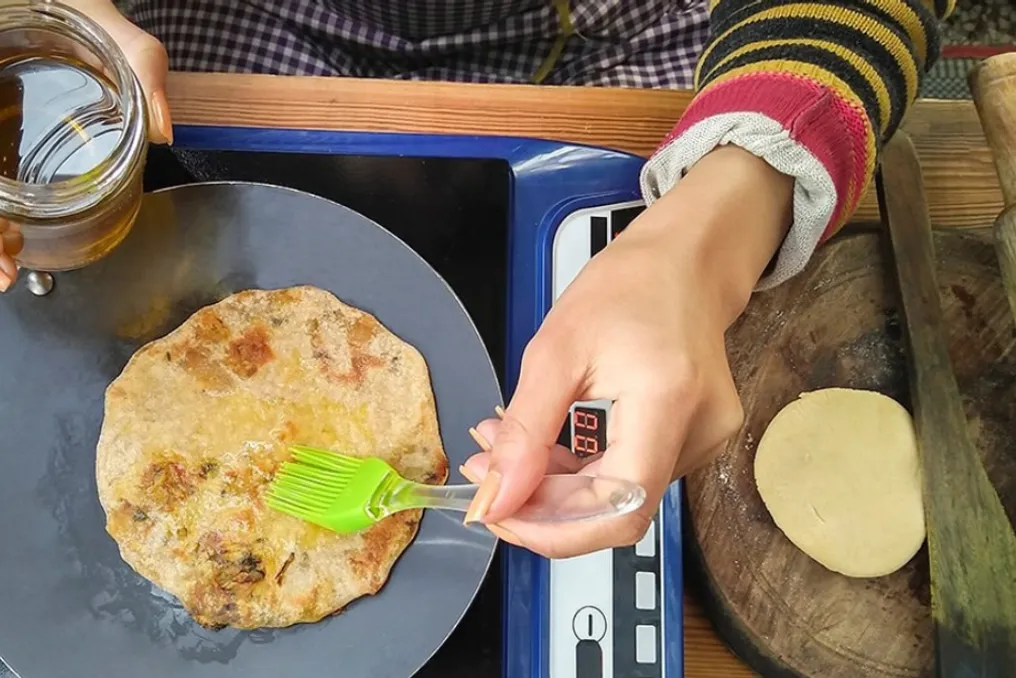
The 'How It Works?' series from The Better India explores everyday objects, revealing the technology, design, and sustainable thinking that allow them to function efficiently. Innovations are often hidden in the ordinary things we use daily.
Several months ago, many households in India began looking for alternatives due to issues with the availability of Liquefied Petroleum Gas (LPG) and rising fuel prices for cooking. One such solution was the induction hob.
Unlike a gas stove, it does not require an open flame. It also differs from a traditional electric stove, which relies on a heated coil to transfer heat to the cookware. Instead, an induction cooktop uses an invisible but ubiquitous phenomenon—electromagnetic fields.
There is a coil under the glass
If you look beneath the smooth glass surface of an induction cooktop, you can find tightly wound copper wire. When the hob is turned on, alternating current passes through this coil. Because it is alternating current, it constantly changes direction, generating a rapidly changing magnetic field around the coil.
This field is invisible but powerful enough to interact with specific types of kitchenware placed above it. The glass surface itself does not generate the heat needed for cooking; it merely allows the magnetic field to pass through it and reach the pan.
The pan becomes the heating element
This is where the interesting feature of induction cooking begins. When cookware made of a suitable magnetic material, such as cast iron, ductile iron, or magnetic stainless steel, is placed on the heating zone, the changing magnetic field penetrates the metal base of that cookware.
According to the principle of electromagnetic induction, a changing magnetic field is capable of creating electric currents in a nearby conductor. Inside the cookware, these currents move in rotating loops called eddy currents. These currents are invisible, and they do not pass through a wire connected to the cookware; they are generated directly inside the metal by the influence of the created magnetic field.
Resistance converts electricity into heat
But how exactly is the moving electricity converted into heat? Every metal has a certain degree of resistance to the flow of electric current. When the eddy currents circulate along the bottom of the cookware, they encounter this resistance. This resistance transforms electrical energy into thermal energy, meaning heat. The bottom of the cookware heats up, and this heat spreads throughout the vessel to the contents, whether it is food or water.
Simply put, the induction cooktop does not heat the cookware from the outside. It uses a changing magnetic field to create tiny electric currents inside the cookware itself, and the cookware's resistance converts these currents into heat. This is why the cookware effectively becomes its own heating element.
Why does the glass surface remain relatively cool?
If the cookware gets very hot, why doesn't the glass underneath become equally hot? The magnetic field passes through the glass, which is not the primary target of the heating process. Since glass does not conduct electricity in the same way as the metal base of the cookware, it does not form the same eddy currents that generate heat in suitable cookware.
As a result, the surface of the hob generally remains significantly cooler than the cookware during operation. Nevertheless, it is not completely insulated from heat. Hot cookware transfers some heat back to the glass, so the cooking zone can still heat up during or after use.
Furthermore, the hob is equipped with sensors and electronic regulators to control power and detect suitable cookware. If the cookware is removed, many induction hobs automatically reduce or stop heating.
A small change that makes cooking smarter
Induction cooking serves as a clear example of how science can transform a household appliance into a more efficient solution. By directing energy directly into the cookware, rather than relying on a flame or a continuously heated coil, it reduces heat loss to the surrounding air and provides precise temperature control.
It also eliminates the need to burn LPG during cooking, offering a practical alternative for households aiming to reduce dependence on traditional fuels for cooking. Next time you see water boiling on what appears to be an ordinary glass surface, remember: beneath it, a copper coil creates an invisible magnetic field; this field induces currents in the cookware, and electrical resistance does the rest. No flame, no glowing coil, just electricity and magnetism working together to turn the cookware into a heat source.