Uzbekistan put forward a proposal for joint efforts by Central Asian countries and South Korea to address desertification issues, land degradation restoration, and the promotion of reforestation projects. Among the initiatives mentioned are the creation of the 'Central Asia Green Belt,' the formation of a regional carbon hub, and the development of a unified program for protecting saxaul forests.
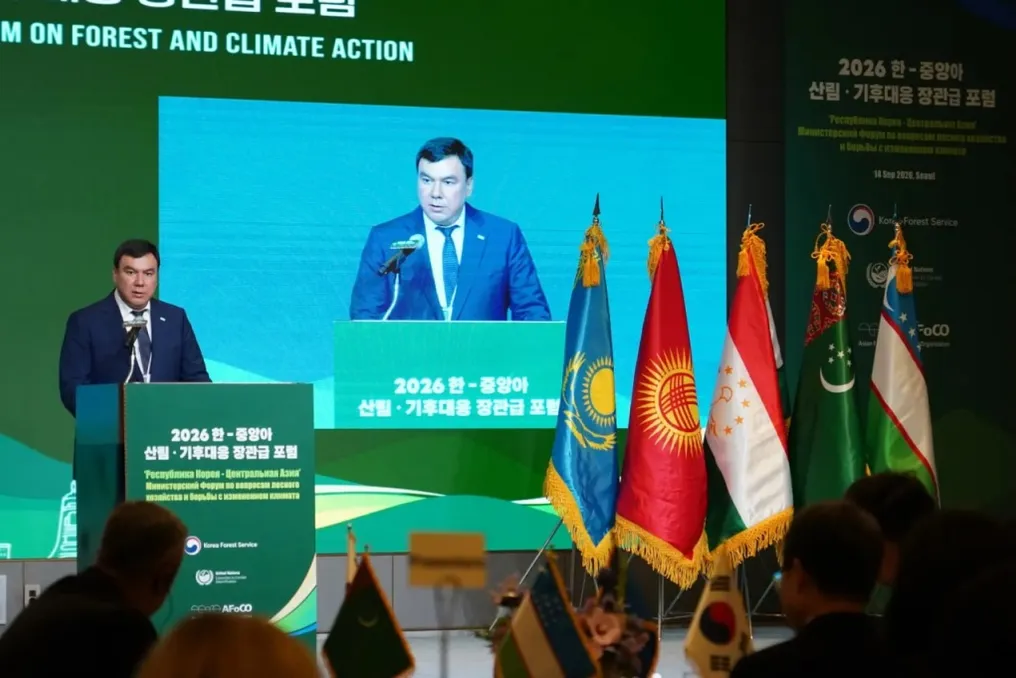
These proposals were presented during the Korea-Central Asia Ministerial Forum on Forests and Climate and the Ministry of Dialogue, which took place in the Republic of Korea. Uzbekistan was represented by Aziz Abduhakimov, the Presidential Advisor on Ecology who chairs the National Committee on Ecology and Climate Change.
During these meetings, successes of environmental projects implemented in Uzbekistan were demonstrated. As part of the nationwide 'Yashil Maqon' campaign, over one billion seedlings have been planted in the country. This has increased the greening level from 8% to 14%, with a planned growth to 30% by 2030.
Significant work is also underway in the Aral Sea region. Forest plantations covering about two million hectares have been established on the dried bed of the Aral Sea. Furthermore, a project aimed at restoring forest landscapes and developing eco-tourism infrastructure is being implemented with the support of the World Bank.
New cooperation format and protection of saxaul forests
During the Ministry of Dialogue, Uzbekistan proposed introducing a new interaction format called 'Korea – Central Asia: Green Cooperation' and beginning the practical implementation of the 'Central Asia Green Belt' concept. It is envisioned that jointly with South Korea, UNCCD, and the Asian Forestry Organization (AFoCO), pilot zones will be selected, timelines set, and financing mechanisms determined.
Special attention was paid to saxaul forests. Uzbekistan proposed developing a regional program for their conservation and modernization. This program will include the use of modern technologies in seed production, genetic research, satellite monitoring, and artificial intelligence. The creation of a Unified Digital Atlas of saxaul plantations is also planned.
Another important initiative relates to attracting investment for land restoration. Uzbekistan proposed establishing a regional carbon hub involving Korean financial institutions and companies.
Moreover, in collaboration with the UN Convention to Combat Desertification and the UNFCCC, the development of an Arid Lands Carbon Standard was discussed. This standard should take into account the specifics and high cost of implementing carbon projects in arid and desert areas.
As a result of the meeting, the Research Institute for Combating Desertification and Developing Desert Economy at Green University was designated as a regional scientific and practical platform. Joint research, field tests, and pilot projects are planned here, involving scientists from South Korea and Central Asian countries.
The initiative to develop the green sector and adapt to climate change was put forward by Shavkat Mirziyoyev at the first 'Central Asia – Republic of Korea' summit in Seoul, where he proposed launching a partnership between Central Asia and Korea in the fields of climate and carbon.