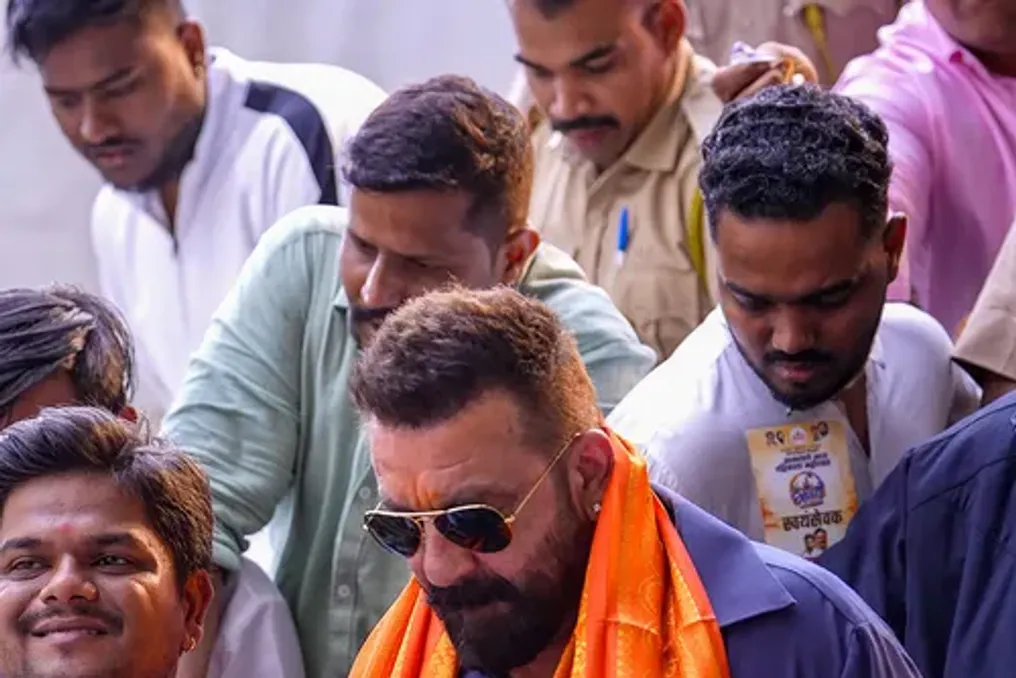
A joke made by veteran actor Sanjay Dutt has once again ignited discussion regarding the controversial decision of the Maharashtra state government, which mandates that everyone living or working in the state must be fluent in the Marathi language.
Dutt participated in a recent celebration of Dahi Handi. This traditional Hindu festival is observed in Maharashtra during Krishna Janmashtami, which marks the birthday of Lord Krishna. The event was organized by Maharashtra Transport Minister Pratap Sarnaik in Thane, near Mumbai.
Recently, Sarnaik came under scrutiny for introducing a policy requiring public transport operators, such as auto-rickshaw and taxi drivers, to possess working knowledge of Marathi. Similar statements by other party leaders in recent months have led to violent attacks by party workers on shopkeepers and laborers who addressed them in Hindi, the national language, instead of Marathi.
Political groups often target migrants, shop owners, and service staff based on whether their signage or speech adheres to the Marathi language, while major celebrities and corporate elites rarely face such coercion.
The minister jokingly prompted Dutt to address the gathering in Marathi, which unintentionally triggered a chain reaction he could barely foresee. Responding with his characteristic candor, Dutt declined the request with a self-deprecating anecdote in Hindi: 'I spent 6 years in Yerwada jail, but even then I couldn't learn Marathi.'
Although the comment elicited laughter from the host and the audience, it immediately provoked a negative reaction on political and social media. Critics pointed to clear class inequality: while working-class migrants face strict requirements, administrative control, and political threats regarding adopting the local language, elite cultural icons who have lived in the state for decades can brush off this expectation with a smile.
Dutt's remark reignited the ongoing discussion about cultural identity, linguistic heritage, and regional pride in Maharashtra. His passing phrase quickly moved beyond celebrity small talk, escalating into debates over the status of the Marathi language in its home state—a conversation closely linked to the status of Mumbai as the capital of Hindi cinema, now known as Bollywood.
The actor's fans supported him, stating that he did not need to learn Marathi. Cultural activists insisted that he should not be exempted from this requirement due to his status.
This scandal highlights a historical paradox deeply rooted in the state's culture. Maharashtra, and particularly Mumbai, has served as an undisputed center of Bollywood for over a century. The Indian film industry generates billions of rupees, attracts global attention, and shapes the nation's popular culture. However, the language of this film empire is predominantly Hindi and Urdu, not Marathi.
Mumbai's status as India's financial and entertainment capital attracts millions of non-Marathi speakers from across the country. Regional political parties argue that this influx threatens to marginalize the local language and indigenous population within their own state. Despite working in Film City in Mumbai, Hindi cinema has historically operated within a cosmopolitan bubble where Hindi and English are the primary means of communication.
While regional cinema, such as Marathi films, thrives on artistic merit, it often struggles for screen time against massive Hindi blockbusters. The broader political basis of the Marathi language debate is not solely related to speech or cinema. It is deeply connected to political mobilization and regional identity.
For decades, political formations like Shiv Sena and Maharashtra Navnirman Sena (MNS) built their core platforms around Marathi Asmita (Marathi pride). In recent years, the state government has taken steps to strengthen linguistic protection, including mandating the use of Marathi in state schools and granting the language 'classical' status nationally.
However, the implementation of these policies creates a delicate balance. On one hand, proponents argue that preserving the local dialect is vital against the homogenizing impact of migration and global trade. On the other hand, residents and critics caution against turning language into a tool for political intimidation or administrative dictates that disproportionately punish vulnerable workers.
Dutt's comment served as an abrupt reality check on how language integration actually functions. Mere physical presence in a region—even in institutional settings like a state prison—does not automatically lead to linguistic assimilation unless accompanied by conscious effort and social integration.
For Bollywood and its prominent figures like Dutt, this episode may serve as a clear signal that while their artistry belongs to a global Hindi-speaking audience, operating in Maharashtra entails a certain civic responsibility to respect the local culture.