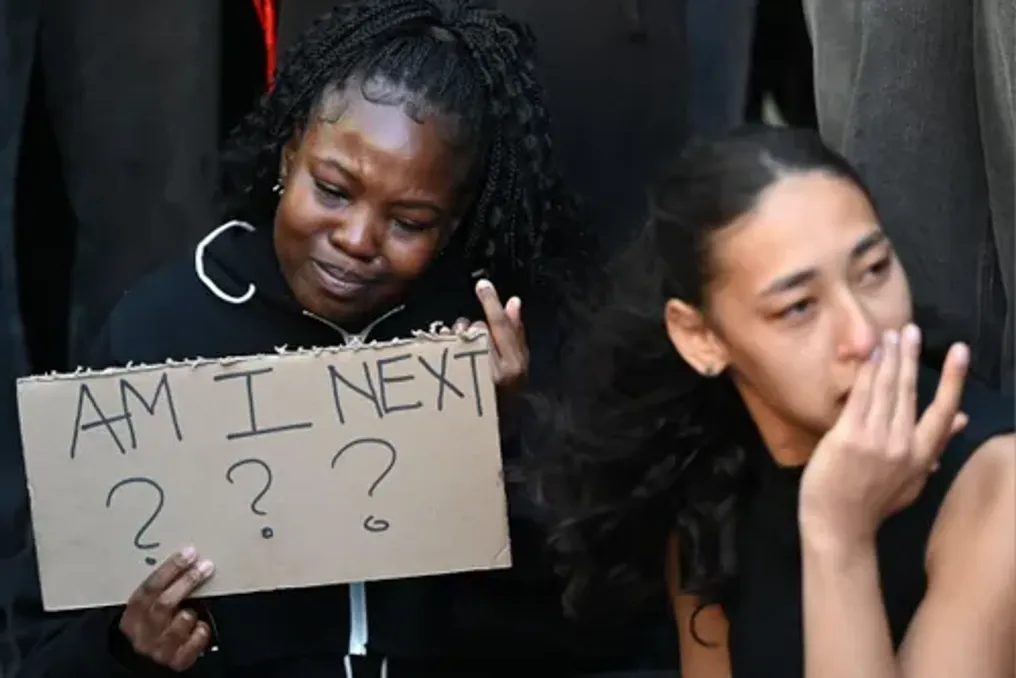
South Africans Protest Women's Murders After Eight Bodies Found in ekurhuleni
Read more
IOL
iol.co.za

South Africans Protest Women's Murders After Eight Bodies Found in ekurhuleni

Following the discovery of eight women's bodies in the Ekurhuleni area, South Africans took to the streets, holding silent marches and runs as a sign of mourning, stating that the situation has reached a breaking point. The police are preparing for a large-scale intensification of operations in Kempton Park and surrounding areas.

The public, from Gauteng to the Western Cape and KwaZulu-Natal, united in grief and fear to pay tribute to the deceased and demand action to prevent further victims.

Gauteng Governor, Panyisa Letsufi, announced on Tuesday evening at a press briefing that the province has requested additional assistance as the police prepare to intensify operations and impose restrictions in Kempton Park and its vicinity.

However, a Gauteng government representative, Elijah Mkhlanga, stated on Wednesday that he could not provide further comments while the police investigation is ongoing.

Crime expert Yusuf Abramjee explained that the term 'lockdown' should be understood as an intensification of law enforcement activity, not a complete ban on movement in Kempton Park. He emphasized that residents should not expect schools, shopping malls, businesses, or workplaces to close, but should anticipate increased police presence, patrolling, intelligence gathering, selective checks, and the work of specialized units under the expanded Channel Operation.

Abramjee noted that the goal must be twofold: preventing new attacks and, equally importantly, gathering evidence to identify and arrest those responsible for these horrific murders. He warned that a short-term surge in police activity would be insufficient, requiring a 'highly visible, intelligence-led, and sustained' response.

He added that increased police visibility can have a deterrent effect, but this must be accompanied by arrests, forensic breakthroughs, intelligence-led operations, and successful prosecutions. 'Ultimately, residents want to see action, not just announcements. The eight women whose bodies were found deserve justice, and the residents of Ekurhuleni deserve to feel safe in their communities.'

The police reaction came against a backdrop of ordinary South African citizens continuing to demand greater safety outside Kempton Park.

Activist Jessica Ford, founder of the Jess Ford Foundation, noted that the death of Elizabeth 'Tsonthso' Moselakgomo highlighted the fears women face when carrying out everyday tasks. She stated: 'The horrifying reality of violence against women in South Africa is knowing that it could be you next—not because you did something reckless, but while doing something as ordinary as jogging in your own neighborhood.'

Ford insisted on the need to discuss practical safety measures but cautioned against placing the responsibility for preventing violence on women themselves. She also pointed out that women in underserved communities experience fear during routine commutes, including trips to taxis or short journeys to work. She added that preventative work should include conversations with boys and young men about consent, respect, boundaries, and healthy masculinity, while authorities must address overgrown areas, poor lighting, and unsafe public spaces.

In Cape Town, 24-year-old stylist and activist Jemina Madonna organized a silent march near the Cape of Good Hope Castle on Wednesday following repeated reports of women's bodies being found in Gauteng. Madonna stressed that the murders cannot be viewed as solely a Gauteng problem, as the bodies were found there. She added that, being active on social media, it is impossible to focus on desired content when every scroll brings news of a discovered corpse.

In Gauteng, runners gathered on Tuesday morning to pay tribute to Moselakgomo, whose disappearance and death shocked the running community. Betuel Mangena from Stallion Running Club stated that the meeting was intended to show that women should not have to choose between safety and passion for running. He noted that 'Tsonthso embodies the collective experience of all women, including mothers, wives, and sisters,' and called for increased visibility of police and private security along running routes.

Runners in KwaZulu-Natal also took to the streets in memory of Moselakgomo and other runners. A 5km run started at 5 am from Florida Road; participants wore black in solidarity with Moselakgomo and victims of gender-based violence and femicide (GBVF). One participant said: 'It is very important for me to come out today, firstly because tomorrow I could be next.'

Before her death, Moselakgomo was a member of Team Vitality and recently completed the Wanderers 21km race. Discovery Vitality urged team members to wear pink and join group runs in Team Vitality zones on Thursday and Saturday, September 17 and 19, as well as parkruns on Saturday morning. The running community also supported Moselakgomo's family through the BackaBuddy campaign, raising R84,533 by Wednesday morning, exceeding the initial target of R50,000.

In addition to the mourning events, the National Council on GBVF demanded justice for the women whose bodies were found in Ekurhuleni. The council expects thorough investigations, timely forensic analysis, and properly secured court proceedings. It intends to request an official briefing from SAPS and relevant provincial and municipal authorities regarding the cases and the measures being taken. The council stated: 'This is unbearable, and it is not inevitable. The council demands justice.'

The council also appealed to families of missing loved ones in Gauteng to report to SAPS and the Gauteng Department of Health for DNA identification, as the women remain unidentified. The police urge residents to provide information that may aid the investigation and warn against spreading unverified claims, especially accusations that the deaths are the work of a serial killer or that specific individuals are responsible. Authorities have not confirmed that the eight cases are related.

National calls have also intensified demands for stricter measures. A petition on Change.org, launched on September 14, calls for the reinstatement of the death penalty for offenders convicted of femicide, and has currently gathered over 300,000 signatures.
Similar stories

Despite declaring GBVF a national catastrophe, murders of women continue in South Africa
Read more
iol.co.za

Despite declaring GBVF a national catastrophe, murders of women continue in South Africa

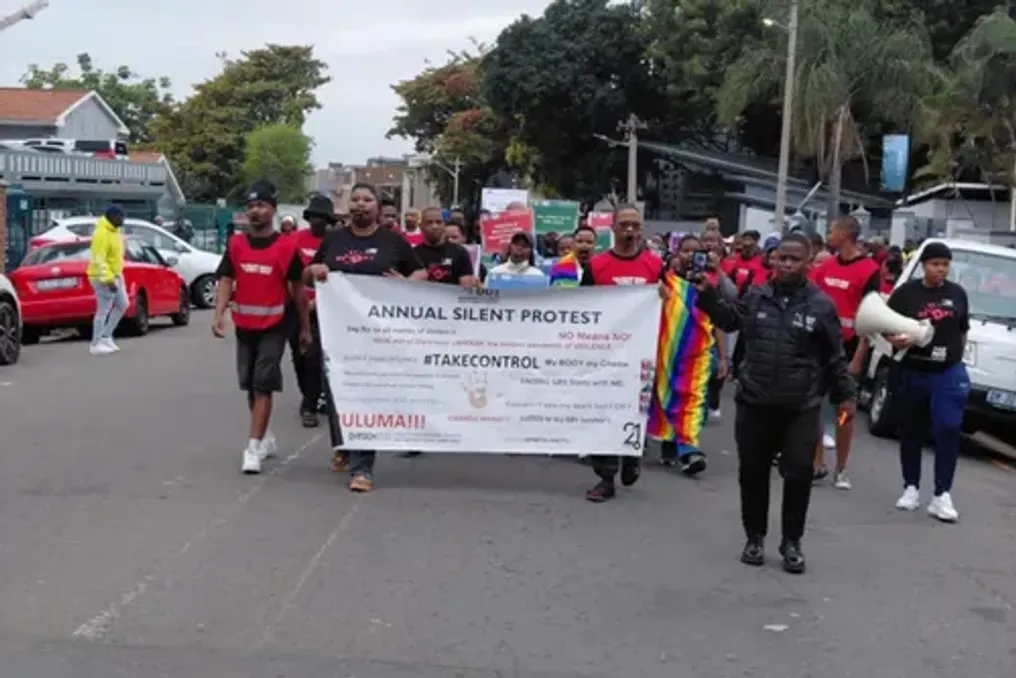
In South Africa, students and staff from DUT marched silently through Durban to honor the memory of victims of gender-based violence and femicide, and to call for an end to violence, fear, and silence.

In the eThekwini area, the body of a sixth woman was found in approximately two months. Police are investigating possible links between these cases but warn that it is too early to speak of a serial killer's guilt.

Nevertheless, this should not distract from the broader crisis. South Africa does not lack reports of GBVF; it lacks consequences, protection, and urgency.

The case of 38-year-old Elizabeth 'Ntontso' Moselakgomo intensified public anger. Moselakgomo, a mother, went missing after going for a run. Her family later identified her body at the Germiston morgue. The police deployed specialized resources to investigate her death alongside other murders.

The circumstances of the deaths are still being determined, and it would be irresponsible to claim that the women were killed by the same person before investigators establish that. However, six bodies in a concentrated geographical area demand an exceptional response.

Police have already involved multidisciplinary investigators and forensic specialists. One suspect is in custody in connection with the first body found in July. Investigators are now working to identify connections between these cases. Therefore, the public needs more than just assurances that investigations are underway; it needs results.

Because for the women living in eThekwini, the question is not whether the authorities will eventually explain what happened, but whether the state can prevent the next woman from becoming another case.

Murders in eThekwini occur against the backdrop of a national crisis. SAPS registered the murder of 569 women between April and June 2026, as well as 9201 rape cases. Over 60% of the rape cases sampled occurred in residential premises, challenging the notion that violence against women is a danger lurking somewhere outside the home.

The scale of this is precisely what led the government to classify GBVF as a national catastrophe in November 2025. This classification was intended to allow the government to coordinate its response, direct resources to the crisis, and strengthen accountability. The government also established a National GBVF Council to coordinate the national response.

However, almost a year after the declaration of the catastrophe, frontline organizations continue to report serious resource issues. The South African National Shelter Movement states that about 90% of shelters supported by them are struggling with funding and other forms of support. These facilities may be necessary for women trying to escape abusive homes, receive counseling, legal aid, or protect their children.

This reveals a fundamental contradiction. If GBVF is a national catastrophe, the infrastructure protecting its victims cannot be treated as a secondary issue.

South Africa is not alone in the fight against femicide. In Cameroon, reports indicate that over 120 women have been killed by intimate partners since the beginning of the year. In response, the government launched a three-month national campaign targeting femicide, domestic violence, gender inequality, and male dominance, focusing on prevention, reporting crimes, and prosecution.

Cameroon's campaign itself does not solve the problem. Campaigns only make sense when backed by functioning institutions. But the comparison raises an important question for South Africa: what does emergency action look like when a crisis has already been officially recognized?

It should mean swift police investigations. It should mean adequately funded shelters. It should mean prosecutors effectively handling cases. It should mean the enforcement of protection orders. It should mean early intervention when patterns of abuse emerge. And it should mean confronting the attitudes among men who normalize control, the right to dominate, and violence against women.

The most dangerous response right now will be another cycle of outrage followed by another declaration. The state has already acknowledged the problem. President Cyril Ramaphosa declared GBVF a national catastrophe, and the government established a status National Council and promised increased policing, survivor support, and prevention programs.

The question is no longer whether the government understands the crisis. The question is whether the system delivers results. This means publishing measurable targets for investigations, prosecutions, convictions, protection orders, shelter capacity, and police responsiveness. It means identifying where resources are lacking and addressing those gaps instead of creating another layer of bureaucracy. And it means that men must become part of the solution, not just receive instructions to condemn violence after another woman dies.

The women found in eThekwini cannot be reduced to statistics. Nor can the 569 murdered women in three months be reduced to statistics. South Africa has already named GBVF a national catastrophe. Now the state must act as if it believes its own declaration.

Five Reasons Why Springboks Could Achieve a Convincing Victory Over All Blacks in Baltimore
Read more
iol.co.za

Five Reasons Why Springboks Could Achieve a Convincing Victory Over All Blacks in Baltimore

The Springboks, led by Rassie Erasmus, are poised to achieve a dominant victory over the All Blacks. The fourth match of the 'Great Rivalry' rugby series is approaching, and signs indicate that the Springboks will have their first 80-minute match in this series and will heavily defeat the All Blacks.

The Great Rugby Rivalry

The Springbok team possesses momentum and confidence. They are in their eighth year under Rassie Erasmus and have established a habit of recovering from setbacks and performing strongly in major tournaments, such as two World Cups and the British & Irish Lions series.

This pattern is repeating itself in the 'Great Rivalry' matches. Although the Springboks lost the first match, they responded with wins in the subsequent two games and appear to have learned how to exert constant pressure on the All Blacks.

In contrast, New Zealand is only in the third month of Dave Rennie's era and is still learning on the fly. The Springboks clearly know their goals, whereas the All Blacks are still searching for their path.

All Blacks Have Suffered Mental and Physical Losses

In the match in Kalabaas, the All Blacks gave everything, leaving nothing on the field and giving South Africa everything they had, yet they still suffered a defeat. The score of 29-24 may underestimate the significance for New Zealand, and they are aware of this. More seriously, three of their key players have sustained injuries, notably their talisman Ardie Savea.

The importance of Savea to the All Blacks cannot be overstated—he is not only a world-class player but also a center of cohesion, an inspiring captain who leads by example. His absence creates a huge gap.

The Springbok attack is putting pressure on New Zealand. The dominance of the Springbok forwards was reportedly hindered by an overly meticulous approach to the scrum in the second match. However, last week, Nick Amashukeli allowed the teams to interact more freely, similar to how Matthew Carlie did in the first match.

The result was telling: the All Black forwards began spending more time moving backward. Signs suggest that Karl Dixon from England will again allow the forwards to compete honorably for the scrum in the fourth match. If this happens, the All Blacks will face a serious problem, as the authority of the Springbok forwards grows as the series progresses, and the pressure inevitably exerts physical and psychological impact.

The All Blacks are experiencing a shortage of personnel. At the start of the series, Erasmus noted that the All Blacks players accumulated about 60 minutes more per person during the World Cup than their Springbok counterparts. This is partly because Erasmus rotated his squad widely during the tournament, while Rennie did not have such an opportunity.

Now the consequences are becoming clear. Over seven matches in the RGR, several players from the All Blacks' first team were forced to return home: from early casualties Billy Proctor and Kalaba Clark to Savea, Quinn Tupai, and Luca Jakobsen. Rennie was forced to make significant changes for the fourth match, including eight newcomers in the matchday squad. This is a large number of changes for a team aiming to win a match of this magnitude.

Springboks Have Gained Speed

This series has been very intense, but when the third match reached critical moments, it was South Africa that managed to find extra pace. Jesse Kriel's try changed the course of the game, and the Springboks sealed the victory. They won two consecutive matches and, crucially, demonstrated how to finish a competition of this level.

The All Blacks must win in Baltimore to level the series score. This might seem like an advantage for New Zealand, but psychologically, it could work in reverse. The Springboks cannot afford to lose the series, so they can play with the confidence of a team that has already proven its point, and with the freedom that comes from not needing to prove anything.

If South Africa can replicate something like their rout of the All Blacks with a score of 43-10 in Wellington last year, Baltimore could become another memorable chapter in the Great Rivalry.

}, {

Popular