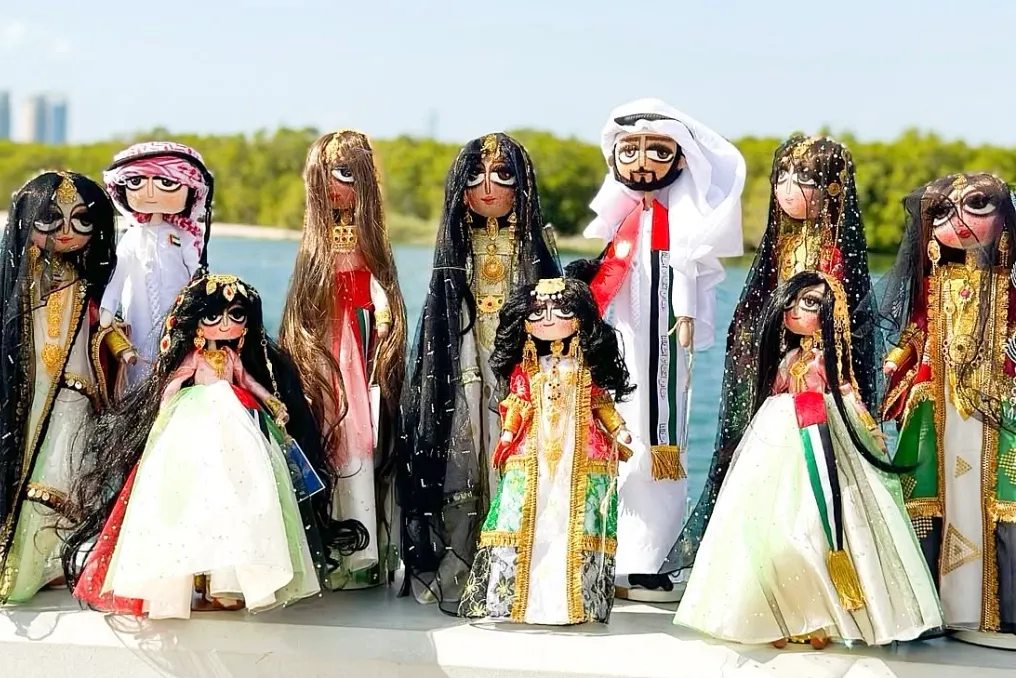
What started as a hobby pursued after work hours has turned into a full-fledged business for Emirati artist Hanadi Badou. She left a stable job to create handmade dolls that reflect the clothing, character, and stories of the UAE.
Badou is from Abu Dhabi and holds a degree in graphic design. Previously, she worked in a semi-governmental organization. Despite the comfort of her former position, her interest in making dolls continued to grow.
“I already had this passion while working,” she shared. “The craft required a lot of time, effort, and concentration, so I decided to quit my job.”
This decision did not cause her fear. “It was hard to start, but I knew where I wanted to go. I believed in myself and relied on God to take care of me,” she added.
Badou mastered the craft independently, studying video materials, analyzing designs, and constantly testing her methods. She is now entering her seventh year in this field after six years.
Her production process is characterized by slowness and meticulousness. Creating one doll takes four to five days of continuous work. She breaks down the production into stages: first, the body and clothing are made, then the facial features are painted, hair is attached, and accessories are completed.
“It used to take me much longer,” she recalls. “Later, I organized the work and allocated time for each stage.”
The result is not a mass-produced toy, but a unique character whose appearance is rooted in the identity of the Emirates.
After completing the initial sketches, Badou opened an Instagram account to present the dolls to a wider audience. A friend helped her with photography and marketing, providing a professional start to the first collection, which consisted of about 14 dolls. Orders came in faster than she expected.
Clients can choose elements such as hair color, clothing, and color palette. However, Badou maintains the distinctive character and visual identity of her creations. Each doll is also accompanied by a name and a small passport. For custom orders, parents can request that the doll bear their child's name; for exhibition pieces, Badou chooses the name herself.
For many years, she participated in events in the UAE and traveled abroad for exhibitions and cultural events. However, an unexpected surge of attention occurred during her participation in the International Hunting and Equestrian Exhibition in Abu Dhabi in 2026.
Badou hoped to secure a dedicated space at the exhibition, but it was not provided to her. Then, another artist invited her to join a small shared gallery area. Upon arriving there, she simply hoped that visitors would see and learn about the dolls. Instead, videos of the creations spread across social media and drew crowds to the exhibition.
“I cannot describe that feeling,” said Badou. “People believed in my talent. Those who filmed and interacted with the dolls helped me reach a much wider audience.”
The latest versions were developed to make them more appealing to children. If the early dolls were seated, Badou created movable puppet figures that visitors could admire in action. One character imitates movements inspired by Emirati folk traditions.
The appeal was not limited to children. Adults stopped to look at, film, and converse with the dolls, which surprised the artist with the scale of the response.
After the exhibition, Badou reported that her phone hardly stopped ringing. She received interest from government bodies, kindergartens, media organizations, and TV channels, as well as requests related to upcoming National Day celebrations. This increased interest, she said, generated a new sense of responsibility.
“For me, this is a very big deal,” she noted. “I must meet this responsibility and ensure that I bring something new every time.”
For Badou, these dolls are not just decorative items. They are a way to give Emirati and Arab children an image that seems familiar to them in appearance, clothing, and identity. “I feel like I have given this doll to an Emirati child, an Arab child, and especially an Emirati child. It is an Emirati doll in every detail.”
Her long-term goal is to use this craft to convey a piece of UAE culture to an audience outside the country. “The Emirates are rich in heritage and culture,” concluded Badou. “I am very proud to be from the UAE. This places a great responsibility on me to represent my country to the world in the best possible way. I hope, with God's help, to bring this work to a global level.”