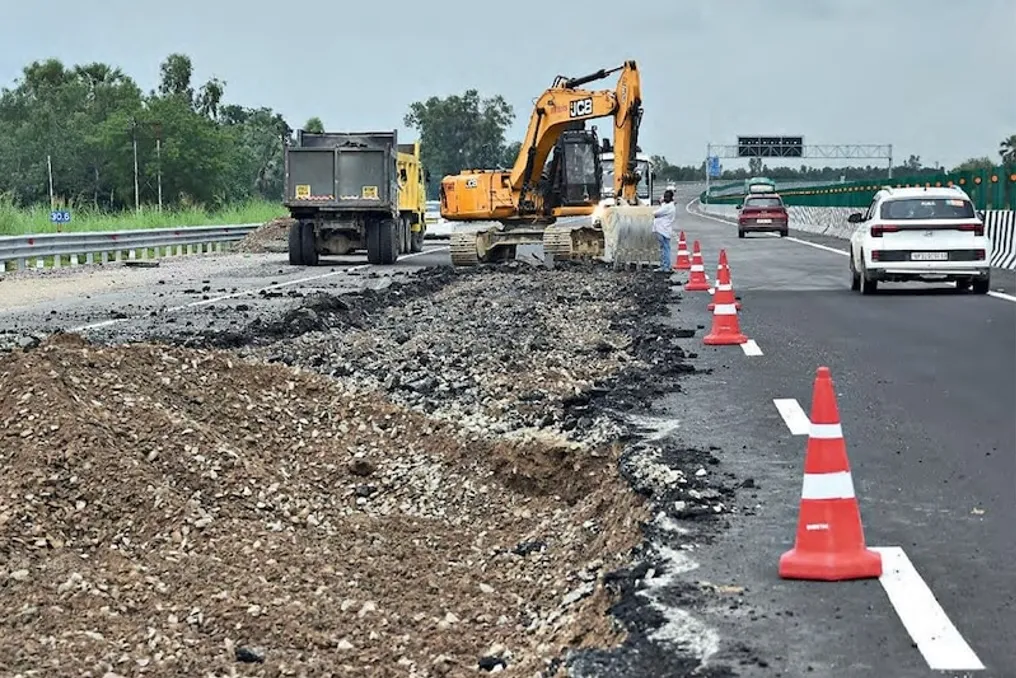
NHAI bans PNC Infratech for 3 years over Lucknow-Kanpur Expressway issues
Read more
Aaj Tak
www.aajtak.in

NHAI bans PNC Infratech for 3 years over Lucknow-Kanpur Expressway issues

Following the discovery of negligence and low construction quality on the Lucknow-Kanpur Expressway, the National Highways Authority (NHAI) has taken strict measures. NHAI declared the company responsible for building the expressway, 'PNC Infratech', as an 'inefficient contractor'.

As a result, the company has been excluded from all NHAI projects for a period of three years. NHAI formed a technical committee to conduct a thorough investigation into the entire matter.

According to available information, a significant portion of the Lucknow-Kanpur Expressway collapsed shortly after its opening. Complaints were also received regarding the shifting of the road surface layer and the appearance of large cracks in many places.

Serious questions have arisen regarding the condition of this high-speed corridor, which was built at a cost of millions of rupees. Consequently, NHAI established a special technical committee to investigate the situation. This committee is examining the materials, design, and engineering flaws used in the construction of the expressway.

Previously, NHAI had recommended declaring PNC Infratech an inefficient contractor, imposing a fine of 2 percent on it. Furthermore, due to the negligence of the company 'Theme Engineering Services', an independent engineer was issued a work ban notice.

As a consequence of violations in supervision and construction, PNC Project Manager Vivek Gupta, Resident Engineer Yatendra Kumar, and Independent Engineer Team Leader Surendra Kumar were immediately suspended from their positions. These three employees have been completely banned from working on any NHAI, MoRTH, and NHIDCL project for the next two years.

Moreover, NHAI also shifted Project Director Nakula Prakash Verma, and former Project Director Saurabh Chorsia was sent a charge sheet demanding an explanation.
Similar stories

West Bengal Government Orders Closure of 252 Madrasas and Sends Notifications to 100 Others Following Inspection
Read more
www.aajtak.in

West Bengal Government Orders Closure of 252 Madrasas and Sends Notifications to 100 Others Following Inspection

The West Bengal government has issued an order to close 252 madrasas in the state. Additionally, about 100 other madrasas have received a notification requiring them to provide explanations. Officials stated that these measures were taken after conducting a comprehensive inspection across the state.

During this inspection, the absence of necessary permits and basic amenities was found in many madrasas. The Minister of the Department of Minority Affairs and Madrasa Education, Kushidurram Tudu, clarified that madrasas possessing the required permits will continue their operations. The decision for these actions was based on the deficiencies discovered during the inspection.

The department began the inspection in all districts of the state at the beginning of June. As part of this process, the situation in both government and private madrasas was examined. Staff assessed the infrastructure of the madrasas and also checked their management system and the presence of relevant permits.

The minister noted that the goal of the inspection was to determine the number of authorized and unauthorized madrasas in the state. This initiative was launched under the directive of Chief Minister Suvendu Adhikari.

Officials stated that 100 madrasas received notifications requesting a response regarding their status. A decision on further steps will be made after studying these responses. The minister emphasized that the 252 madrasas were ordered to close due to the lack of necessary permits and insufficient basic conditions. He also added that madrasas operating in accordance with the law will not be closed.

The Minister for Local Self-Government, Dileep Ghosh, stated that he had received numerous complaints concerning madrasas. He reported that in some cases, individuals arrested for involvement in radical activities were found working as teachers in these institutions. Dileep Ghosh also mentioned complaints about anti-government activities taking place in some madrasas, noting that the government would take action against such institutions. Nevertheless, madrasas with state licenses and operating according to the law will continue to function.

In response to the government's actions, Kunal Ghosh, a representative of the opposition party Trinamool Congress and a legislator, expressed disagreement. He argued that not all madrasas can be treated equally. Kunal Ghosh stated that all madrasas cannot be accused based on complaints received about one specific institution. The state government insists that the measures are being taken exclusively against those institutions where deficiencies in documentation or infrastructure were found.

Popular