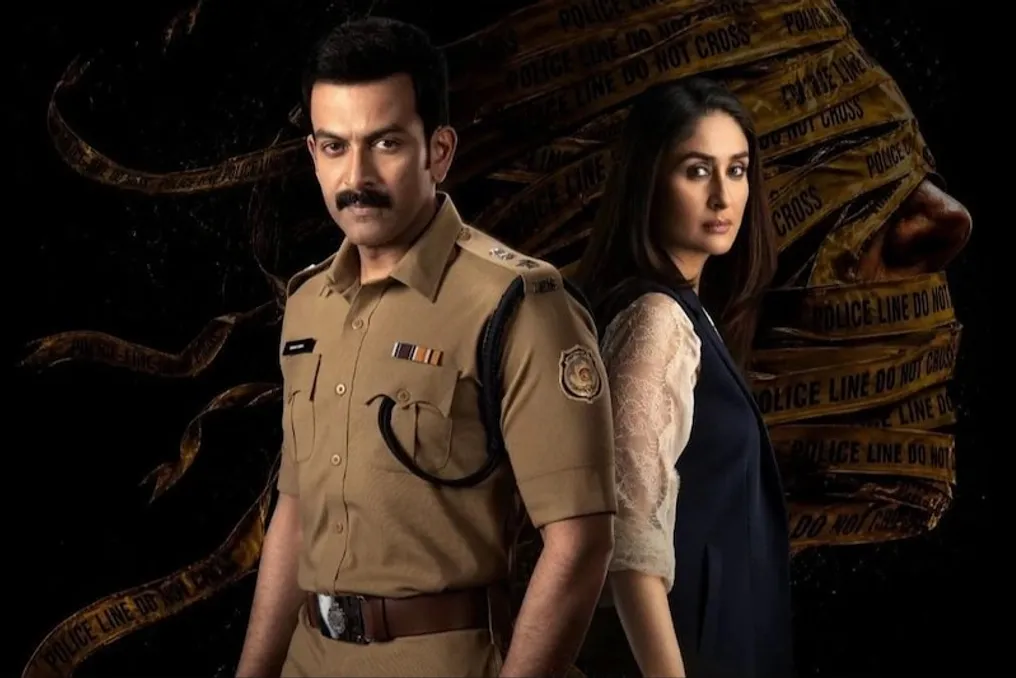
After committing heinous crimes such as murder and rape, the question constantly arises: should the law be allowed to proceed at its own pace, or should those guilty of the crime be punished immediately? This is the question that Meghana Gulzar's film 'Daira' poses to the viewer. However, the film does not impose a definitive answer but encourages the viewer to consider both sides of the issue.
The main feature of 'Daira' is that it is not just a story about the police and criminals. It is a narrative about the fine line between law, justice, police responsibility, and personal ethics, where the boundary between good and evil suddenly becomes blurred.
The film will be released in theaters on September 18th. Before going to watch, you can read a review and learn more about the picture.
The plot of the film centers around DCP Raman Kumar (played by Prithviraj Sukumaran) and DCP Ajuni Kohli (played by Kareena Kapoor Khan). Raman and his team are handling a case of an encounter, during which suspects in the rape and murder of a young woman were killed. Subsequently, Ajuni is assigned the investigation of this case. This is where the main drama of the film begins.
Ajuni clearly states that she is investigating not the actions of her colleagues, but the events themselves, asserting that the law stands above form. On the other hand, Raman believes that when the system constantly drags out the process, punishment must be ensured for the criminals for their deeds. This conflict between them maintains the tension in the film.
The story draws inspiration from real incidents, including debates on the law and cases of rape following the Nirbhaya case in 2012. Nevertheless, the film does not merely reproduce this tragedy but uses it as a basis for discussing issues of delayed justice and police accountability.
Kareena Kapoor Khan in the role of DCP Ajuni proved very convincing. Her character differs from the stereotypical image of an impulsive policeman in Hollywood. Ajuni defends her point of view through dialogues, arguments, and dry humor. Her calm yet strict approach sets the character apart. Prithviraj Sukumaran in the role of Raman is also strong. His character does not shout excessively but creates pressure through silence and facial expressions. Raman knows the legal procedure, but for him, the delay in achieving justice is a serious problem.
The most interesting aspect is the professional rivalry between them. The chemistry between Kareena and Prithviraj here is not romantic, but based on the clash of ideas and laws, which constitutes the film's great strength. The supporting cast, including Kanwaljeet Singh, Achint Kor, Anuja Sate, Sima Ajmi, Bishwapati Sarkar, and Jitendra Joshi, successfully handles their roles, although some characters do not get much screen time.
Meghana Gulzar previously demonstrated an understanding of similar themes in the films 'Talvar' and 'Ragini'. In 'Daira', her direction serves not as a dominance over the story but helps it develop. The soundtrack is used appropriately in most scenes, without unnecessary noise or excessive sound design, allowing the situation and actors to 'breathe.'
The first half of the film is the strongest part. Ajuni's investigation, Raman's perspective, and the growing confrontation between them keep the viewer engaged in the story. The questions raised at the beginning create anticipation that the film will deepen the discussion on justice and law later on.
However, after the intermission, the film focuses more on the actions and consequences of the events. The script somewhat simplistically concludes the search for criminals and subsequent events. The depth of the system and the legal process felt in the first half is not as pronounced in the second part. Here, the film slightly loses its initial sharpness.
Moreover, the character of the victim's mother, played by Kshiti Jog, leaves a significant impression. Her pain provides the necessary emotional anchor to the film. The author believes that 'Daira' is a good and serious crime thriller whose main strength lies in the question: should the law do its job, or should justice be immediate? As a woman, the author was able to strongly respond to this topic. Although readers may accuse her of bias, she emphasizes that the film does not make a decision for the viewer. That is its beauty, as well as a certain limit.
The first half brilliantly creates an atmosphere that Kareena and Prithviraj enhance with all their power, whereas in the second half, the plot becomes more straightforward. Nevertheless, this 143-minute film keeps you in suspense, and its questions remain in your mind even after leaving the theater. If you like serious crime thrillers, police dramas, and thought-provoking films, then 'Daira' is a movie worth watching on the big screen.