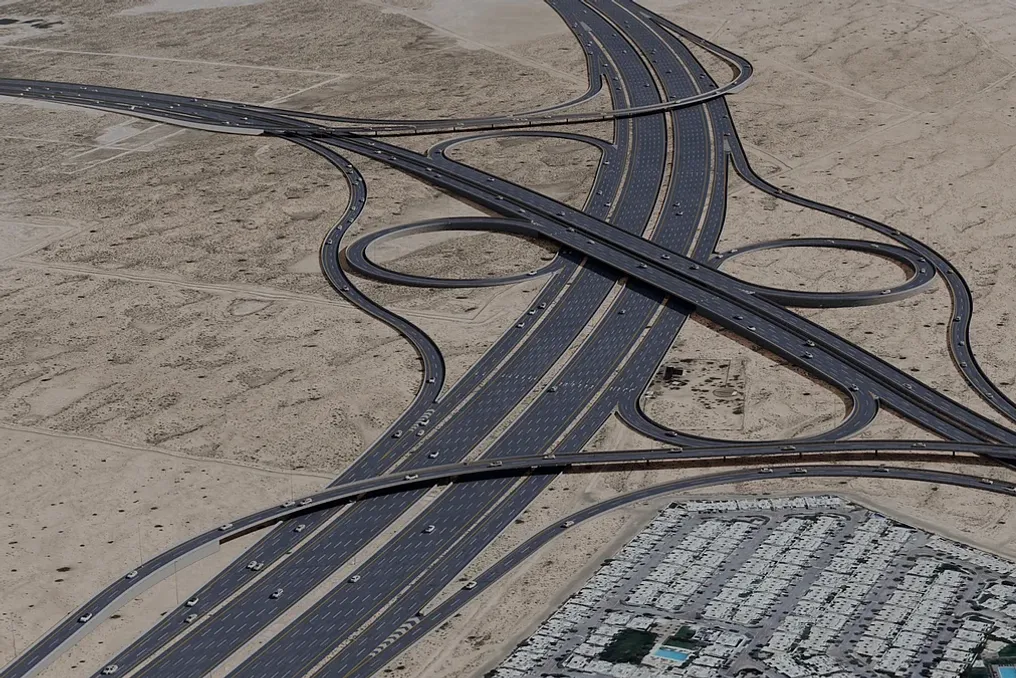
Drivers using Dubai's planned Fourth Corridor may notice a reduction in travel time on certain route sections by more than double; one segment will allow the journey to be shortened from 35 minutes to just 14 minutes.
Details of the project show that this 80-kilometer corridor will be implemented in two phases, which are expected to serve approximately 600,000 people and 3.1 million people, respectively.
The corridor is named the Fourth Corridor because it will become the fourth strategic road axis connecting the UAE emirates, following major highways such as Sheikh Zayed Road/Al Ittihad Road, Sheikh Mohammed bin Zayed Road, and Emirates Road.
Sharjah to Dubai-Al Ain Road:
The first phase will stretch approximately 30 kilometers from Al Shnouf Road in Sharjah to Dubai-Al Ain Road. Travel time is expected to decrease by 60 percent, dropping from 35 minutes to 14 minutes.
Dubai-Al Ain Road to Abu Dhabi:
The second phase will cover 50 kilometers, running from Dubai-Al Ain Road to Al Fayah Road in Abu Dhabi. A reduction in travel time of 52 percent is projected, from 50 minutes to 24 minutes.
Each phase will feature a total of 12 lanes in both directions, providing a capacity of up to 24,000 vehicles per hour. The first phase will run from Al Shnouf Road in Sharjah to Dubai-Al Ain Road, and the second from Dubai-Al Ain Road to Al Fayah Road in Abu Dhabi.
This will create another strategic road link between the three emirates and strengthen Dubai's connections to the federal road network. The route will also pass by Al Maktoum International Airport, Al Marmoom Nature Reserve, the Desert Wildlife Reserve, and the Etihad Rail line. It will serve several residential and developing areas, including Madinat Latifa, Madinat Hind, Al Yalayis, Al Awir, and Dubailand.
Authorities stated that the corridor will also support future urban expansion in new zones, help integrate the road network with major transport projects, and support the logistics and commercial transport sectors.
The project includes expanding Dubai-Al Ain Road from three to four lanes in each direction between Emirates Road and Lehbab Road. Additionally, four major intersections will be modernized as part of the first phase.
The key goal of the corridor is to divert transit traffic, especially trucks, away from urban areas. The Roads and Transport Authority stated that this will help reduce the load on existing road corridors while improving traffic flow and safety.
The corridor is also expected to promote the development of commercial transport and strengthen Dubai's logistics sector. The scale of the project requires significant new infrastructure. Over the two phases, plans include the construction of 72 bridges, 17 tunnels, and 45 drainage canals.
The first phase will comprise about 55 kilometers of ground roads, 2.5 km of tunnels, and 21 km of bridges and ramps. The second phase will cover about 190 kilometers of ground roads, 3.5 km of tunnels, and 157 km of bridges and ramps. The project implementation is divided into two phases due to its large scale. The first phase, from Al Shnouf Road to Dubai-Al Ain Road, is estimated at approximately 3.5 billion dirhams.
