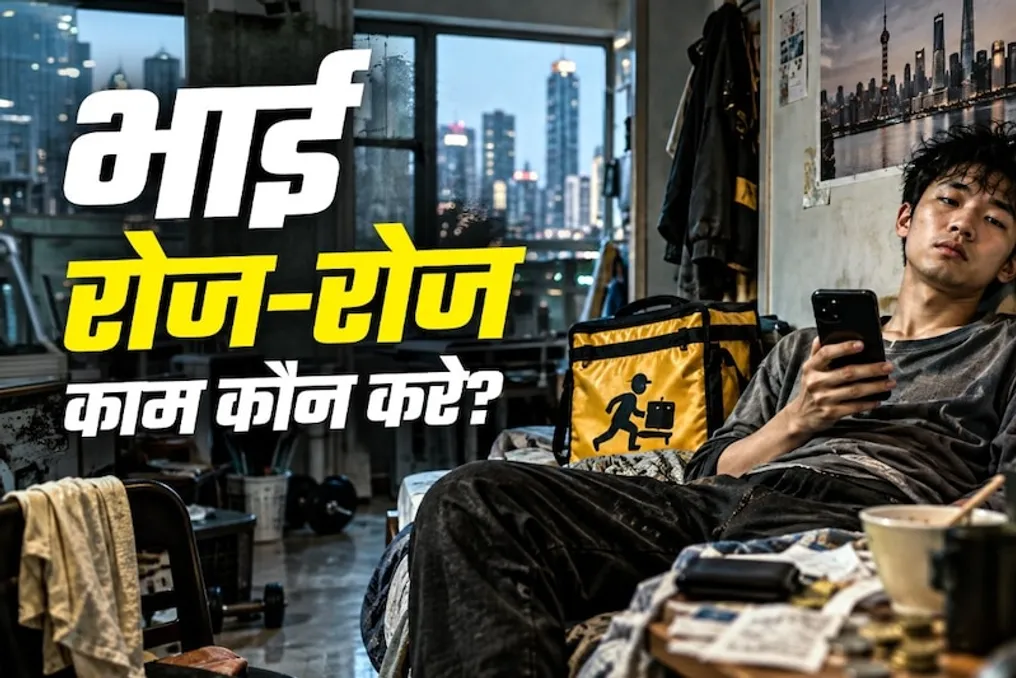
A trend described as 'Wall-hanging youth' is gaining popularity among young people in China. After completing their education, young individuals often face a prolonged job search, which leads to the depletion of financial resources and a feeling of lacking a clear life path. In a humorous way, they say they work for one day and spend the next three days in a state of rest known as 'let flat.'
This phenomenon is caused by several factors, including unemployment, financial difficulties, and uncertainty about the future. The term 'Wall-hanging youth' has gone viral in China and is used to describe young people who have somewhat distanced themselves from society and do not have stable employment or an income source. This group includes university graduates. Instead of following the traditional path of continuous employment, they engage in temporary earnings and then spend days without working, meaning their lives are not moving according to a set schedule.
The story of 29-year-old Guo Cixiao illustrates this situation. Guo lives in Shenzhen, southern China. At one point, he did not even have a place to live and temporarily stayed in 24-hour billiard halls. At a difficult moment, he only had 20 yuan, equivalent to approximately 3 US dollars. Guo emphasized that this period was extremely challenging not only due to financial problems but also due to constant time pressure.
Despite coming from a well-off family and studying economics and management, his life changed due to job and financial issues. His story demonstrates that even after obtaining an education, there is no guarantee of permanent employment and economic stability for every young person.
The most notable characteristic of 'Wall-hanging youth' is their approach to work. Some of these young people engage in irregular or temporary work instead of a permanent position. After a period of work, they may spend several days without being occupied. This regime is ironically called 'one day of work, three days let flat.'
'Let flat' refers to distancing oneself from big ambitions or the continuous race, focusing only on what is necessary. However, the situation differs for each young person: some may have financial support, while others have to deal with issues of food and housing. Although this trend might seem like a sign of laziness or avoidance of work at first glance, the reality is much more complex.
Causes such as the inability to find permanent work, low income, rising expenses, and future uncertainty push some young people out of the traditional career race. Guo's story shows that such a situation can arise not only for those without family or educational support but also for educated individuals due to circumstances.
Guo insists that the problems of 'Wall-hanging youth' cannot be ignored. He believes that such young people should not be judged solely by their financial status or lack of work. His account highlights the difficulties faced by Chinese youth who are searching for a normal life and stable employment but constantly encounter uncertainty. This is why the term 'Wall-hanging youth' has become a topic of discussion on social media and in China's work culture, reflecting the lives of youth stuck between job searching and financial stability.