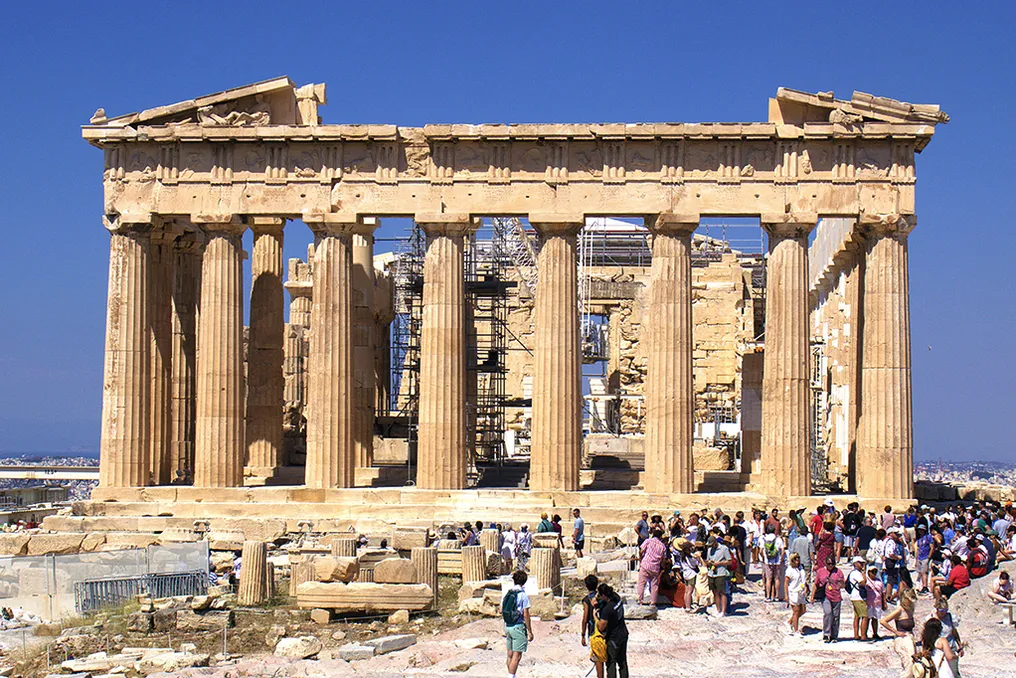
The famous optical illusion associated with the Parthenon is, in fact, a myth. The building, located in Athens, Greece, is one of the main vestiges of Ancient Greece, originally a temple dedicated to the goddess Athena, but later serving as a Christian church and mosque.
With approximately 30 meters in width, over 13 meters in height, and built mainly of marble, the Parthenon appears to have perfectly straight lines. However, it features subtle curves. For a long time, the scientific community believed that these curvatures were intentionally incorporated to compensate for optical illusions that might make the Parthenon look crooked from a distance.
New research has shown that this belief is, in reality, a persistent myth. Mathematician Alain Goriely, affiliated with the University of Oxford, conducted a detailed investigation into these supposed illusions. Initially, he performed a literature review, identifying the oldest source of this idea as a book from the 1st century BC, written by the Roman architect Vitruvius, information that was accepted as fact in subsequent studies.
Subsequently, Goriely used mathematical modeling to examine the effects of the curves on the Parthenon. He concluded that any illusions generated by the curves were practically imperceptible. The findings were published on Wednesday, the 16th, in the scientific journal Royal Society Open Science.
It was noted that the base of the Parthenon has a slight curve and is slightly elevated in the center, by about six centimeters. The traditional explanation for this feature was that the Greeks sought to neutralize the optical effect of the structure sagging in the middle when viewed from afar. However, Goriely found no proof to support this theory.
Regarding the columns, they have small protrusions, which theoretically aim to correct Hering's optical illusion, where superimposed parallel lines appear to curve at a distance. However, this hypothesis was also refuted, as the columns of the Parthenon are extremely vertical and do not produce such a visual effect; moreover, the protrusions are minimal and barely perceptible from a distance.
Thus, the study suggests that the illusion was a human perception, not a Greek architectural feature. The builders likely incorporated these elements for practical reasons, such as preventing rainwater accumulation, or simply for aesthetic reasons. The author emphasizes that the lesson of the Parthenon is that humans tend to be deceived in the search for ancient mysteries and fantasies of order, requiring the application of science to go beyond these illusions.