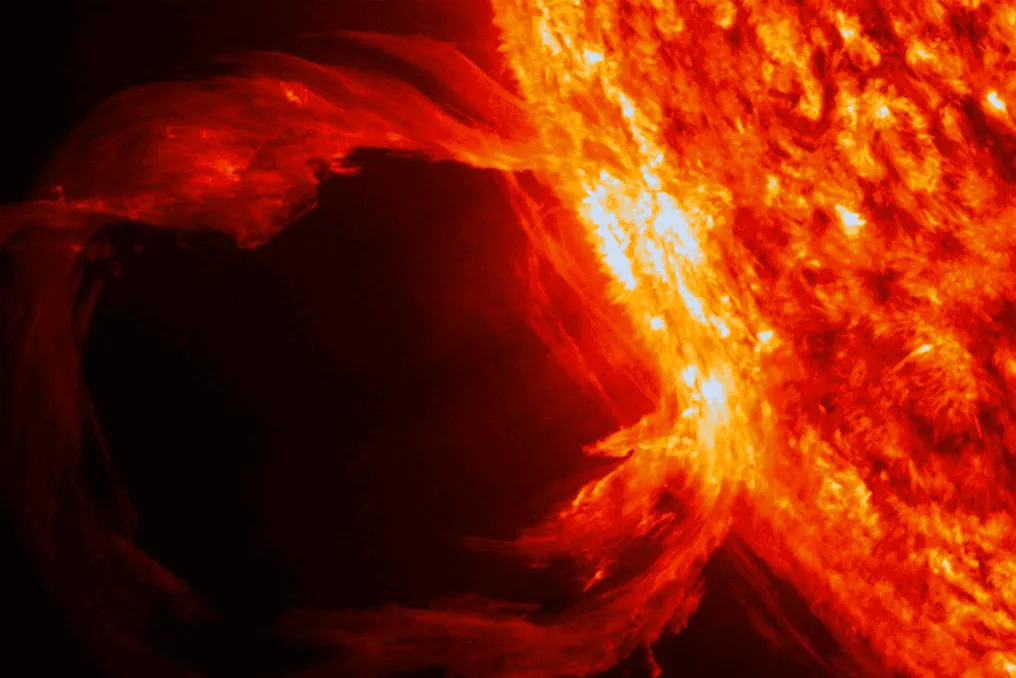
In May 1967, the Sun produced one of the most significant solar flares observed in the 20th century. A vast active region on the Sun's surface released a huge amount of radiation, causing intense radio emissions. On Earth, this solar excitation generated beautiful auroras and communication system interference across the planet. Although these effects were serious, they are not comparable to the Carrington Event, the most powerful solar storm known, which occurred in 1859.
However, there is a specific factor that makes the history of 1967 particularly interesting and equates this storm to the most dangerous for humanity. A solar flare occurs when energy accumulated in the magnetic fields of a solar active region is released extremely rapidly. This generates radiation across various ranges of the electromagnetic spectrum, including X-rays and radio waves.
Traveling at the speed of light, X-rays reach Earth in about eight minutes. Upon hitting the atmosphere, they cause disturbances in the ionosphere—a higher layer containing charged particles that plays a vital role in radio wave propagation. The ionosphere reflects high-frequency (HF) radio waves, enabling long-distance communication. This type of communication was therefore vital for decades for ships, military forces, and other operations needing to transmit information far beyond the horizon, including rescuing lost aircraft at sea.
But a sufficiently intense solar flare can drastically alter ionospheric conditions. The result can be radio silence, affecting HF communication across much of the planet. This is precisely what happened on May 23, 1967. The solar flare was accompanied by exceptionally intense radio emissions that directly disrupted communications. Subsequently, energetic particles associated with solar activity reached Earth and caused other effects, especially in polar regions. In the following days, solar activity contributed to a significant geomagnetic disturbance.
This was not the first time solar storms had interfered with communication on Earth, nor will it be the last. But to understand why it was so dangerous for humanity in 1967, one must recall the historical context of that time. The world was at the height of the Cold War. The United States and the Soviet Union maintained massive nuclear arsenals, and facing an attack that could jeopardize their very existence, the US possessed a network of radar and warning systems to detect potential Soviet missile launches. These systems depended on fast and reliable communication.
Imagine the situation: fundamental equipment for detecting and responding to a potential military threat begins experiencing communication problems. And all at once. This affects systems that must operate precisely when information needs to be transmitted with absolute certainty. One of the hypotheses considered in that context was the possibility that this was a deliberate act by Soviet personnel—sabotage of communication systems to give missiles a clear path to a final attack. It is easy to imagine the scale of the problem: if this interference were interpreted as a Soviet action, the reaction would be inevitable and extremely dangerous.
Fortunately, for Americans, Soviet citizens, and the world, the United States had already established a space weather department with specialized groups monitoring the Sun and its effects on Earth. Therefore, when communication problems began, specialists were able to link them to the immense solar activity occurring at that moment. The origin was not Soviet; it was solar.
Since the United States was in daylight on Earth during the flare, they were the first to feel the consequences of this storm, which subsequently spread worldwide. Presumably, if the Soviet Union had been on the sunlit side, the dilemma would have repeated itself, but with switched flags. During the Cold War, tensions between the two superpowers were high and constant. Without systematic monitoring of solar activity, which was recently initiated, this solar storm could have triggered a series of events with unpredictable consequences here on Earth.
However, we learned from this incident that a solar flare can cause different effects at different times. Electromagnetic radiation, radio waves, energetic particles, and magnetic field disturbances can affect technological systems in different ways. This is why the 1967 storm is so interesting. It demonstrates that there is no single way to measure the danger of a solar storm. It can be extremely intense from a geomagnetic perspective, or it can cause particularly severe radio silence. And the ultimate effect also depends on which technologies are operating on Earth at the time.
Today, human dependence on radio technology, satellite transmission, and electronic devices that can be affected by solar storms is much higher than it was 60 years ago. We also have more advanced science capable of predicting these extreme events with greater lead time. But would the main world leaders have possessed such caution in the face of technological shutdown consequences?
It is interesting that the main lesson of this story is that in 1967, scientific knowledge helped humanity cope with one of the most dangerous solar storms we have faced. But the greatest danger was not in the Sun or the particles directed at Earth. It was here, among the people who gained the ability to destroy their own existence.