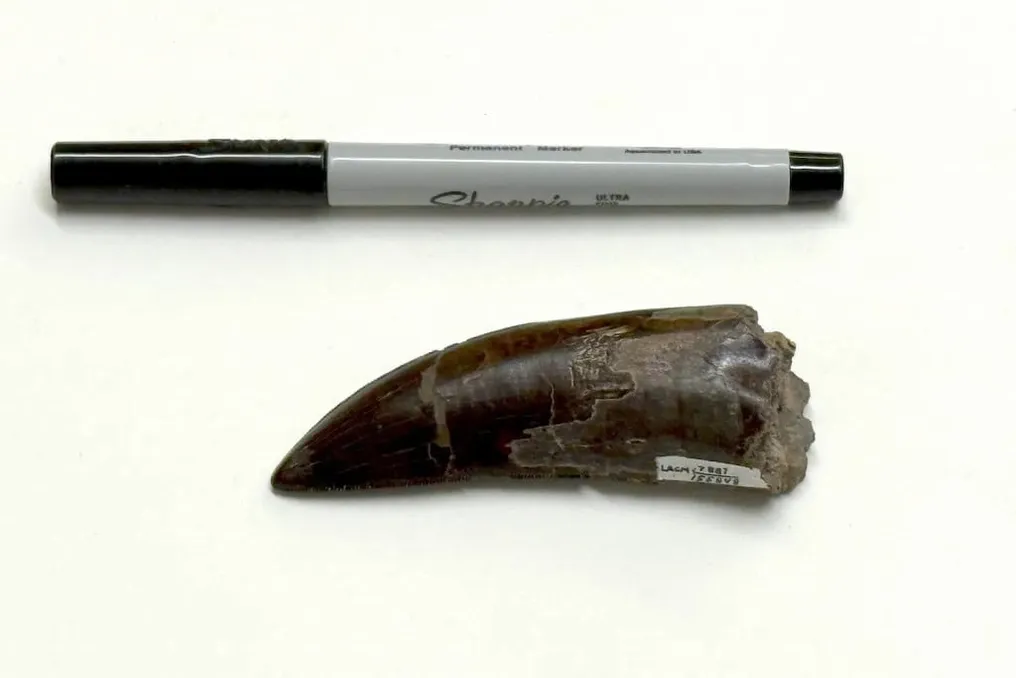
For many years, the scientific community debated whether Tyrannosaurus rex was a cold-blooded reptile, whose temperature depended on the environment, or if it could maintain its body heat autonomously. A recent investigation based on fossilized teeth provided the most concrete evidence to date that this notorious predator was endothermic.
According to a study published in the journal Science Advances, it was found that T. rex maintained a body temperature of approximately 36.3 °C, a value quite close to that of humans. This finding was achieved through the analysis of three T. rex teeth recovered from the Hell Creek Formation, located in Montana, United States.
Scientists examined the fossilized enamel looking for correlations between rare isotopes of carbon and oxygen, whose proportions change according to temperature. Although the method already existed to measure the temperature of extinct animals, it required a larger amount of fossil material. The refinement of the technique reduced this need by about 90%, allowing work with mere milligrams of T. rex dental enamel.
This optimization was crucial, given that T. rex teeth are extremely scarce items in museum collections. To conduct the study, researchers obtained permission to collect small samples from two teeth belonging to Thomas, a T. rex specimen preserved at the Los Angeles County Museum of Natural History.
The enamel fragments were removed using a dental drill and subsequently dissolved in phosphoric acid. This procedure released carbon dioxide containing the essential isotopes for analysis. Subsequently, a mass spectrometer was used to determine the chemical compositions and calculate the animal's body temperature, resulting in 36.3 °C.
For comparison, modern cold-blooded reptiles generally have temperatures between 28 °C and 30 °C, while birds—descendants of a dinosaur lineage—typically range between 40 °C and 43 °C. Robert Eagle, a geobiologist at the University of California, Los Angeles (UCLA) and co-author of the study, commented that 'the temperature is approximately what I would have imagined,' emphasizing that the value is higher than that of a reptile or a slower-metabolizing mammal, such as a sloth, but lower than that observed in birds.
Implications of the Discovery
This new knowledge also helps distinguish T. rex from ectothermic animals, those that depend on external heat sources to raise their body temperature. Researchers compared the data with crocodile teeth found in the same area, which recorded body temperatures of approximately 30 °C, lower than the 36.3 °C of T. rex. This disparity suggests that the dinosaur's temperature was not merely determined by the climatic conditions of Hell Creek.
For scientists, this difference corroborates the hypothesis that T. rex internally generated much of the heat necessary to maintain its temperature. Furthermore, the result aligns with other evidence accumulated over the years regarding characteristics of endothermy in tyrannosaurs and other groups of dinosaurs. However, researchers warn that this does not imply that all dinosaurs were warm-blooded, as different groups might have adopted distinct physiological strategies.
A body temperature close to that of humans offers an explanation for certain characteristics attributed to T. rex. An endothermic animal requires more energy to sustain its metabolism and temperature, but it is also capable of maintaining high levels of activity without depending on environmental heating.
Researchers suggest that an endothermic T. rex would be a vigorous and active animal, capable of hunting or foraging to meet its accelerated metabolism. The discovery may also clarify how T. rex managed to inhabit regions with large thermal fluctuations, since tyrannosaur fossils have been found in cold climates, such as present-day Alaska.
Aradhna Tripati, a geochemist at UCLA and co-author of the study, stated that the teeth demonstrate that T. rex was warmer than its surrounding environment. The ability to generate its own heat would have allowed the animal to occupy a vast area, potentially including arctic zones. This result constitutes the first direct estimate of T. rex body temperature, offering chemical support to an old suspicion of the researchers. Additionally, the technique can be applied to other extinct animals to investigate the evolution of thermoregulation capacity among dinosaurs.