NASA has taken an important step in the Nancy Grace Roman Space Telescope mission by successfully activating its main scientific instrument. This initiative marks the beginning of an investigation phase covering everything from planets outside the Solar System to the mysteries of dark matter and energy.
The Wide Field Instrument (WFI), which functions as a 300-megapixel infrared camera, is capable of capturing in a single photograph a celestial area larger than the apparent diameter of a full moon, while maintaining sharpness comparable to that achieved by space telescopes like Hubble.
Along with the activation of the WFI, the mission team conducted the first tests of the Coronagraph Instrument, equipment specifically designed to enable the direct visualization of planets orbiting other stars.
These two activities are part of an extensive schedule of calibrations and tests that will extend over several months, as Roman continues its journey toward its destination, the Sun-Earth L2 Lagrange point.
Statements on Mission Progress
Josh Schlieder, the scientist responsible for the Wide Field Instrument at NASA's Goddard Space Flight Center, expressed satisfaction with the progress, stating: 'After years of effort to build and test the instrument on Earth, we now have confirmation that it is operational in space. This is a major milestone for the Goddard team, our industrial teams at BAE Systems and Teledyne, and our scientific centers.' He added that although there is much work ahead, the mission is heading towards revolutionary science.
On the same day, the team activated the calibration system, and the next day, engineers began receiving the first test data transmitted by the instrument.
Saturday night's tests focused on the element wheel, a mechanism that groups filters, prisms, and other optical components. This system is responsible for selecting the wavelengths of light reaching the detectors and separating the light from celestial bodies into distinct colors. It was the first time this system was evaluated in a zero-gravity environment.
On Sunday morning, engineers also inspected the WFI's focusing mechanism, which will be used to refine the focus of the hundreds of thousands of images the instrument is expected to generate.
Parallel to these procedures, the detectors were kept in a cooling process until they reached the final operating temperature, estimated at about -183 °C.
First Records of Starlight
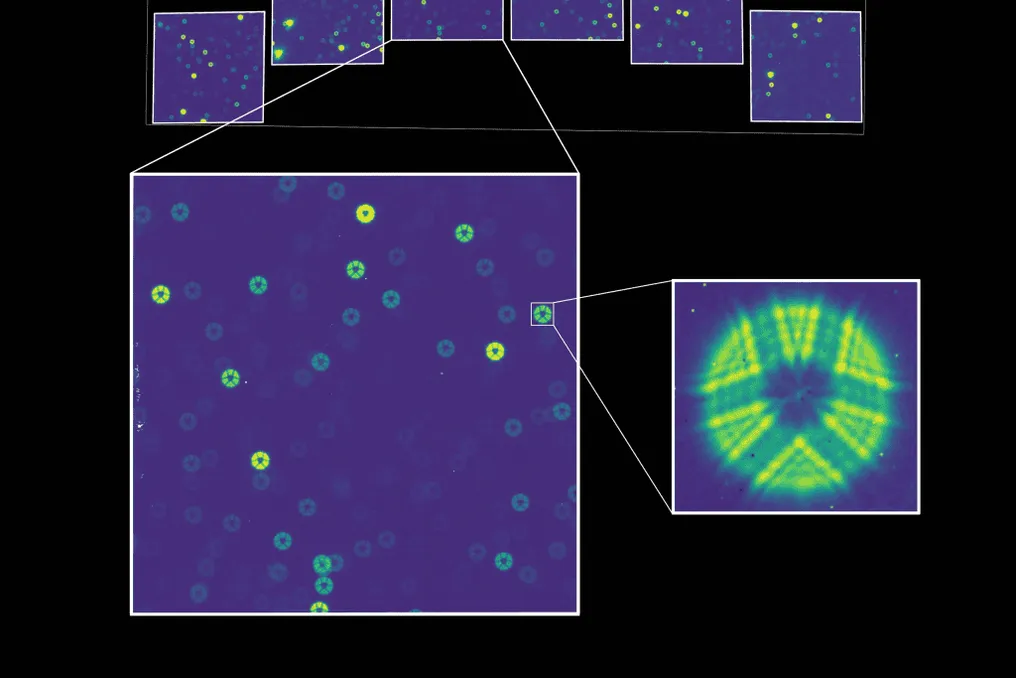
The WFI has already managed to record its first photons of starlight. This image was generated during an initial performance evaluation, a moment when the detector array was still positioned as it was at launch and far from the ideal focus. For this reason, the first recording presents a field full of blurred stars, each dispersed across thousands of pixels.
Although it does not constitute a definitive scientific image, this record proves that starlight is already being received by Roman's main scientific instrument.
The Coronagraph Instrument, aimed at the direct observation of exoplanets, also completed an initial phase of testing. This instrument employs a set of optical components, masks, adjustable mirrors, and sensors to block the intense brightness of stars, thereby allowing the detection of the much fainter light reflected by the planets orbiting them.
The coronagraph was turned on in early September and underwent a new verification, where its team tested the digital, electronic, and mechanical components, confirming remote communication between the various parts of the equipment. Its project aims to demonstrate advanced technologies for direct planet observation, assisting scientists in studying worlds and dust disks near stars.
It is clear that Roman still faces a long sequence of checks and calibrations before scientific operations can begin.