As part of the series 'Brazilian Technologies That Changed the World,' this article discusses the history of the automatic transmission, an invention made possible by two Brazilian engineers: José Brazo Araripe and Fernando Lemos.
Similar to the typewriter, early devices existed, but it was the Brazilians who developed the first truly working model. In 1902, brothers Thomas J. and Thomas L. Stertewant created a rudimentary automatic gearbox; the prototype, patented in 1904, was mechanical and only functioned at high speeds.
Later, in 1921, Canadian Munro Alfred Horner, a steam specialist, developed a pneumatic mechanism using compressed air. Although this device lacked sufficient power for commercial use, Horner patented it in 1923.
Two years later, German Hermann Rißeler patented his version, making a significant contribution by combining a hydraulic torque converter with a planetary gear set. However, his design was also not released into commercial production.
The main difference between these three projects lay in the force used for gear shifting. In the 1930s, prototypes existed, but none of them functioned properly for market release. Among them, Rißeler's project was considered the most promising, serving as the basis for the device created by the Brazilian engineers Araripe and Lemos.
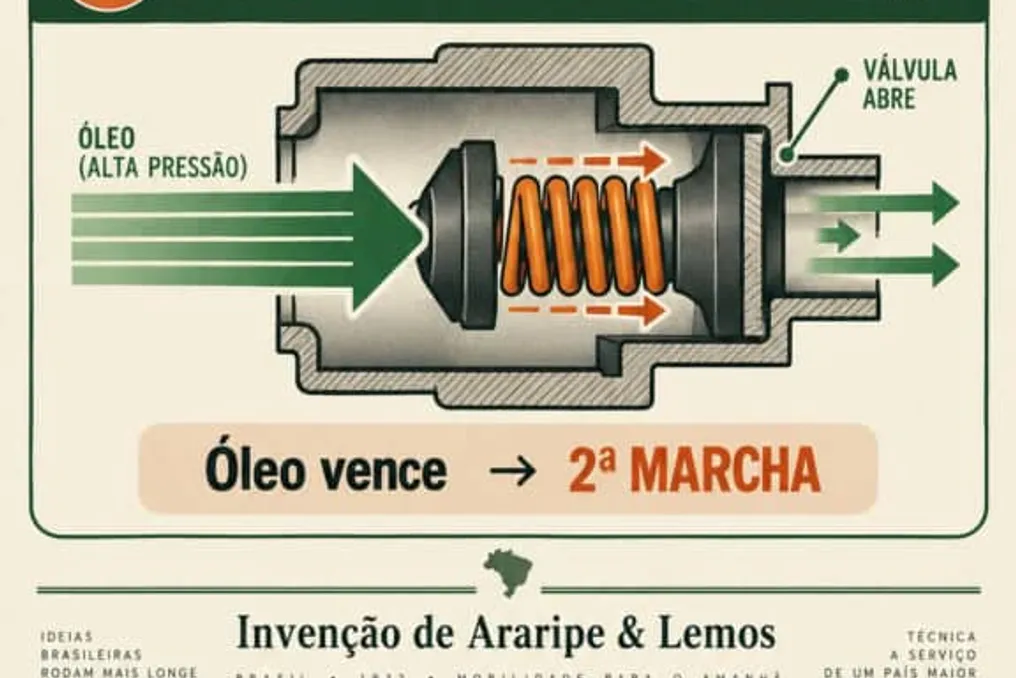
In 1932, this pair of engineers achieved a decisive breakthrough by learning to precisely control oil pressure. While Rißeler used hydraulic fluid to transmit engine power, the Brazilians developed a system where the pressurized oil itself controlled and executed gear shifting without jerking.
Although the system might have seemed similar to artificial intelligence, this was impossible given that the development took place in the 1930s. This system was based purely on physics and fluid mechanics.
Imagine a labyrinth of channels with small baffles (valves) pressed by springs. The 'brain' of this system was the speed of the vehicle. Thus, the pair of engineers created the first functional prototype of an automatic transmission ready for the market. It is important to note that, being Brazilians, they developed this system in the United States, as they moved there in the 1920s to work in ship repair workshops, dedicating over ten years to this secret project.
In 1932, they patented their invention and presented it to General Motors in Detroit. GM showed interest and made two offers: $10,000 lump sum or $1 per car sold using the technology. The pair chose the first offer. According to the official U.S. Bureau of Labor Statistics inflation index, this amount is equivalent to approximately $244,500 today (about 1.25 million Brazilian reais at the current exchange rate), which is a substantial sum. However, if they had chosen the second option, they would have earned much more.
After perfecting the Brazilians' project, GM released the Hydra-Matic transmission in late 1939. This technology debuted in Oldsmobile models in 1940.
Today, the technology invented by this pair of engineers is called the Standard Automatic Transmission (also known as 'Torque Converter'). Since the 1930s, this technology has undergone significant changes, but its hydraulic foundation remains the same. Over time, the system has gained computer control and increased from four to six, eight, nine, or even ten gears.
In conclusion, it is worth mentioning that mechanical engineer José Brazo Araripe was the cousin of the writer Paulo Coelho. Part of the story of the automatic transmission invention is contained in the book 'Mag,' the author's biography written by journalist Fernando Moraes.