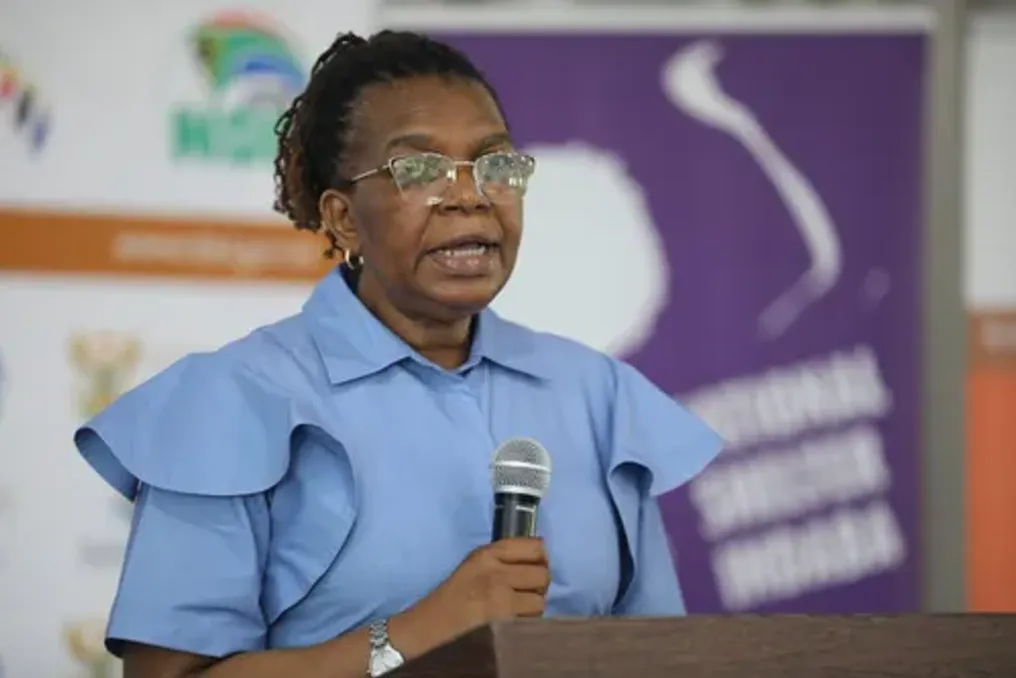
During the sixth National Shelter Meeting held in Gauteng on Wednesday, Minister of Social Development Dina Pule emphasized the need to strengthen both national and global efforts to prevent gender-based violence and femicide (GBVF).
This year's theme was set as 'Social Integration of GBVF Interventions.' Delegates from the Department of Social Development (DSD), the National Shelter Movement of South Africa (NSMSA), and shelter representatives noted during the meeting in Gauteng on Wednesday the need for closer cooperation and collective action to address GBVF issues.
The Department stated that since its establishment in 2021, this meeting has served as an important professional platform for officials, participants, and stakeholders striving to eradicate GBVF, allowing them to exchange knowledge, experience, and lessons learned.
Furthermore, the meeting provides participants with an opportunity to develop strategies for effectively addressing the problems, gaps, and challenges affecting the provision of services to affected women and their children.
Promoting Social Cohesion
One of the topics discussed on the first day of the meeting was tolerance. Government and shelter representative organizations agreed that promoting tolerance and social cohesion is crucial for making progress in combating the GBVF crisis.
The Department of Social Development leads the Fourth Pillar of the National Strategic Plan on Gender-Based Violence and Femicide (NSP-GBVF), which focuses on support, care, assistance, and healing.
Dina Pule highly commended the continuous support provided by NSMSA and the Heinrich Böll Foundation over six years.
Pule addressed shelter staff, social workers, counselors, and support personnel, saying: 'I greet you. Your work is at the forefront of our national response. You are the hands reaching out to survivors, the voices breathing hope into despair, and the guardians of dignity when it has been most cruelly taken away.'
She noted that the statistics necessitating such a statement remain shocking. 'One in three women aged 16 and older has experienced physical violence. Three women are killed by their intimate partners every day. Between July and September 2025 alone, over 2000 survivors sought help at Thuthuzela Care centers. Approximately 65% of all registered victims of gender-based violence in some provinces are children,' she stated.
Crime Asset Recovery Fund Account
Pule also expressed gratitude to the department for the work conducted in 134 operational shelters, made possible through the joint efforts of her department and the Department of Public Works and Infrastructure (DPWI).
She reported that through funding from the Crime Asset Recovery Account (CARA), the department acquired nine vehicles for anti-trafficking shelters (TIP) across nine provinces. Additionally, the department is establishing four integrated Khuseleka centers in the provinces of Limpopo, Mpumalanga, North Cape, and KwaZulu-Natal.
Pule emphasized: 'Social integration is not an abstract concept. It requires concrete actions. Survivors must be at the center of policy, services, and resource decision-making. Their voices must guide our actions.'
Saving Lives
The National Development Agency (NDA) plays a vital role in the economic empowerment of women and GBVF victims. Pule explained that the NDA served as a mechanism through which DSD directed and utilized funds allocated from CARA for the Victim Empowerment Program through Civil Society Organizations (CSOs), which provided direct and indirect support to GBVF victims.
This program ran from 2020 to 2023, allocating 95 million rand. Pule concluded: 'To the shelter representatives, your work saves lives. Every woman who finds shelter, every child protected from harm, every family given a chance to heal—that is your achievement.'