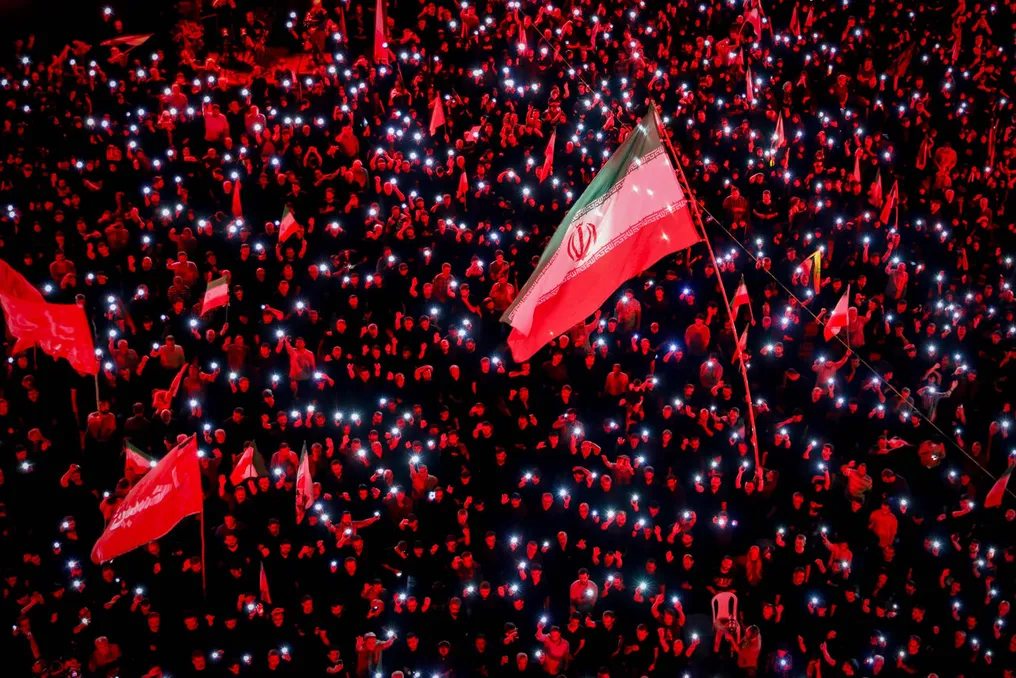
Across the Islamic Republic of Iran, people took to the streets to mark the 200th night of protests directed against aggression from the United States and Israel. These gatherings take place in various cities: on Hargh Island, where darkness descends upon the waters of the Persian Gulf; in Shiraz, where the squares are lit up; in Sanandaj, where people head to Azadi Square; in Birjand, where families gather in the cold; and in Tonekabon, on the Caspian coast, where an elderly veteran slowly walks toward the crowd.
In the city of Arak, a woman named Zahra Fattahi sits at a sewing machine under the light of Martyrs' Square. For nearly 200 nights, she has brought her machine, mending damaged Iranian flags and preparing them for re-raising. This image—a woman, a sewing machine, a piece of torn fabric, and a square filled with people—may tell more about these nights than any official statement.
Two Hundred Nights
Two hundred nights have passed since the start of nightly gatherings in Iranian cities following the outbreak of war. According to correspondents from Mehr News Agency, these assemblies continued through heat, humidity, rain, and winter cold. The nature of the gatherings varied from city to city: some were dedicated to mourning, others included cultural programs, Quran readings, music, children's activities, as well as tents with food and tea, speeches, and family reunions.
However, despite all the differences, one constant motif emerges: people return to the same public spaces every night. For many participants, these nights have taken on a second, more personal meaning—the absence of Ayatollah Seyyed Ali Khamenei, the former Supreme Leader, who died during the war. His absence is noticeable in photographs, banners, conversations, and moments of silence. According to some respondents interviewed by Mehr, the nightly gatherings have become a place where grief and public presence exist side by side.
Previously, on March 12, 2026, in his first military address, Ayatollah Seyyed Mojtaba Khamenei called on people to help each other in difficult times. On April 9, he stated that the announcement of negotiations should not lead people to conclude that public presence in squares, neighborhoods, and mosques is no longer required. The subsequent 200 nights have turned into an extensive collection of local stories.
Arak: Three Generations Under One Flag
In Arak, the capital of Markazi Province in central Iran, a camera captures a mother holding her child. At first glance, there is nothing remarkable about this scene: no speeches, no scenes, or dramatic gestures. Just a mother, a child, and a crowd gathered at night. Nevertheless, it is precisely this that gives the photograph emotional weight. Over 200 nights, the square hosted families who came together. Parents brought their children to the public space where different generations stand side by side.
Another photograph illustrates a different version of the same story: women of different generations standing together under a banner. Older and younger women occupy the same frame, separated by decades but united by one night. Then, the sewing machine appears. Every night, Zahra Fattahi brings it to the square, mending flags damaged during the gatherings and preparing them for re-raising. She told Mehr that she attended almost all 200 nights. Her contribution is small physically—a thread passing through fabric, a needle moving back and forth, joining a torn edge. But repeating night after night, it has become a symbol in the visual chronicle of Arak.
There is also a quiet sorrow in this picture. A flag can be repaired. A torn piece of fabric can be sewn. But a lost person cannot be brought back. For some participants, this is the deep emotional component of these nights: continuing to gather, remembering a leader whose absence has changed the very meaning of these assemblies.
Shiraz: The City That Remembers
In Shiraz, the capital of Fars Province in southern Iran, the night begins with light. Imam Hussein Square, Mollem Square, and Vali Asr Square gradually fill with people. Families arrive, young people stand next to older residents, and flags rise above the crowd. Mehr's report describes a city whose nightly gatherings repeated for 200 nights. This scene has its own rhythm: people arrive, the light grows brighter, programs begin, voices fill the square, and then late at night, people disperse home to return the next day.
The emotional power of such repetition lies not necessarily in the size of the crowd, but in the passage of time. One night can become an event, and two hundred nights—a memory.
Hargh: Heat, Humidity, and Gulf Lights
On Hargh Island, the story unfolds against the backdrop of one of Iran's most important oil landscapes. The island is located in the Persian Gulf, in Bushehr Province, and is closely linked to Iran's oil export infrastructure. It is also very hot and intensely humid there. Nevertheless, local residents continue to gather throughout this 200-night period. The oppressive heat does not completely disappear at night, humidity remains in the air, and the sea is visible beyond the lights of the gathering, yet people still come. There is something primal in this scene: an island surrounded by water, a city accustomed to heat, and people gathering after dark.
Birjand: Teenager Among Generations
In Birjand, the capital of South Khorasan Province in eastern Iran, gatherings took place in Maalem, Abuzar, and Modares Squares. Children stand next to adults, the elderly watch the programs, and flags and cultural tents become part of the nightscape. Fourteen-year-old Maedeh Fayazi is among those reported to have attended most nights. Mahdi Rahimabadi, 42, was present on the 200th night. Their ages are separated by nearly three decades, but the photograph of them in one story reflects what is repeating across the country: the coexistence of generations in one public space.
We Will Trample America Under Our Feet
From the first night of the 'Ramadan War' to the 200th night of nightly gatherings across Alborz Province, residents of Karaj continued to gather through heat and cold, rain, and, in the early days of the war, amidst bombings and missile attacks. In Gohardasht, residents proceed to the nightly gatherings along familiar routes; in Azimieh, people walk along another established path; and Karaj itself, the provincial capital, hosted the largest gatherings every night. Mahmoud Moradpour, a resident of Karaj holding a handwritten sign reading 'We will trample America under our feet,' states that people will stand behind the Islamic Republic, their Islamic and Iranian identity until their last breath. Mr. Akbari, another participant who says he attended neighborhood and street gatherings for exactly 200 nights, describes this period as '200 nights of alienation and separation from our beloved Imam.' Mehdi, a 20-year-old participant, claims that over the 200 days during which Iranians took to the streets, the sense of national honor rose above differences in beliefs and origin. For those who gathered in Karaj, enduring 200 nights became a testament to continuous presence, shaped by changing seasons, complex circumstances, and a shared resolve to stay together.
Sanandaj: When the Square Becomes Memory. In Sanandaj, the capital of Kurdistan Province in western Iran, Azadi Square became one of the most recognizable places in this 200-night history. It is a square that was once just a square, but became a place people remember because they returned there so many times. Gatherings included children, teenagers, youth, and families. But the square also transformed into a cultural space, accompanied by student anthems, Quran readings, Daf music, public pavilions, and other events. In some cases, wedding ceremonies were even held there. Mortaza Sharaf-Bayani, 35, told Mehr that he attended all 200 nights and helped with programs and Quran readings. Mohammad Hassan, an 11-year-old boy from Kurdistan, who attended the gathering with his family, told Mehr's correspondent: 'I came to this gathering to seek justice for the martyred leader and express support for this demand.' Zahra Jafari, a university student in Sanandaj and another participant in the nightly gatherings, stated that students cannot remain indifferent to the events unfolding in their country. The younger generation must understand political issues and know how, under various circumstances, to distinguish between different problems and political currents.
Shirvan: 'Steadfastness is Not a Habit, But a Faith.' In Shirvan, North Khorasan Province in northeastern Iran, the story unfolded around Imam Khomeini Mosque and Revolution Square. As the seasons changed, when summer heat gave way to winter cold and rain, the nightly gatherings continued. For Fatemeh, a teacher and mother of three, participation became more than just attending a nightly gathering. She recalls that the gatherings initially began in an atmosphere of mourning and remembrance, but gradually took on a different character. 'Every night I saw more women joining, and the voice of solidarity grew louder,' she says. 'What started as small groups of just a few people has now become a regular nightly gathering. I feel like we have become one big family, gathering every night to raise our voice in solidarity and resilience.' One of her most vivid memories is a cold, rainy night when she expected heavy rain to drive many away. 'I thought to myself: 'Maybe no one will come today',' she recalls. 'But when I arrived at the mosque, I saw that our gathering was as full and warm as always.' For Fatemeh, this night gave deeper meaning to her presence. As she later told Mehr, 'Steadfastness is not a habit, but a faith.'
Around Revolution Square, tents with tea and food opened up, and the surrounding area was filled with exhibitions, children's drawing areas, books, photographs, and cultural programs. On cold nights, warm tea became part of the visual memory: steam rising from cups, people gathered around the tents, children clinging close to their parents, and the light left on while the square prepares to welcome another night.
Kom: Grief and Succession
In Kom, one of Iran's major religious centers in the central part of the country, gatherings took place in several locations, including Mofid Square, Tawhid Square, Army Square, and Imam Khomeini Square, as well as on routes to the shrine of Hazrat Masumeh. Samira Zangi, 33, told Mehr that she attended from the first night. She spoke of attending with her family despite the heat, cold, and having a small child. Her story reflects one of the recurring themes in the reports of 200 nights: the gathering as a family experience.