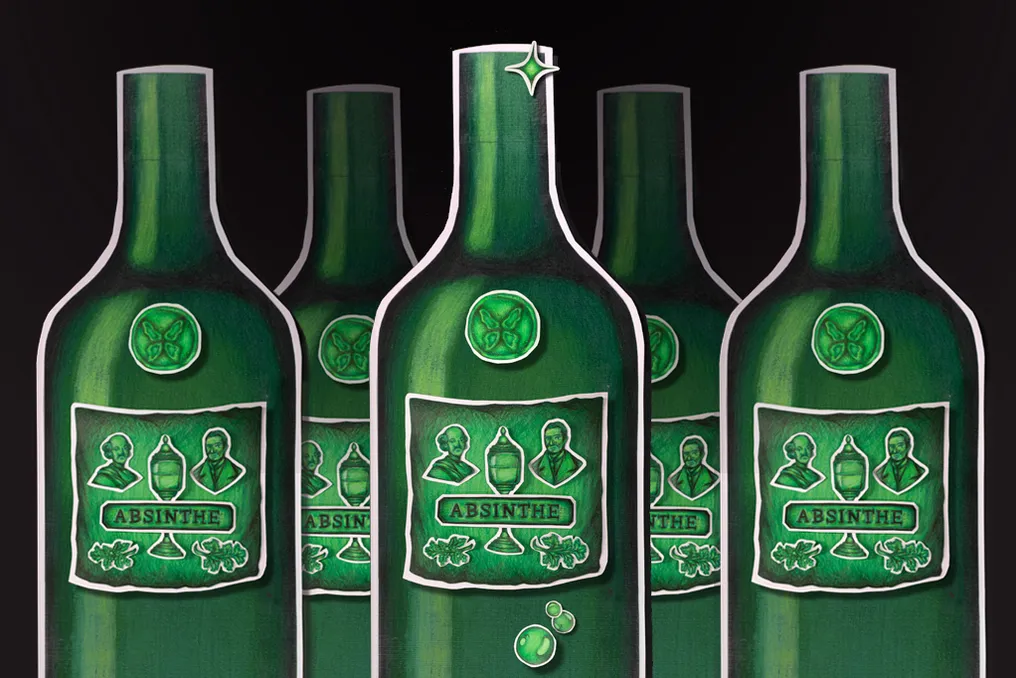
Absinthe, a highly controversial drink, has a complex history marked by tragedies, legends, and regulatory changes. A dramatic milestone occurred on August 28, 1905, when Jean Lanfray, a French peasant residing in Commugny, Switzerland, assaulted his wife and daughters, and subsequently took his own life. After being tried for multiple homicide, Lanfray committed suicide in prison three days later, on February 26, 1906.
This event attracted international press attention, not only because of the family murder but also due to the killer's mental state. Prosecutors suggested that the crime was the result of a classic case of absinthe-induced madness. A petition mobilized Swiss society, resulting in the prohibition of the drink in the region in less than three months, and this prohibition became national law in 1910. Similar incidents of domestic violence led to the banning of absinthe in other European countries and in the United States.
Although Lanfray had consumed several alcoholic beverages, including seven glasses of wine and six shots of cognac, the focus of the demonization fell on the two doses of absinthe. However, the drink's bad reputation transcends the tragedy of Commugny, being fueled by legends and stories of disturbed artists.
The origin of the elixir dates back to 1797 in Couvet, Val-de-Travers, Switzerland. The French doctor Pierre Ordinaire created the base of the drink, which is made by infusing herbs in alcohol, using anise, fennel, and Artemisia absinthium. In 1805, Henri Louis Pernod, another Frenchman, began large-scale commercialization, establishing a factory in Pontarlier, a French town that became an absinthe production center.
During the 19th century, absinthe established itself as one of the most famous anise-flavored drinks. Pernod, through the Pernod Fils brand, built a vast empire of spirits. With an alcohol content between 45% and 75%, it gained followers in France, Switzerland, and other nations, becoming a cultural icon. A notable cultural aspect is the traditional consumption ritual: the dose is served in a small glass, covered by a perforated spoon containing sugar, and cold water is slowly added, clouding the liquid, known as the 'green fairy.'
This turbidity is caused by the 'louche effect,' characteristic of anise-flavored drinks. The essential oils of the herbs do not dissolve in water, forming suspended droplets that scatter light, leaving the liquid whitish, giving it a sophisticated appearance. In the 19th century, the market involved not only producers but also manuals and 'absinthe professors,' opportunists who gave lessons in decadent bars.
The historical popularization of absinthe was driven by the French invasion of Algeria in 1830. Troops consumed the drink as a preventative measure against dysentery and malaria, spreading the habit upon their return. This led to the 'green fairy' craze in Parisian cafes, marking the beginning of absinthe's golden age. Initially, consumption was moderate, concentrated during the 'green hour,' between 5 PM and 7 PM, considered acceptable before dinner.
The situation changed drastically after 1870, with the French defeat in the Franco-Prussian War, which shook the country. In the following decade, the phylloxera plague destroyed vineyards, forcing consumers to look for other alcoholic options, which boosted absinthe's popularity among the working classes, which was previously more elite.
Artists also became frequent consumers. Absinthe came to symbolize the Belle Époque, associated with figures such as Oscar Wilde, Ernest Hemingway, Vincent van Gogh, Émile Zola, and Arthur Rimbaud, although it also contributed to the alcoholism of many mediocre artists. Since the 1850s, alcoholism began to be viewed as a medical condition, and absinthe consumption was treated with greater seriousness.
In 1903, the French National Academy of Medicine classified absinthe as one of the most dangerous substances, linking its consumption to hallucinations, convulsions, and insanity. Politicians also associated it with national decline. Consumption was extremely high: in 1874, the French consumed 700,000 liters annually, jumping to 36 million in 1910, surpassing the production of all countries combined.
The growth of anti-alcohol leagues accelerated the transformation of absinthe into a public enemy. Producers of other drinks exploited the discourse, contrasting absinthe as a 'foreign poison' with wine as a genuinely French product. Although Congress tried to regulate consumption through taxes, no ban was approved because taxing absinthe generated revenues much higher than those from wine. Rod Phillips, a historian, points out that governments could not give up these profits.
The final pretext for the ban came with the First World War. In August 1914, sales were vetoed under the argument of national defense, aiming to protect the French people from the damage of absinthe and promote discipline. In 1922, French legislation allowed similar drinks, provided they were free of tujone, the chemical component suspected of causing hallucinogenic effects. Thus, absinthe entered decades of ostracism, surviving in clandestine locations in Neuchâtel, Switzerland.
In Switzerland, producers in Val-de-Travers maintained the tradition, hiding bottles in strategic locations known as 'absinthe springs,' resisting the ban. On the French border, the ban was enforced more strictly. Later studies debunked the dangers of tujone; a German laboratory concluded that the levels found were not sufficient to cause euphoria. The Pontarlier Museum clarifies that risk studies were based on cerebral injections in mice, not reflecting human consumption. Phillips also states that there was no record of higher rates of insanity in regions of higher consumption.
The majority conclusion is that health problems were linked to excessive alcohol consumption in general. In 2005, Switzerland repealed the ban, and France definitively legalized it in 2011. Currently, absinthe is growing globally, with a projected market of US$ 318 million in 2025, and manufacturers are already operating in Brazil. The 'cold fountains' have become a tourist attraction on the Franco-Swiss border.